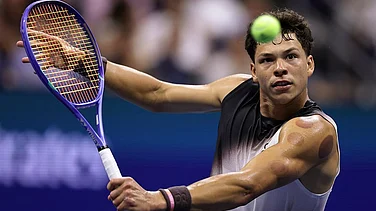
Wimbledon's 11 pm curfew halted Alexander Zverev's match against Jiri Lehecka mid-contest
The curfew stems from local council regulations to reduce late-night noise for nearby residents
The article also explores lesser-known tennis rules, including serve clocks, hindrance calls and medical timeout regulations
Wimbledon's famous traditions are usually celebrated rather than questioned. From the all-white dress code to strawberries and cream, the tournament prides itself on preserving customs that have defined it for over a century.
But on Monday night, another long-standing rule took centre stage, not because of fashion or etiquette, but because it interrupted one of the biggest matches of the tournament. Alexander Zverev's fourth-round clash against Jiri Lehecka was halted with the German leading 6-4, 7-5, 3-3 after play hit Wimbledon's strict 11 pm curfew, leaving players and fans waiting until Tuesday for the conclusion.
Why Does Wimbledon Have An 11 PM Curfew?
Unlike the other three Grand Slams, Wimbledon operates under a strict 11 pm local time curfew on the show courts. The rule was introduced in 2009 when Centre Court received its retractable roof, allowing matches to continue late into the evening.
However, planning permission granted by the local Merton Council came with one key condition: play must end by 11 pm to minimise noise and disruption for nearby residents. The rule applies regardless of the importance of the match, and tournament officials have repeatedly insisted that there are no exceptions.
That rule came recently into focus during Zverev's Round of 16 contest against Lehecka. Their match started only around 8:45 pm (local time) after Arthur Fery's marathon victory over Grigor Dimitrov delayed the schedule. Zverev had built a commanding two-set lead and the third set was level at 3-3 when officials stopped play moments before the deadline.


Spectators inside Centre Court voiced their frustration with loud boos, but supervisor Denis Parnell confirmed that play could not continue beyond the curfew. The players will resume the contest on Tuesday, with the winner advancing to face Taylor Fritz in the quarterfinals.
Similar Rules In Tennis
Wimbledon is not the only sporting event governed by time restrictions, although its curfew is among the strictest. The US Open, Australian Open and Roland-Garros have no fixed nightly cut-off, allowing matches to stretch well past midnight if necessary. The Australian Open has produced several matches ending after 4 am, while the US Open's night sessions have frequently run into the early hours.
Even at Wimbledon, the curfew has influenced major matches before. Andy Murray's second-round victory over Marcos Baghdatis in 2012 finished at 11:02 pm because officials allow a game already in progress to conclude, while Coco Gauff recently admitted she had mistakenly believed her match would stop exactly at 11 pm before learning that a game underway can be completed after the deadline.
While Wimbledon's 11 pm curfew is one of tennis' most recognisable regulations, the sport has several other little-known rules that occasionally influence high-profile matches. One of the most common is the 25-second serve clock, introduced across the ATP Tour and Grand Slams. Once the previous point ends, players have only 25 seconds to begin the next point, with repeated violations leading to time penalties.
Players are also allowed just one bathroom break (or two if taken together) during a best-of-five match under Grand Slam rules, and excessive delays can result in code violations. Electronic review systems have also reduced challenges at many tournaments, but tournaments still enforce strict rules regarding player conduct, audible obscenity and racket abuse, which can escalate from warnings to point, game and even match penalties.