Reports of pigs being worshipped as Varaha near Muslim homes in Tri Nagar have heightened fears and deepened mistrust
Residents allege a pattern of provocations following recent tensions in Uttam Nagar spilling into nearby areas
Some Muslim families say they are considering leaving, citing concerns over safety and lack of assurance from authorities
In a narrow lane in northwest Delhi’s Tri Nagar, a row of metal cages with food bowls now stands empty.
Just weeks ago, residents say, they held pigs, fed, decorated, and in some cases, worshipped as Varaha, the boar incarnation of Vishnu. Today, the pigs are dead according to the residents. But the neighbourhood is on edge, divided by suspicion, fear, and competing narratives of provocation.
For Muslims living here, who consider pigs impure animals, the presence of pigs outside their homes was a deliberate provocation.
“They brought them to trouble us,” says Liaqat Ali, 36, who has lived in Tri Nagar for over two decades. Two years ago, he moved to Onkar Nagar B—a predominantly Hindu pocket of the neighbourhood, unaware of what lay ahead.
A motor parts trader, Ali says he invested heavily in building a comfortable home, bringing in interior designers and spending his savings to set up a space for his wife, young son and ailing father.
“They said it openly. Muslims don’t like pigs, so they will leave,” he tells Outlook, sitting in his office days after what he describes as violent attacks by some Hindu residents in the area, as a group of Hindu neighbours barged into his house in Tri Nagar’s Onkar Nagar B, an area where only 2-3 percent Muslims live. Fearing for his family’s safety, Ali says he has stored hundreds of videos as evidence, “just in case someone questions us or tries to frame us.”






Ali says he along with a few other community members have filed an official complaint against the Hindu community members as the violence has escalated significantly with “no action from the police,” in the Northwest District, Rohini Court. The documents shared with Outlook, seek directions for registration of an FIR against the accused. It alleges a series of serious offences including criminal intimidation, attempted murder, harassment, and outraging the modesty of women, invoking multiple sections of the Bharatiya Nyaya Sanhita (BNS) and the IT Act.
During a visit to Onkar Nagar B, Outlook reached the residence of the main accused. However, family members declined to comment, stating that the police had advised them to remain silent on the matter.
Many of these Muslims, including Ali, believe the tensions are not isolated. They describe them as part of a wider spillover, an after-effect of anger that followed the death of a Hindu man, Tarun Bhutolia, in Uttam Nagar, about 15 kilometres away, on Holi this year. In the aftermath of his killing, which was a result of clashes between two families, the incident was given communal colour and Muslims were attacked. That incident has since travelled beyond its immediate geography, residents say, reshaping local fault lines. “In Uttam Nagar, what happened… after that, everything changed,” Ali says. “The same anger has come here.”

A Neighbourhood on Edge
The lane looks quiet in the afternoon. But residents say the calm is recent, and fragile.
In the past few months, videos circulated online show men speaking directly to the camera, declaring that pigs would be kept in every lane and that the area would be “purified”. Some Hindu residents have described this as an expression of faith, worship of Varaha. But Muslim families in the same lane see it differently.
“They were not doing this earlier,” Ali says. “This started only recently, and only outside our houses.”
He alleges that the animals were sometimes named “Sultan” or “Abdul”, and that residents would call out these names when Muslim neighbours passed by. “It was meant to provoke,” he says. The claims have been verified by Outlook through several videos, one of which shows the Hindu resident, also the Resident Welfare Association (RWA) member of Onkar Nagar B society, talking to the pig just as a Muslim neighbour passes by. He says: “Sultan, tera bhai jaa raha hai. (Sultan, your brother is going),” giving the pig a Muslim name and triggering the Muslim neighbours by calling them the pig’s brothers.
For Ali, the conflict has reached his home.
On a recent day during Ramzan, a crowd gathered outside his house with sticks, shouting abuse and asking him to come out. Inside, his son aged nine, and a nephew and niece aged eleven and three, began crying. “That day, everyone was terrified,” he says.
Months later, he is preparing to leave Tri Nagar. “If I were alone, I wouldn’t care,” he says. “But for my family’s safety, I have to think of moving.”

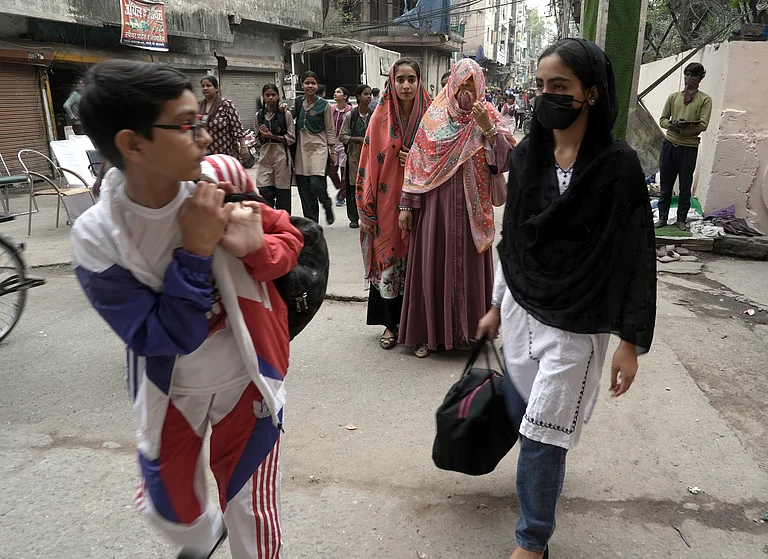
Ali says the past year has seen a steady escalation, one that intensified sharply in the last four to five months. He alleges that local residents began targeting Muslim households through loudspeakers, public abuse, and constant surveillance. “They stand outside and record videos, calling us ‘jihadi’ and ‘Pakistani’,” he says.
He has installed CCTV cameras along his lane. Initially meant for security, they now document what he describes as repeated acts of intimidation, people gathering outside, filming, and circulating clips online.
Videos accessed by Outlook show individuals being recorded as they step out of their homes, with slurs like “katwa” (a derogatory term used against Muslim men, referring to circumcision) and “haraami” (bastard) used in the background. In some clips, these videos are shared in local WhatsApp groups with captions asking others to identify them.
“They make videos and write, ‘ye katwa kaun hai, iski shakal dekho’ (Who is this katwa show his face,” Ali says. “This is happening daily.”
The atmosphere has altered everyday life. This year, his family did not celebrate Eid at home. Ali says he sent them away on Eid, and again on 1 April, the day of Hanuman Jayanti. “The CBI advised that it would be safer if we weren’t here on those days,” he says, adding that officials warned him that if violence broke out, he could be held responsible.
Tensions peaked during Ramzan when a food cart was attacked. According to Ali, rumours spread quickly that Muslims had gathered to target a nearby temple. “It was completely false,” he says. “But that same night, heavy police force came.” He insists CCTV footage shows no such gathering.
‘Preventing’ demographic changes
For 27-year-old Abdul Bari, the conflict began not with religion, but with money.
After purchasing a plot in the neighbourhood in 2023, Bari began constructing his house. That is when, he alleges, members of the local residents’ association approached him with a demand. “They asked for ₹1 lakh per floor,” he says. “If I wanted to build, I had to pay.”
When he refused, he says, the situation changed, adding that their behaviour started to change. “They said, ‘you are Muslim, we won’t let you live here’.”
According to Bari, complaints were filed against his construction, and he was accused of damaging neighbouring houses and blocking light and air, allegations he denies. When he continued building, he says, the pressure escalated.
“They started entering my house, making videos, harassing me,” he says, adding that he even asked them to buy his apartment and pay him the money to put an end to the conflict. However, he says that nobody came forward for that either.
And then, he adds, came the pigs. Bari alleges that pigs were brought and kept in cages outside Muslim homes as a form of provocation. He claims residents would call out to him while pointing at the animals.

“They would look at the pigs in front of us and say that they’d bring many more ‘brothers’ for us,” he recalls, referring to the pigs. He also disputes claims that Muslims were responsible for the deaths of the pigs, an allegation that has circulated widely in the area.
“There is no proof,” he says. “But they made it a big issue.” In fact, he alleges that the animals were poorly treated and that their deaths were later used to blame Muslim families and escalate tensions.
The conflict, he says, has followed a pattern: from financial pressure to legal complaints, from harassment to public targeting.
“They are trying to set an example,” he says. “That Muslims should not come and settle here.”
The explanation offered by some of those accused of targeting Muslim families centres around a single idea, “demographic change”. Several residents claim that Hindu-majority areas are gradually changing as more Muslim families move in. This belief, often amplified through social media videos, has become a justification for resistance. “They say we will take over,” Bari says. “But we are just living here.”

Hindus Against Communal Polarisation
At the entrance to the lane, a metal gate has been installed. Posters line the walls. The cages that once held pigs are now empty but two large flex banners covering almost two floors of the houses are still there. The tension is visible, but so is disagreement. Not all Hindu residents support what has unfolded.
“Only two or three houses are creating all this,” says a neighbour who has lived here for several years.
He dismisses several of the rumours circulating online, including claims that Muslims have been throwing bones near temples. “These are false,” he tells Outlook. “Nothing like that is happening.”
He adds that the families being targeted have the right to live in the area. According to him, the issue lies with a small group driven by what he calls an extremist mindset. “If someone has bought a house with their own money, they have the right to stay,” he says.
As a result, many residents have chosen to stay silent rather than intervene.
Avdesh Kumar, a Hindu employee at a local shop, says that tensions in the area are a recent development and were not part of everyday life earlier. He recalls that members of groups like Bajrang Dal had visited the locality once for a religious event. According to him, such visits often make Muslim residents retreat indoors. Kumar says the situation has increasingly become politicised, with religious identity turning into an “agenda” in many places.

He also points to what he described as political pressure, with groups gathering with flags, as seen in circulating videos. Questioning selective enforcement, he adds that illegal constructions, such as a temple on public land, would be treated very differently if done by Muslims, referring to Nyaya Dhaari Panchmukhi Hanuman Mandir, a local temple that has been hastily constructed on the road outside the area. “This is a clear encroachment, done to trigger Muslims,” he says.
The impact of these tensions has extended beyond individual incidents. Muslim residents point out that the area does not have a single mosque. They allege that when one resident attempted to begin construction on land he owned, the structure was demolished using bulldozers and later sealed by authorities. In contrast, they say, religious activity on the other side continues unchecked. Every morning, bhajans play over loudspeakers across the locality, forming the backdrop of daily life.
“During Ramzan this year, they would deliberately increase the volume just before iftar or prayers,” says Shabana, alleging that the timing was meant to disrupt and provoke.

Keeping An Eye
For Shabana, the shift was immediate. She moved into the area around five to six months ago after struggling to find housing in Karol Bagh where she had lived since her childhood but now the owners were not ready to rent their homes to Muslims, a problem widely experienced by Muslims across different parts of Delhi. “I went to more than 200 builders,” she says. “No one was willing to rent to Muslims.”
When she first arrived in Tri Nagar, she says, the neighbours were polite, as they did not realise that Shabana was Muslim. However, once they found out, everything changed, she says. “They stopped talking to me. They started watching me.”
Shabana alleges that she is regularly filmed when she steps out of her house, and that her images have been circulated in WhatsApp groups.
“They say— ‘look, a Muslim woman is here’,” she says.
Even small incidents escalate quickly. Once, when her dog defecated in the lane, she says she apologised and cleaned it immediately. But she was still confronted and recorded. “They want a reaction,” she says. “So, they can show it.”
Despite this, she says she does not want to leave, even though the fear is constant. Shabana has stopped going out much except for something very urgent, however, she says, she feels eyes on her. “I keep looking back when I go out,” she says. “You don’t know who is watching.”
Back at his home, Ali, the resident of Tri Nagar says the hardest part is what this has done to his children. “They didn’t even know what Hindu-Muslim meant,” he says. “Now they ask whether to greet people with ‘salaam’ or ‘namaste’.”
“I don’t think this will reduce,” he says about the ongoing violence and threat. “It will only increase.”