Islamabad talks yielded no breakthrough, though efforts continue to stop the war resuming.
The US has begun operations in the Strait of Hormuz, seeking to reopen a vital global trade route.
Success could weaken Iran’s leverage, but risks escalating the conflict and widening the war.
There was no breakthrough in Islamabad. Not that anyone expected one, considering the lack of trust between the two sides and the maximalist demands that both put on the table. But efforts by Pakistan and other countries will continue to ensure that the war does not resume.
A new and significant dimension, however, has entered the equation with the news of two U.S. destroyers successfully navigating the Strait of Hormuz on Saturday. This is the first step in a US plan to secure the vital waterway for the flow of global trade.
On Sunday US President Donald Trump, announced a blockade of the Strait of Hormuz hoping to turn the tables on Iran. "We will also begin destroying the mines the Iranians laid in the Straits. Any Iranian who fires at us, or at peaceful vessels, will be BLOWN TO HELL!"
Even as the marathon 21-hours peace talks were on in Islamabad, the US navy was at work in the Strait getting ready to secure the waterway.
“Today, we began the process of establishing a new passage and we will share this safe pathway with the maritime industry soon to encourage the free flow of commerce," Admiral Brad Cooper, the head of the US Central Command, said in a statement, even as talks were on in Pakistan. The US destroyers USS Frank E. Peterson and USS Michael Murphy crossed the Strait of Hormuz.
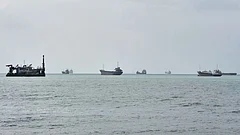


“We're now starting the process of clearing out the Strait of Hormuz,” Donald Trump wrote in a Truth Social post, adding with his usual flourish that “all 28” of Iran's “mine dropper boats are also lying at the bottom of the sea”.
The immediate issue today is not so much Iran’s nuclear ambitions, but its control of one of the world’s most critical energy chokepoints. By laying mines and aiming at oil tankers and ships of “enemy countries”, Iran has effectively controlled the movement of cargo through the Strait of Hormuz, disrupting global trade and sending oil prices soaring. Nearly 20 percent of global oil, gas and fertilisers pass through this choke point, and the world is already feeling the impact.
This is why Trump is keen that the Strait of Hormuz is wrestled out of Iran’s control quickly, a point that the Americans had also put on the table before the ceasefire.
Significantly, US Vice President JD Vance did not mention the blocked waterways at his brief press conference, emphasising instead the nuclear question, even as the maritime crisis deepens.

Whether this is going to be a game changer and whether US mine sweepers can successfully clear the waterways remains to be seen. Analysts here have refused to comment on the implications of two US warships crossing the Strait. “It is difficult to make a comment, before getting a clearer picture,” says Uday Bhaskar, retired navy commodore and analyst.
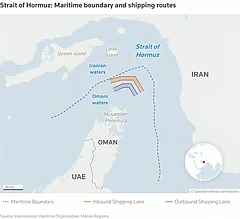
Much will also depend on the route that the American warships chose, whether they tested waters near the Oman coast or along the Iranian side of the Strait. It is not clear yet which route was taken. Significantly, the IRGC has earlier denied that the US destroyers had crossed the Strait, asserting that “the initiative for the passage and movement of any vessel is in the hands of the Armed Forces of the Islamic Republic of Iran,” and vowing a “strong response” to any military ships passing through.
Opening the choke point without Iran’s consent is not easy. De-mining even on land borders is a complex and time-consuming task. India, for instance, is still dealing with de-mining along the Line of Control following Operation Parakram. The challenge is even greater at sea, and it could take a long time for the US, or even a group of countries working together, to fully clear the Strait and restore the flow of energy to pre-war levels.
If the U.S. succeeds in securing passage through these waters, it could tilt the balance in the war. Despite the enormous military might of the US and Israel, Iran has so far held its own and refused to capitulate, retaining a clear geo-strategic advantage. At the same time, any American move risks widening the theatre of conflict and raising the stakes further.
For now, much will depend on how events unfold and how Iran reacts to Trump's latest move.