The Bharatiya Janata Party government has completed 12 years. Of the promises made to the people in 2014, which ones have been fulfilled?
We promised exceptionally good infrastructure, improvement in industrial conditions, better lives for the middle class and special focus on agriculture and women. On all these fronts, there has been substantial progress. One major promise was [abrogation of] Article 370. For decades, Jammu and Kashmir had a unique constitutional arrangement with separate provisions. The situation there was unsafe, there was no accountability in governance. People were exploited politically and sidelined. Only certain families benefitted and the situation was exploited by Pakistan. After Article 370 was removed, there has been major developmental change. I visited recently and saw the transformation personally.
Another issue was Naxalism. Eight states and around 126 districts in the country were heavily affected. Development schemes never reached ordinary people because extremists blocked them. Under Narendra Modi, we declared that Naxalism would be eliminated by March 31, 2026, and the situation has dramatically improved now. Development is reaching those areas and people can move around freely.
Earlier governments ignored the Northeast. For the first time, a separate ministry for development of the northeastern region was strengthened. Significant development has taken place—medical colleges, educational institutions, infrastructure.
When it comes to ordinary citizens, we focused on two things: improving financial conditions and ensuring access to basic necessities. The prime minister provided toilets, water connections, electricity, pucca houses, free ration and health coverage up to Rs 5 lakh. Crores of houses were built, millions connected to piped water, electricity connections expanded and health care was made free for poor families. This gave people more disposable income for other needs.
Didn’t the Congress government also do some of this?
I am not saying they have not. But several people were left out. The World Bank has recognised the reduction in poverty. Extreme poverty has fallen significantly. Income-tax exemptions have also increased dramatically, giving middle-class families more relief. GST [Goods and Services Tax] rates have reduced while total GST collection has risen substantially. This shows purchasing power has increased. Bank deposits have grown significantly, mutual fund participation has increased..
What is the BJP’s plan for the monsoon session and for the next three years?
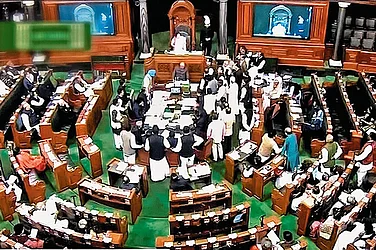
Women’s reservation is already a commitment from the BJP and we passed the legislation reserving 33 per cent seats for women. However, implementing it requires increasing seats in Parliament and state Assemblies, which requires constitutional amendments. We tried our best, but opposition parties created hurdles.

What about One Nation One Election?
One Nation One Election was discussed on the floor of Parliament and then sent to a joint parliamentary committee headed by P.P. Chaudhary. The BJP wants it, but it has to come through Parliament. We are trying to build consensus. And the committee is meeting stakeholders.
The number of seats has to increase so democracy becomes more representative.
The Opposition says there is no need to link women’s reservation with delimitation and that reservation can be brought in within the existing 543-member Parliament.
Delimitation is not something the BJP invented. It is part of the Constitution of India. Congress governments have carried out delimitation exercises in the past as well. We cannot ignore demographic changes. Population has increased manifold. It is very difficult for one MP to effectively represent 25 to 30 lakh people. Constituencies have become too large. The number of seats has to increase so democracy becomes more representative.
Will this disproportionately affect the southern states that have controlled population growth?
States that have successfully controlled population growth should be appreciated. But this is not simply a North versus South issue. Different states have performed differently on population control. The prime minister has already said in Parliament that representation would not be based exclusively on population. The ratio of representation can be maintained. We can proportionately increase seats for all states so the balance remains similar to what it is today. That is the best solution.
So you don’t not think it will affect the southern states?
No. If the proportional share remains the same, there is no disadvantage. Tamil Nadu, Kerala, Karnataka—all these states can see seat increases proportionately. The ratio remains unchanged. Karnataka will get 42 seats, Tamil Nadu 59 and Kerala also accordingly.
The Opposition says that delimitation could permanently alter the balance of power between states.
I don’t understand that argument. In Parliament, MPs generally vote along party lines, not state lines. Congress MPs from the southern states do not vote independently based on state interests; they follow the central leadership. The BJP has already agreed that representation ratios should remain unaffected. If seats are proportionately increased for all states, the balance remains unchanged. So, this fear is politically motivated.
Many in the Opposition accuse the BJP of engineering defections. How do you respond to this?
Rajiv Gandhi introduced the anti-defection law in 1985. That law still exists. If leaders are leaving the opposition parties, the fault lies with those parties and the leaders of those parties. It is because of the anti-democratic stand of Mamata Banerjee that everyone is leaving the party. Representatives observe public opinion and understand where people stand politically. We have strong inner-party democracy. Our workers feel respected and connected. In many other parties, the organisation belongs to one family or individual. Ours is a cadre-based party. If other parties are breaking, why should the BJP be blamed?
But when defectors join the BJP and get important positions, doesn’t that create resentment among long-time party workers?
Our workers do not work for posts and we are continuously working at the grassroots level. In our party, everyone feels respected. What people want is that our political philosophy should be implemented hundred per cent around the country, which is what the government is trying to do. For us, the nation comes first, ideology second and personal ambition third.

MORE FROM THIS ISSUE




When people join BJP from other parties, are they given ideological training as well?
Yes. We conduct training camps across the country at district and mandal levels. Those joining from outside are specifically invited. We train them the same way we train our own workers so they understand BJP ideology.