Group Captain Shubhanshu Shukla is one among the four astronauts chosen for the Indian Space Research Organisation’s historic Gaganyaan mission—India’s first human spaceflight programme which is set for a 2027 launch. Shukla began his career as a fighter pilot in the Indian Air Force and evolved into a combat leader and accomplished test pilot. In 2025, he served as mission pilot on the Axiom Mission 4 to the International Space Station (ISS), creating history by becoming the first Indian to set foot on the ISS. In his new memoir The Second Orbit (Penguin Random House), Shukla shares the behind-the-scenes details of his journey. He spoke to Vineetha Mokkil about the thrill of being the second India to travel to space after Rakesh Sharma, the thrill of space exploration, the rigorous training astronauts undergo and the personal sacrifices involved. Edited excerpts:
You say in your book that flying has intrigued you since you were a boy.
As a child, when I first saw fighter jets streak across the sky, I was mesmerised. They were unlike anything I had encountered before—machines that seemed to defy the very logic of the world I lived in. Once I started flying, I understood why. It is liberation in its purest form. Humans are not designed to fly, and yet there you are—doing precisely that, at speeds that make the ground irrelevant. But beyond the physical experience, the fighter cockpit has been my greatest teacher. It doesn't just teach you to fly—it teaches you patience when everything is moving too fast, courage when every instinct tells you to hesitate, and the quiet confidence that comes from trusting your team with your life. I don't think any classroom has ever taught me as much.


What aspects of space travel thrill you? Are there moments when you feel overwhelmed by the risks involved?
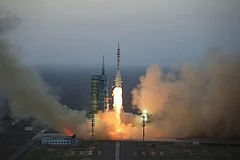
Everything about it is thrilling—the scale of it, the strangeness of it, the sheer improbability. Space travel is one of those rare experiences that exceeds every expectation you bring to it, which is remarkable given how high those expectations already are. The risks are real and well understood—by the engineers who design every system with extraordinary care, and by the astronauts who train to manage what those systems cannot. Launch and re-entry are the most demanding phases, and yes, there are moments of anxiety. But training doesn't eliminate anxiety, it redirects it. You learn to focus entirely on what is in front of you, on the next task, the next switch, the next breath. And that removes the anxiety from the equation.

What was your reaction when you heard you had been selected for Axiom Mission 4?
Disbelief, followed very quickly by joy, followed almost immediately by an enormous sense of responsibility. A few years ago, space wasn't even a distant dot on my horizon—it was simply not part of the plan. And then, quite suddenly, I was being told that I would be flying there. I was driving when I received the news. I had to pull over. There are moments in life when you need to stop moving in order to fully receive what is happening to you—and that was one of them. I sat there in the car, quietly, trying to absorb it. The happiness came easily. The gratitude even more so.
How crucial a factor was teamwork for the mission's success?
It is not merely crucial, it is everything. People often imagine space exploration as the story of a few extraordinary individuals, but that is only the most visible layer of a vastly deeper effort. Thousands of people work in concert to put a single astronaut into orbit—engineers, flight controllers, trainers, medical teams, mission planners — each one essential, most of them never in the spotlight. And once you are actually in space, the work doesn't become more individual; if anything, it becomes more collective. The mission's success is a direct function of how well the team functions—not under ideal conditions, but under pressure, in tight quarters, across different languages and cultures and backgrounds. The ability to work effectively as a team is, in my view, not just one of the requirements for being an astronaut. It is the most important one.
What did it feel like to leave the planet? Did you struggle to explain the experience to people who've never been to space?
Leaving the planet feels like the universe letting you in on a secret it has been keeping for a very long time. There is a moment during ascent where you cross a threshold—and everything you have known about the world, every assumption about up and down and weight and sky, simply stops applying. It is disorienting and magnificent in equal measure.
I don't struggle with the telling. I struggle with knowing that no telling is ever quite enough. I was warned about this by people who had been to space before me. I listened politely, and I still wasn't prepared. That gap between description and experience is, I think, permanent and unbridgeable. But sharing it is still worth doing because even an imperfect account of something extraordinary is better than silence. So, I will keep talking and I hope people keep listening.
Who are some of the people that have inspired you or influenced your life choices?
At every stage of my life, there has been someone; a parent, a teacher, an instructor, my wife— who saw something in me before I saw it in myself, and who nudged me, sometimes gently and sometimes firmly, in the right direction. My parents gave me the foundation. My teachers in school gave me curiosity. My instructors in the IAF gave me discipline and the belief that excellence is not inherited. It is earned, every single day. And my wife has been the most constant, grounding force through all of it. I don't think any of us arrive anywhere significant entirely on our own. We are, in large part, the sum of the people who believed in us.
Is this book your way of motivating young readers to pursue their dream of space exploration?
Precisely. Though I would say it's less about space exploration specifically and more about the permission to dream. I was that child. Sitting in a classroom in Lucknow, gazing out of the window, convinced that the extraordinary was something that happened to other people. I want every child who reads this book to feel, that it doesn't have to be. That the distance between a classroom daydream and the cockpit of a spacecraft is not a matter of exceptional talent or fortunate circumstances alone. It is, above all, a matter of deciding not to give up on the dream. If this book does that for even one child, then it has done what I set out to do.
What are some of the important attributes people interested in pursuing a career in space exploration should cultivate?
Resilience, without question—the kind that doesn't just survive failure but learns from it and carries on. Closely related is the refusal to give up, which sounds simple until you are genuinely tested by exhaustion, self-doubt, and circumstances that are entirely outside your control. But I want to be careful not to make this sound like a list of superhuman qualities, because they aren't. These are fundamentally human traits that can be developed by anyone willing to put in the work. Beyond character, the practical skills that matter most in space exploration are problem-solving—the ability to think clearly when the situation is unclear—and adaptability, the capacity to function with composure in an environment that is inherently uncertain. Space does not forgive rigidity. It rewards flexibility and adaptability.
You're training for the Gaganyaan mission now and your second voyage into space. Is the second time as exciting as the first?
I am no veteran. The moment you start feeling like one in this profession is precisely when you should worry. Space has a way of reminding you, quite firmly, that humility is not optional. Experience helps, of course—you carry a certain calmness that you didn't have before, and your training feels less like learning and more like refining. But the excitement hasn't diminished. If anything, knowing more about what awaits you makes it sharper. My focus right now, though, is less on the thrill and more on the responsibility. Gaganyaan is a historic programme for India, and my job is to contribute to it as effectively as I possibly can. That, for now, is more than enough to keep me fully present.

MORE FROM THIS ISSUE


How do you like to spend your free time? Any favourite authors you like to read?
Sports, family, and books—in no particular order, depending on the day. Reading has always been important to me; it is one of the few activities that slows me down in a way I genuinely welcome. I am particularly drawn to thinkers who challenge comfortable assumptions: Nassim Nicholas Taleb on uncertainty and risk, Daniel Kahneman on the architecture of our own biases, Ayn Rand on the fierce sovereignty of the individual, Bill Bryson on the quiet wonder of the world we overlook. What draws me to all of them, I think, is the same thing that drew me to flying: the refusal to accept the world as merely ordinary.