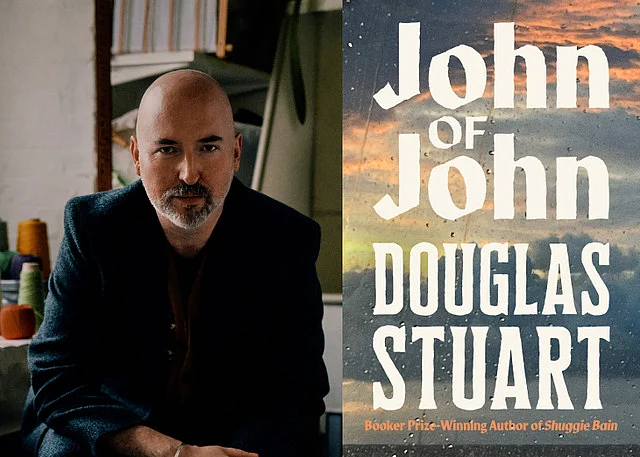
Douglas Stuart's third novel, John of John, finds a father-son duo negotiating coming out to each other.
Being the prodigal son who’s returned home, Cal isn’t innocent to his being seen as a rank failure.
John of John circles those cowering parts of ourselves which we wedge away in dread of judgement and reproving glances
Douglas Stuart’s third novel, John of John, is swift to disburse its revelations which may take up the bulk of other lesser books. John Calum (Cal) Macleod returns home to Falabay on the Scottish Isle of Harris, summoned by his father, John. His maternal grandmother, Ella, is unwell. John shares the same roof with Ella. Cal’s mother, Grace, has long extricated herself from the scene. The 22-year-old Cal lands right back in the pit of self-loathing and abasement. He flamboyantly puts his queerness forth as an open challenge to his father. Unknown to him, John has nursed a secret for years. He has harboured an intimate relationship with his neighbour and sole friend, Innes, for a while. Stuart doesn’t go to elaborate lengths in springing this surprise. The way the tenderness to this relationship unfurls as a discovery for us is delicate and movingly spare. It’s like a whisper in the dark. That doesn’t diminish how abiding it has been across a breadth of time.
But John of John sits more with callused, prickling sensations. It circles those cowering parts of ourselves which we wedge away in dread of judgement and reproving glances. Cal, who is back from his art school in Edinburgh and having cut his teeth in a freer way of life, has no such curbs that chain John. Being home with his stern, punishing father instantly stirs tension, heightened disagreements and full-blown clashes. Each conversation is under the welter of identity and appearance that has to be negotiated with his father for authorisation. As Stuart emphasises, “The worst boss in the world was always a father”, Cal is directly under the naked purview of John’s excoriating gaze. Being the prodigal son who’s returned home, Cal isn’t innocent to his being seen as a rank failure.



Denial colours every leaking crevice of shame and guardedness in John of John. Bundled together with a community that has known one for decades, there’s an internalised impossibility of branching towards secret joy. Accustomed to spartan rhythms, John views a public admission of his desire as the ultimate transgression. A deacon at the village’s Presbyterian Church, John is hemmed in. Desire is overtaken by subservience to religious doctrine, which he upholds as the code governing all relationships, expectations, social comportment. Between the church and weaving which underpins the community’s livelihood, John stays complacent, avoiding the boldness to break free.

Central to the novel is a father’s inability to be honest with his son. His lack of transparency has had a long domino effect. The real reason as to why his mother, Grace, left remains a mystery to Cal. It has been fifteen years since she visited him. Grace freed her husband, taking ignominy on his behalf. Yet, John is stuck. Refusing to cut away, Stuart details these compulsions, the endless reserves of self-pity, the psychological marooning in a state of desolation. Cal drifts through the town before John ropes him into the weaving grind.

John’s intense faith keeps him in a stranglehold of guilt. He cannot commit fully to Innes despite their rippling private history. To do that, he feels, would be a betrayal of his religious beliefs and might lead to public humiliation. It’s a tight-knit community that closely surveys every relationship that forms, destabilises, curls into a collective. At the slightest of straying, censure barges in, quick and ruthless. John is borne down by this weight. Even as Innes extends a hand in bravery and generosity, John baulks. Like any regular parent, John projects his fears and insecurities onto Cal, whom he sees “as his property, an extension of himself”. Ella serves as the cutting mirror, implicitly thrusting in John’s face all that he thinks he can escape: “How can you tell a man that hates himself that his son is made in his image?” They may not confront the dilemma outright, but it hovers in the air.
Watched by a father who weaves intimacy with sinning as ordained by scriptures, Cal “had been raised to be fearful” of it. Nevertheless, while John is nervous over accusations of being errant, Cal has been impervious, thanks to his mainland exposure. John is constricted, disconsolate. Both have starkly different attitudes in their pursuit of love and attention. If John doesn’t budge from the swamp, Cal ventures recklessly. Courting rejection and misplaced sexual conquests become just as vivid a reality for Cal. Even his childhood friend and hook-up partner, Doll Macdonald, is cold and has turned away. Loneliness envelops both the father and son. Stuart writes into the narrative a constant expansion and contraction of space. The wind-flecked dramatic landscapes of the island are as crucial as the Macleod house containing resentment and denial. The emotional maelstrom stems from the closet desires jabbing for embrace. When one keeps hiding, stifling for so long, the soul curdles into a stew of delusion, bitterness and hurt.
Stuart writes powerfully about the spate of lying to oneself, peering behind the carapace of men too proud to be vulnerable. John is wounded by his own ego. He has sealed himself into a silo of self-inflicted cruelty. Stuart deepens how this travels also outwards, lashing out in seeming apathetic bursts towards family and loved ones. As solitary John is, Cal is on an unapologetic quest of connection. It tows him toward none other than Innes. Scenes that could have turned queasy thrum instead with humbling, devastating poignance.

Just this section alone is a testament to how Stuart respects the decrepit yearnings of queer bodies across an age bracket. He holds up the crashing wave of pining, the youthful tactlessness but also the grace to remember and retreat. John of John is about the spurning we unleash on ourselves. Through John, faith and desire exact this irrevocable pull on each other. Cal represents a generation at a remove, no longer cuffed by institutional duty and dogma. The spirit of release may well be in his hands. Kinship ties, that tighten and control Cal, must be rearranged to suit a tide of freedom. Steeped in a craggy temperament, John of John surges toward the clutching of possibility.