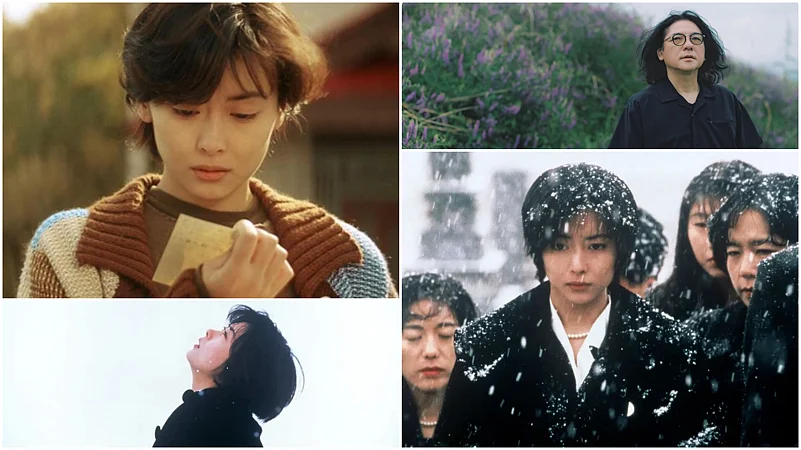
Shunji Iwai's debut, Love Letter, is set for its 4K theatrical release.
The plaintive drama was a runaway hit when it came out in 1995.
Ahead of the restoration's North American release, Shunji Iwai spoke to Outlook about its changing avatar, his relationship to his past work and the future of storytelling.
In 1995, Shunji Iwai broke out with his debut, Love Letter. Miho Nakayama pulls a double act as a widow and the school sweetheart of the dead man. As the bereaved Hiroko Watanabe sends letters to her late fiancé’s childhood address, not expecting a reply, Itsuki Fujii, the librarian who shares his name, continues a thread of recollection. What ensues is a drama told in the softest notes, wistful and shimmering with melancholy. The diaphanous narrative recounts an ache for connection amidst profound loss and snowy landscapes.
Film Movement Classics is bringing the film’s 4K restoration to North America. The theatrical rollout begins on June 5. Thirty years on, Love Letter remains just as gorgeous and swoony. Iwai’s debut is subtle, wrenching and uniquely life-affirming despite being wreathed in the pining for the lost. Ahead of the release, Outlook’s Debanjan Dhar caught up with Shunji Iwai for an exclusive interview.
There’s this fundamental unknowability about each other that’s at the heart of so many of your films. Besides the loss and ache, there’s a recognition of the many places and times the other has been through, of which we can only know just a portion. How much of these ideas and questions did exist already when you thought you’d make a TV series that eventually became this film? Did Murakami’s Norwegian Wood serve any inspiration for this film?
That has been an important theme right from the beginning. I wouldn’t call Norwegian Wood an inspiration. I did read the book around 2005, which was when I received the proposal for the film adaptation.


When you were embarking on the TV series that became the film, did you also begin with the widow who’s lost someone and is triggered by the memories? Could you trace that early spark?
The first proposed narrative for the television series didn’t even have Hiroko Watanabe, the character who lost her boyfriend. I had only written the character of Itsuki Fujii, the young woman who lives in Otaru. I had proposed an Ozu-esque storyline centred on the Japanese tradition of match-making. But in the story, she’s receiving letters from someone who’s asking about a classmate from junior high. She’s writing about her memories of the person. This part has remained similar. The TV version had the protagonist ending up married. In addition, I’d asked for the project to be shot in black and white. The pitch sounded too eccentric to producers, so they rejected it. It would be one thing to broadcast an Ozu film on TV, very much another for a new director to make an Ozu parody in a TV show. Luckily, there was another producer at the network who wanted it as a film. When I knew I had to rethink more seriously, that’s when I introduced Watanabe, the woman who’s writing the letters. I knew I wanted the two women to have similar appearances.
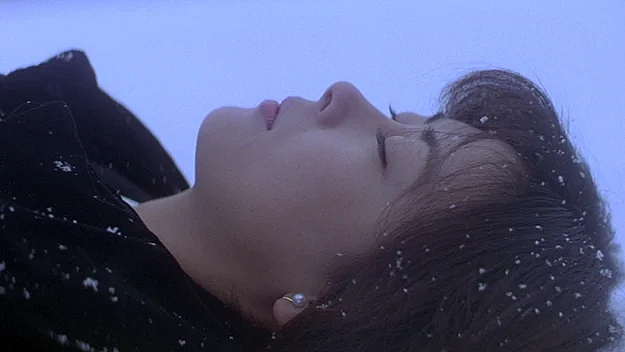
Even when it was a black and white TV thing, the snowy landscape was central?
Yes, I believe that was written into the story from the very beginning.
What’s your own relationship with the act of writing and receiving letters? Do you see it as a nostalgic act?
Back then, it was normal to write letters to family and lovers. I was interested in two strangers writing to each other. There was a fantasy element to this that I wanted to explore. Back then, it wasn’t a common occurrence for strangers to communicate. But today, it’s practically normalised we talk to strangers every day through the internet. If I were a young person today, I wouldn’t have come up with the story that became this film. I think the fact that it was such a rare occurrence back then produced my motivation for this narrative. That’s a huge shift I notice in these three decades.

When you look back at the film, what’s your relationship with it? Are you proud and content with it? Can you ever be with your work? Are you perplexed a bit by how it has endured and made a wide fanbase with each decade and generation?
As a filmmaker, I remember the experience of making, the tight rope it was between being a success and a failure. Even when I watch the film today, I feel nervous. I notice many of its flaws. I trust that fans who love the work don’t get bothered by those so much.
The music is extraordinary, as in each of your films. Can you talk about how you go about devising the soundtrack, what made you team up with Remedios? At what stage do you rope in the composer? How does the collaboration work?
How I deal with the score differs between projects. As I’m writing my scripts, I’m listening to some form of classical or instrumental music that’d serve as inspiration for how I want the score to be shaped. However, as for the scores, they come up when I’m watching the scenes in the edit. I’ll have my composers listen to the references that I have.

What still drives your storytelling impetus? I read somewhere that in the early years you asked yourself what cinema is, how you are going to tell a story. In this age of AI and misinformation, how do you confront that question? Do you still feel as intensely raring to go forth in various media? How do you combat jadedness?
My answer to that is simple. My initial impulse comes from a place of wanting to improve myself. Imagine a person trying to hone their skills at painting or writing, seeking to be better. As to how the viewer receives, it’s just the creator’s ego driving his curiosity regarding the reception. But for example, animation that’s hand-drawn will definitely be received from that produced through computer graphics. People have a tendency not to be impressed with what’s not made by human hands. It’s not that the advent of photography led to the extinction of painting. I think people are now surprised by paintings that are made photo-realistically. Viewers and humans will always have curiosity for what humans can accomplish. AI may be a distraction, but as long as there’s joy in creating things with our own hands and there’s a desire to create, viewers will be surprised and interested. AI will change, but as long as our humanistic impulses stay intact, we’ll be alright.
With thanks to Monika Uchiyama for translating.