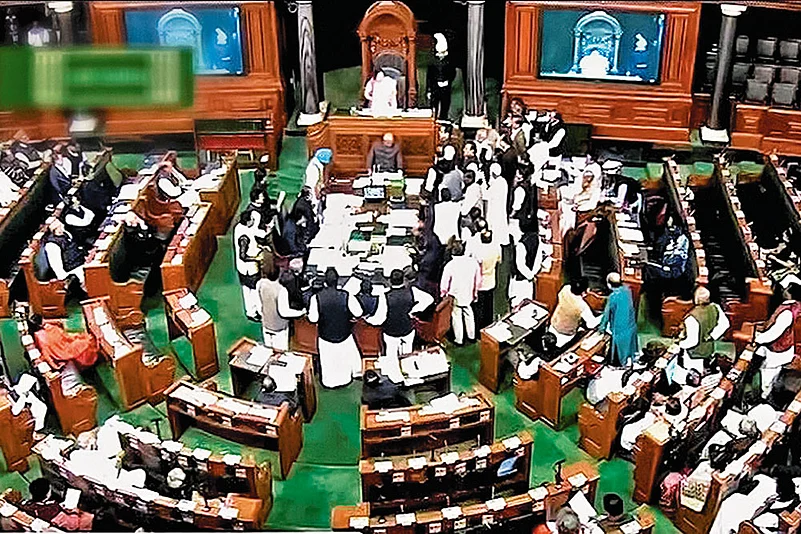
Just 54 more votes could have been enough to push the Constitution (131st Amendment) Bill through the Lok Sabha in April 2026. The bill fell short of the special majority required for a constitutional amendment. With 528 members participating in the vote, the two-thirds threshold stood at 352 votes.
The bill, which sought to link the implementation of women’s reservation with a delimitation exercise, failed to secure the required special majority despite garnering 298 votes in favour and 230 against. The bill failed because under Article 368, a special majority is required for constitutional amendments, a threshold that has become harder to secure in an age of coalition governments.
The last time a single party secured such an overwhelming mandate in the Lok Sabha was when the Congress party under Rajiv Gandhi won 414 seats in 1984. No government has come close to matching it in the four decades since.
While 272 remains the benchmark in the Lok Sabha for forming a government, constitutional amendments require a much higher threshold under Article 368.
The actual threshold for a two-thirds majority varies depending on vacancies and the number of members present and voting, though it cannot fall below a majority of the total membership of the House.
In a full-strength Parliament, where all members are present and voting, two-thirds works out to 362 members in the Lok Sabha and 164 in the Rajya Sabha. Unlike the Lok Sabha, the Rajya Sabha is a continuing House, with one-third of its members retiring every two years. As a result, governments often require multiple election cycles and state Assembly victories to build strength in the upper House as opposed to the Lok Sabha, where the numbers are almost locked for the five years.




Does a Two-thirds Majority in the Lok Sabha Mean Unlimited Power?
Simply having an overwhelming majority in the Lok Sabha does not guarantee constitutional change. Any amendment to the Constitution must secure the required special majority in both the Lok Sabha and the Rajya Sabha. Also, in the 1973 Kesavananda Bharati vs. State of Kerala verdict, the Supreme Court limited Parliament’s power to amend any part of the Constitution so long as it did not alter or amend “the basic structure or essential features of the Constitution”.

Certain constitutional amendments additionally require a nod from at least half of the state legislatures before they can come into force. P.D.T. Achary, former secretary-general of the Lok Sabha, highlighted that with the two-thirds majority, the Rajiv government implemented the anti-defection law under the tenth schedule in 1985. “That was a major constitutional amendment,” he says.
Yet, even such dominance did not guarantee constitutional change. While Gandhi could bring in the anti-defection law, he failed to constitutionalise Panchayati Raj institutions during the same term.
Ravindra Garimella, former joint secretary (legislation) in the Lok Sabha secretariat, recalls that Gandhi’s government failed to secure passage of the 64th Constitutional Amendment Bill. Though it was cleared in the Lok Sabha with the required special majority in 1989, it failed in the Rajya Sabha, where the Congress lacked the necessary support. “Both houses have equal power. If a constitutional amendment is passed by the Lok Sabha and fails in the Rajya Sabha, or vice versa, the bill becomes defunct,” he explains.
Garimella says that while all constitutional amendments have met the requirements of Article 368, for some, the numbers were actually not there with the ruling party. In such cases, the government of the day usually convinced members from other parties or independents to vote in favour.
Citing the example of the Goods and Services Tax (GST) Bill (122nd Constitution Amendment Bill), Garimella says that the bill was passed by the Lok Sabha in 2015 but stalled in the Rajya Sabha, where the National Democratic Alliance (NDA) lacked the numbers to secure its passage without opposition support. It was only after amendments that the Rajya Sabha supported the Bill in 2016 with zero votes against it.
“At the time of the GST Amendment Bill, the NDA had a two-thirds majority in the Lok Sabha, but till 2016, that two-thirds majority was not held by the ruling coalition NDA in the Rajya Sabha. So ultimately, after agreeing to opposition parties’ amendments, it was passed,” he says.
Building the Two-thirds Majority
Garimella says that a single party has secured a clear two-thirds majority in the Lok Sabha only three times—the Congress under Indira Gandhi in 1971 (352 MPs) and 1980 (353 MPs), and the Congress under Rajiv in 1984. He adds that the current quest for a two-thirds majority is “being pursued through changes in party alignments inside the house rather than solely through election results and outcomes of political parties’ strength represented by respective legislative parties inside the house.”
Achary tells Outlook that after the defeat of the Women’s Reservation Bill (131st Amendment), the NDA has been trying to build a two-thirds majority. “All the Opposition parties are in danger of breaking up,” he says. “So, the government seems to think that by doing that, they will be able to muster a two-thirds majority before the next session. Perhaps, they want to bring all these bills which were defeated last time in this coming session.”
Achary adds that the Congress securing 414 out of the 541 Lok Sabha seats was a record mandate for a single party in the history of the Indian Parliament. “It was actually not two-thirds, but three-fourths,” he says.
Post-1984, the Bharatiya Janata Party (BJP) became the first party to secure a majority on its own when it won 282 seats in 2014. Yet, a constitutional amendment still required support beyond the BJP’s own numbers in both Houses.
Ordinary vs. Special Majority
Achary explains the need for a two-thirds majority as largely a “psychological factor” when it comes to the matter of day-to-day governance. He says, “The majority is required for two things: for ordinary legislation, a normal majority is required [half-mark]. And for amendment of the Constitution, a different majority, that is, two-thirds of the members present and voting, is required.” He emphasises that a constitutional amendment can only be passed after securing this majority.
He also recalls that the minority government (1991) led by then Prime Minister P.V. Narasimha Rao was rated as a good one, which brought about significant changes in India’s economic policy. “It can be called a good government without a majority,” he says. “It opened up the economy and all the developments that have taken place since then are because of that. Rao could usher in very basic, fundamental changes in the economic policy,” he says, adding that good governance has nothing to do with numbers or the fact that a government is a majority or minority one.

MORE FROM THIS ISSUE


Whether the current government eventually secures the numbers or not, the defeat of the Constitution (131st Amendment) Bill has once again highlighted the difference between winning a majority and commanding the special majority needed to amend the Constitution.