The world is embracing artificial intelligence and India is no different. The country has introduced Artificial Intelligence and Computational Thinking into schools to make education future ready. But more than 95,000 schools still lack electricity, over 5.41 lakh have no computers for teaching, nearly 5 lakh have no internet and almost 10 lakh have no smart classrooms across India.
In April, Union Education Minister Dharmendra Pradhan launched CBSE Curriculum to introduce Artificial Intelligence and Computational Thinking (AI & CT) for students of Classes III to VIII. The idea was part of an ambitious plan to make the education system future-ready.
The Challenge
The country has one of the world’s largest school systems covering about 25 crore students, supported by over 1.03 crore teachers across 14.67 lakh schools, including 10 lakh government schools, data from Unified District Information System for Education Plus (UDISE+) shows.
Even in 2026, out of the 95,000 schools without functional electricity, about 60,000 are government schools. The computer gap is worse still for teaching specifically. While 5.41 lakh schools lack functional computers for pedagogical purposes, four lakh schools have no computers at all.
The question, then, is no longer whether the curriculum can make students future-ready, but whether schools have the infrastructure to deliver it.




Who is responsible?
Education is a subject under the Concurrent List, with responsibilities shared between the Centre and the states. About 70% of the total schools in India are government schools: 10 lakh under state government and 2,194 central government schools. Since roughly seven in ten schools fall under state governments, the primary responsibility for infrastructure also lies with them.
But before India can adopt AI or other technologies in its schools, electricity remains the most basic requirement, followed by computers, internet connectivity and smart classrooms. But why do these parameters matter?
Why Does Digital Infrastructure Matter?
NITI Aayog’s ‘School Education System in India: Temporal Analysis and Policy Roadmap for Quality Enhancement’ noted that electricity is a foundational enabler of school functionality.
“It powers classroom lighting and ventilation, allows for the use of teaching aids and digital tools, and is vital for ensuring continuity during extreme weather,” the report from May 2026 reads.
It also pointed out that access to functional computers is a key enabler of technology-integrated learning and digital skill development. As schools move towards NEP 2020’s vision of blended education, the availability of functional computers becomes foundational to bridging the digital divide.
For internet access, the report said that it is an essential component of digital infrastructure, enabling access to online content, educational platforms, and ICT-based instruction.
“As digital pedagogy becomes more central to classroom practice under NEP 2020, ensuring reliable connectivity in schools has become increasingly important,” it said.
The NITI Aayog report highlighted that smart classrooms digitally enabled teaching spaces that integrate tools such as projectors, interactive whiteboards, audio-visual content, and access to e-resources.
“Their purpose is to make classroom learning more interactive, engaging, and effective, while also supporting teachers in delivering competency-based and technology-driven instruction. By moving beyond traditional chalk-and-talk methods, smart classrooms are intended to prepare students for the demands of a digital economy and 21st century learning,” the report added.
Schools with Functional Electricity
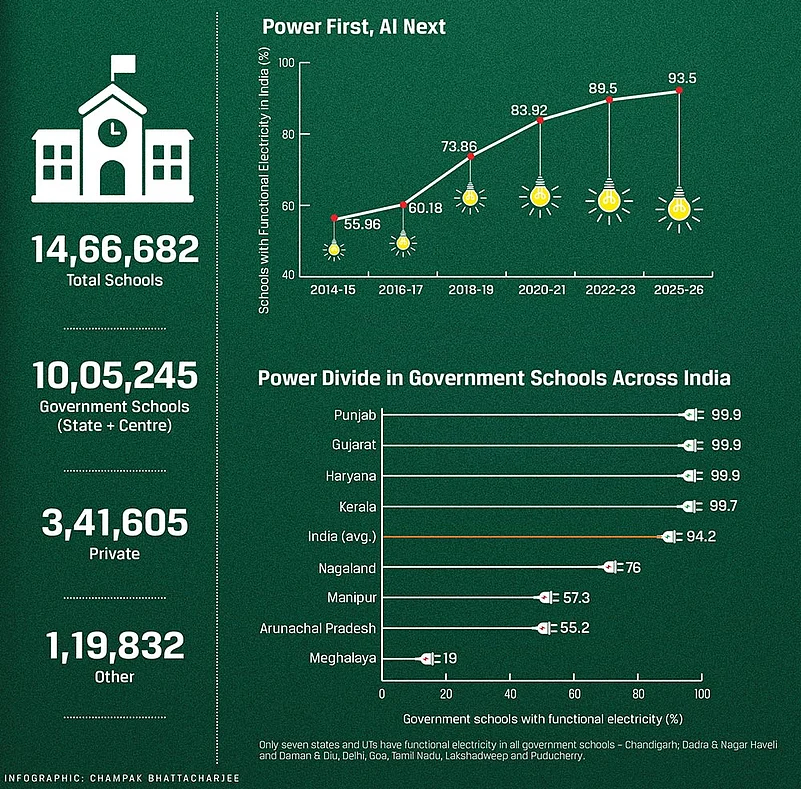
Functional electricity is present in more than 93.5% of schools, an improvement from about 55% in 2014-15. As of 2025-26, 13.71 lakh schools in India have functional electricity, including 9.5 lakh (94.2%) government schools. At the national level, India has come closest to bridging the electricity gap but Meghalaya remains a dramatic exception as only 19% schools in the state have functional electricity, as shown in the graphics.
Only seven states and UTs have functional electricity in all government schools – Chandigarh; Dadra & Nagar Haveli and Daman & Diu (DNHDD); Delhi; Goa; Tamil Nadu; Lakshadweep; and Puducherry.
The NITI Aayog report pointed out that since 2014-15, the sharpest gains were recorded in Jharkhand (from 14.7% to 93.2%), Bihar (23.6% to 99.3%), Odisha (28% to 96.7%), Assam (20.1% to 90.2%), Jammu and Kashmir (25.1% to 88.3%), and Madhya Pradesh (26.3% to 90.7%).
Computer for Pedagogical Purposes
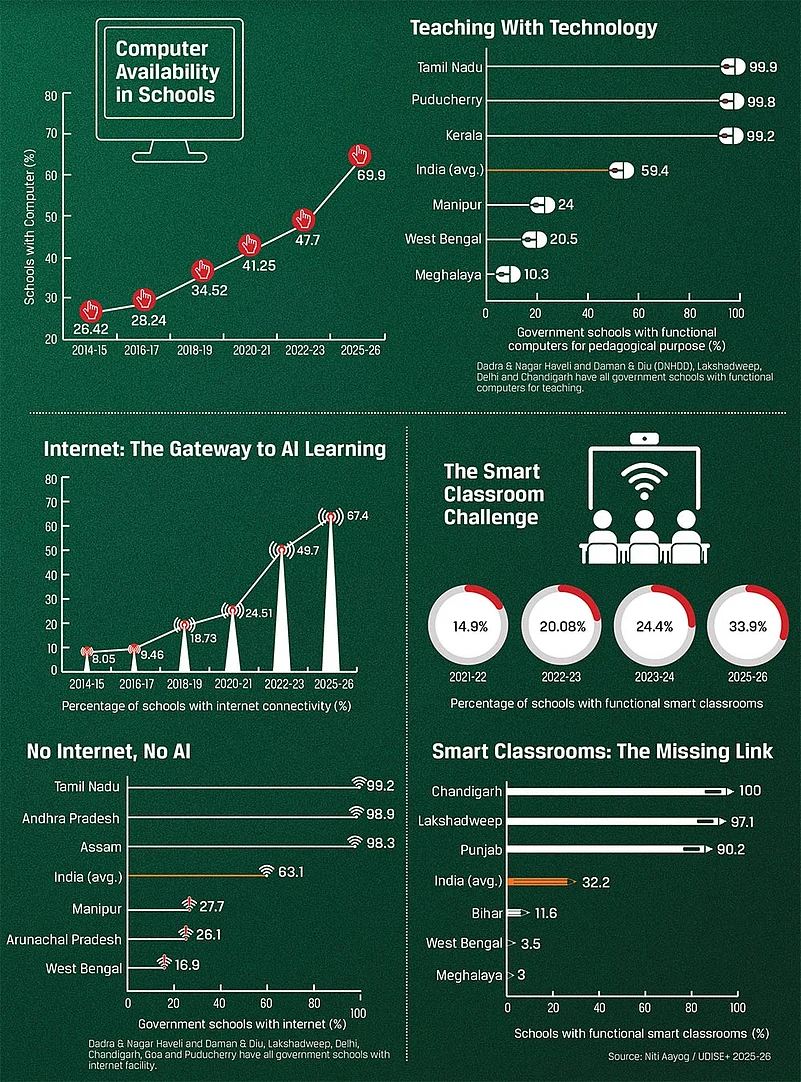
India has 9.24 lakh (63.1%) schools, including 5.96 lakh (59.4%) government schools with computer facilities for pedagogical purposes. Among the states and UTs, Delhi, Chandigarh, DNHDD and Lakshadweep are the only parts of India where all government schools have functional computers for teaching.
Over the past decade between 2014-15 and 2024-25, the sharpest gains were recorded in Assam (9.8% to 78.7%), Jharkhand (9.7% to 76%), Odisha (13.7% to 76.7%), Uttarakhand (33% to 91.3%), and Dadra & Nagar Haveli (40.1% to 97.2%).
In contrast, the smallest improvements were observed in Karnataka (38.7% to 55.7%), Goa (43.5% to 57.1%), West Bengal (12.1% to 25.1%), Manipur (25.2% to 38%), and Meghalaya (10.6% to 19.7%), the NITI Aayog report noted.
"Overall, the decade marks a rapid expansion of computer facilities across most States. Yet, more than one-third of schools still lack computers, and wide interstate disparities persist,” the report added.
Internet in Schools
A total of 9.89 lakh (67.4%) schools in India have internet facilities, including 6.34 lakh (63.1%) government schools. Only Delhi, DNHDD, Chandigarh, Goa, Lakshadweep and Puducherry have internet in all schools.
Over the past decade, the sharpest gains were recorded in Dadra & Nagar Haveli (from 6.7% to 100%), Andhra Pradesh (12.3% to 98.9%), and Assam (1.3% to 98.3%). In contrast, the smallest improvements were observed in West Bengal (4.1% to 16.9%), Arunachal Pradesh (4% to 26.1%), and Manipur (5.8% to 27.8%).
Internet connectivity in schools has expanded rapidly over the past decade, moving several States close to universal provision. Nonetheless, limited access in certain regions continues to constrain the integration of digital tools in teaching and learning.
Presence of Smart Classrooms
Among the infrastructure needed to support AI in schools, smart classrooms remain the biggest gap. Only 4.97 lakh schools (33.9%) across India have smart classrooms for teaching with digital/smart boards and smart TV. In case of government schools, smart classrooms are available in only 3.23 lakh schools (32.2%).
Only Chandigarh has all government schools with smart classrooms while only three percent of schools in Meghalaya have smart classrooms.
Over the past four years (2021-22 to 2024-25), the sharpest gains were recorded in Tamil Nadu (0% to 60.8%), Chandigarh (41.2% to 95.2%), and Maharashtra (17.3% to 63.6%). Meghalaya, West Bengal and Bihar continue to record some of the lowest smart classroom coverage in the country.
“The evidence points to significant interstate disparities: while some States have rapidly expanded smart classroom adoption, most continue to show minimal coverage, highlighting persistent gaps in technology integration,” the NITI Aayog report reads.
Road Ahead
While the CBSE has rolled out AI and computational-thinking lessons, the government data shows a system split in two: the haves and the have-nots.
More than nine in ten Indian schools now have functional electricity, but only about seven in ten have internet connectivity or functional computers for pedagogical purposes, just one in three has a smart classroom, and digital libraries remain rare, available in just 7% of schools.
So, while almost all the facilities are there in schools in Chandigarh, Meghalaya sits at or near the bottom of nearly all of them. Between Chandigarh and Meghalaya , the two extremes, lies the real story of India's AI-readiness gap.

MORE FROM THIS ISSUE





(This story appeared in Outlook magazine’s August 3 issue, 'The AI Divide', which focuses on how India's AI education ambitions are colliding with the reality of inadequate digital infrastructure, undertrained teachers and AI tools that are not built around Indian students' cultural context)