The 2022 suicide of a Jammu University professor sparked allegations of caste-based targeting and institutional bias.
Faculty and students from SC and ST communities say discrimination persists in promotions, admissions and everyday campus life.
Even as the UGC mandates Equity Committees, many question whether structural caste hierarchies in higher education are truly being addressed.
When Neeta Chandra saw her husband’s body being wheeled into an ambulance in September 2022, she thought that he had merely fallen ill.
Earlier in the morning, Chandra Shekhar, an Associate Professor in the Department of Psychology at Jammu University, had left for work as usual. His wife received a sudden call during the day from his colleagues and she was asked to reach the campus hospital, clearly unaware that her husband had hung himself from a ceiling fan in the staff room.
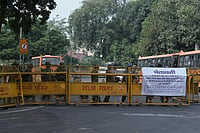
Shekhar had taught psychology at the university for 15 years and his death sent shockwaves through the campus, triggering protests by Scheduled Caste (SC) groups and students in Jammu.
The massive wave of protests started because the protesters alleged Shekhar, who belonged to the SC category, had been targeted and falsely accused of harassment months before he was due to become the Head of Department.

Neeta firmly believes that her husband was pushed to the edge to take such an extreme step. “He was harassed because he belonged to a Scheduled Caste,” she said. “Months before he was to become Head of Department, allegations were levelled against him. He was suspended without being given a proper chance to defend himself.”

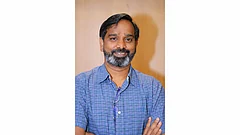

She says the police later found the complaints about his classroom conduct to be “frivolous.” The SC and Scheduled Tribe (ST) communities in Jammu and Kashmir do not see his suicide as an isolated case. Several faculty members and students allege persistent discrimination across institutions. One of the infamous incidents is from 2018 when the convocation invitation cards of recipients allegedly mentioned their caste or tribal category.
Neeta and Shekhar both hail from Uttar Pradesh. They met and fell in love while studying in the same university and ended up getting married to each other later on.
For Neeta, her husband was a man who was committed to students and ambitious about strengthening the department. “I cannot believe he would have done anything wrong,” she said.

‘Deeply Ingrained’
A faculty member, speaking on condition of anonymity, said that over the years the scholarships for SC students had reduced while the promotions of SC professors had been delayed.
“Even if there were some measures made to portray that some kind of equity has been restored with the lower caste category people, they are very cosmetic,” he said, adding that most of the people who were previously hired at top positions were there “to show that there is no caste discrimination, when it is ingrained.”
In Jammu and Kashmir, SCs are entitled to 8 per cent reservation, STs 20 per cent, and OBCs 8 per cent. Previously, incidents of caste and tribal “bias” have not only been reported from the higher educational institutions in the Hindu-majority areas of Jammu, but also in Muslims in Kashmir.
Claims of caste and tribal bias are not limited to Hindu-majority Jammu. In Kashmir, activists and students from the Gujjar Muslim community, listed as ST, say they face slurs and resistance to their reservation rights.
R.K. Kalsotra, a Scheduled Caste activist, called discrimination in higher education “deeply entrenched.” He welcomed the University Grants Commission’s Promotion of Equity in Higher Education Institutions Regulations, 2026, which mandated Equity Committees to address caste-based discrimination. “These regulations are the need of the hour,” he said.
Restricted from speaking Gojri
Students describe discrimination in everyday campus spaces, including being barred from speaking in their language. “We were told not to use our language,” said Yasrab Ali, a law student at Jammu University.
Moreover, he recalled protests against reservation for the Pahari community, after which Gujjar students were allegedly subjected to slurs. “We were called ‘Dodiya Gujjars’,” he said, adding that in another incident, a university staff member from his community was initially refused tea at the campus canteen. “It was served only after we intervened.”
At Kashmir University, a doctoral student from the ST community alleged that domicile rules do not adequately protect local ST candidates. “We compete nationally even for state university posts. Sometimes reserved seats remain vacant. Our concerns are not addressed,” he says.

Responding to this allegation, Kashmir University Registrar Professor Naseer Iqbal said recruitment follows UGC norms and is conducted at the national level to ensure merit.
“The recruitment of teaching staff is done by notifying the posts at the national level, and we also admit students from outside Kashmir as well,” he said, adding that there is a “robust mechanism” in place to look into complaints related to gender issues or caste or tribal bias
Deep-set bias
Abdul Zaheer, an LLM student at Jammu University, said that caste divisions begin early on from the village level, where some groups often consider themselves to be “superior” over the others.
“In my village, Hill Kaka, caste hierarchies are visible. We thought university would be different, but it isn’t,” he said, explaining that discrimination often exists even at “mohalla levels”. He believes formal complaint mechanisms under UGC regulations are necessary, “so that we have forums where we can raise complaints.”
For Neeta, Shekhar’s wife, the loss is both personal and structural.
Despite holding a doctorate in psychology and having multiple research publications, she said she was appointed as a junior assistant in the clerical wing after her husband’s death. Neeta added that a society cannot claim to be modern “when caste discrimination remains a reality.”
“I have a PhD, yet I was given a clerical job,” she said. “Is this justice?”