

Summary of this article
From a weekly magazine, it has expanded into a publication with a wider horizon
30 years later, Outlook works across formats, platforms and ideas
What hasn’t changed is our commitment to reporting over rhetoric
It was a classic David versus Goliath story; but for the world of publishing. In 1995, a small group of enthusiastic journalists, led by an even more enthusiastic editor, launched a tiny, low-budget magazine called Outlook. It didn’t even have an office building yet and operated out of two rooms of a government-owned Lodhi Hotel (not the present swanky version).
Their aim was clear – to rival a media giant named India Today, along with smaller titans like Frontline and others. The time for print was dead, said the naysayers. TV had arrived. It had faces and words (not as loud as today) and early news delivery. But Mehta and co. didn’t care. They had a job to do. To slay the giant. To report. To bring change.
Outlook’s first issue opened with Kashmir. Copies of the magazine were burnt. But the magazine already showed its irreverence to prescribed notions, standards, and everything else at a time when reporting from the region demanded courage, patience, and clarity. We did it. Unafraid, unapologetic, unhinged.
The first issue made a splash. It carried the ‘first-ever opinion poll in Kashmir’. Bold. Brave. As confident as editor-in-chief Vinod Mehta himself, who believed this venture would succeed. In a special issue remembering the iconic AB-10 building—home to Outlook from near-infancy to its 29th birthday—journalist Sunil Mehra writes, “Vinod set the cat among the pigeons with that controversial Kashmir poll story: an overwhelming Kashmiri majority did not want to be a part of the Indian Union. They voted for Azadi. We used that as a headline on our cover. We were not dubbed seditionists or anti-nationals (this was 1994, remember?)”
The first issue disrupted the magazine market. The disruption was strong enough to make India Today adopt a weekly schedule. Like Outlook.
Transformation Over Three Decades
Over thirty years, governments fell and rose, culture transformed, the internet reshaped the world, globalisation accelerated, and Outlook, too, changed. Leadership evolved. Inclusivity deepened. Lenses were swapped. The magazine expanded its horizon, moving beyond the urgency of the moment to reflect, analyse, and step back. Through a ten-day cycle, thematic issues now explore politics, culture, conflict, and resistance in depth, finding meaning in poetry, art, and literature alongside reporting. The past is present, the present is immediate, and together they shape the future.
Outlook returned to Kashmir. Silence in Kashmir. Different times. A different political moment. Article 370 had been abrogated. The Valley had been silenced. But the same insistence on asking difficult questions continued. This is not coincidence. It is continuity.
Over three decades, the world has changed—and so has news. The ways of seeing, the ways of consuming news, the pace, the noise, the never-stopping cycle—all have transformed.
Outlook transformed, across formats, platforms, and ideas, without ever losing its core: reporting over rhetoric, analysis over optics, clarity in confusion, and space for complexity. Women have taken over, the male gaze no longer defines the news, and inclusivity is a mark of irreverence.
We The People
Kashmir returned, again and again. In this issue’s We The People section, we revisit 25 October 2021. Naseer Ganai writes ‘Kashmir Minority Killings: A Throwback To The Terrifying 90s’. It came shortly after the abrogation of Article 370 in 2019.
In the 1 September 2008 Azadi For Kashmir issue, Booker Prize winner Arundhati Roy, journalist Saba Naqvi, Mariana Baabar, and others asked pointed questions: what did Kashmir want? What did it lack? What did it need?
Kashmir’s political landscape evolved. Some celebrated. Some lamented. Meanwhile, more upheavals were gathering across the country.
As the Meitei and Kuki-Zo conflict scarred Manipur, other wounds across the country remained open. Bastar. Quiet villages, violent lives. Outlook’s 26 June 2017 cover story, ‘Destined To Live In No Man’s Land’, explored this strife. A year after its birth, Outlook covered the Naxal movement. The December 18, 1996 ‘People’s War’ issue carried first-person accounts from the bloodiest confrontations between Naxalites, tribals, and the state.
Protests and More
Over time, the ‘Naxals’ were no longer isolated to tribal-dominated hinterland. Political fearmongering introduced a new term: ‘Urban Naxals’. On 18 May 2015, Arundhati Roy asked if the ‘Professor in Peril’—wheelchair-bound Dr G.N. Saibaba, jailed in Nagpur Central on multiple charges—was ‘India’s Most Dangerous Man?’
Years later, August 2023, Outlook returned to investigate caste violence. Dalits faced atrocities, past and present, with Bhima-Koregaon as the focal point.
By the Gun
Political upheavals within the country continued; so did attacks from outside forces. One constant conflict—and sometimes war—was with Pakistan. From the Parliament attack in 2001—where Outlook asked how India should respond—to 24 July 2006, when Mumbai was attacked again, and we asked why this city? Who were the masterminds? Then came war: Kargil, Pahalgam, Operation Sindoor.
War is Elsewhere?
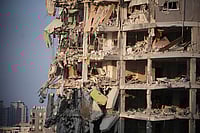
War is never truly over. It simmers, boils, spills from one region to another. When India and Pakistan pause, it is Afghanistan and Pakistan launching rockets at each other. Some wars never paused, like the war against Palestine. Since Israel’s establishment in 1948, Palestine has only known death and destruction. When the war escalated catastrophically, Outlook focused on the plight of Palestinians, bringing clarity and context.
Crime and Punishment
Some wars need no army. They are fought in streets and homes, creating criminal empires. From Bombay’s gang wars in Outlook’s birth year to the rise of the underworld, violence ruled the streets. Gulshan Kumar was killed. The Dawood empire thrived. Fear became a currency.
Yet crime isn’t always organised. Hatred alone can kill, rape, destroy. From standing with Jessica Lal in 2006 to the ‘Woman of the Year’ reportage after Nirbhaya, Outlook covered crime without sensationalism, always with respect for survivors and victims. We never dressed crime as spectacle; we asked hard questions about the system that allowed it.
The Investigator Hat
When Outlook investigated, it did so thoroughly. 29 November 2010: Exclusive Niira Radia tapes, the 2G scam. Conversations revealed how politicians, corporate houses, lobbyists, bureaucrats, and journalists conspired to get A. Raja into Manmohan Singh’s cabinet in 2009. Result: India’s biggest scam, a stain on the Prime Minister’s image, a nation for sale, and the partial collapse of a regime.
And then there was cricket. The ‘gentleman’s game’ wasn’t gentle. Outlook exposed corruption—from ‘India’s Worst Kept Secret’ in 1997 to Aussie players accepting bribes in ‘Cricket’s Hour Of Shame’ in 1998.
Live, Love, Laugh
The world has always been unfair—to minorities, women, the poor, the weak. Yet Outlook also celebrates what allows humanity to survive trauma and tragedy. Humans are strange, funny. We dismiss art and poetry as frivolous. As feminine.
Revolutions are often defined as arms and masculine rebellion, ignoring quieter ones fought with brush, word, or verse, challenging capitalism, patriarchy, and caste.
In its 30th year, Outlook continues to hold a mirror to injustice. Every ten days, thematic issues explore politics in poetry, past and present together shaping the future.
In 2024, ‘Poetry As Evidence’, guest-edited by Amar Kanwar, presented verse as evidence of bleak times, truth, and distortion. Politics is personal. Art is political. India’s minorities embody this truth, their existence challenging the status quo. In 2016, Outlook followed transgender lives claiming the right to exist; in 2023, we decoded The Politics Of Emotions.
We still investigated crimes. Didn’t rush to be first, but strove to be most accurate. Outlook didn’t shout. Ever. The stories were loud enough, yet refused to whisper.
For thirty years, we asked questions—sharp, uncomfortable, distressing. From the first issue asking what the people of Kashmir want, to the latest issue asking what is Left of the Left in India; from interrogating Indira Gandhi’s legacy to debating who qualifies as Indian under a Hindu Rashtra.
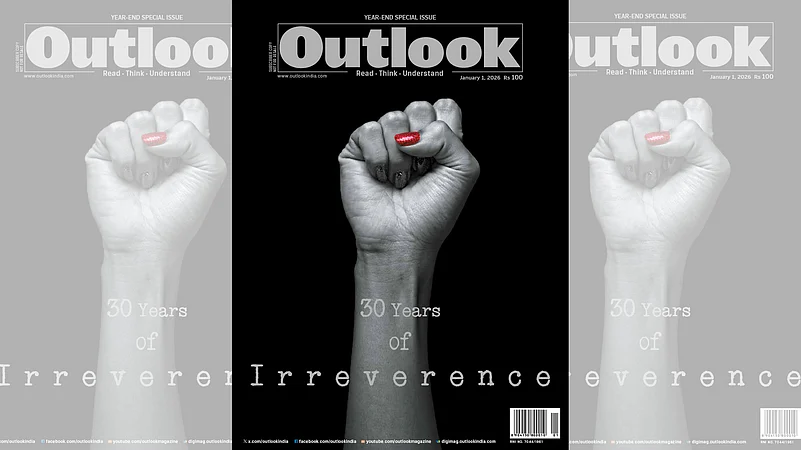
Thirty years of questions, investigations, breaking news, and building stories. From Vinod Mehta to Chinki Sinha. From a newly liberalised economy to a post-truth world in which asking questions is dangerous. From old masculinities to inclusive journalism.
This hundred-page special issue captures fond and forgotten memories. The future will hold all these thirty years—and more.
And we will continue to be irreverent.