BJP rule has narrowed democratic space, pushing India’s political discourse sharply to the Right.
Education reforms, job insecurity, and identity politics are radicalising sections of India’s youth.
Despite electoral setbacks, the Left has an opening to rebuild solidarities and mass politics among Gen Z.
Since coming to power in 2014, the Bharatiya Janata Party (BJP) government has declared a blitzkrieg on the Left and other progressive forces. The Overton window has been pushed far right and we find ourselves grasping for any available hope in front of the fascist onslaught. This is exactly where the Left has the potential to create new solidarities and possibilities.
The Left in India has a long evolutionary history of infighting regarding party lines. From a caste-blind, class-reductionist past to the militant land struggles in feudal parts of India that shattered many assumptions regarding liberal democracy, the story is complex and still evolving. The electoral failures around the nation may paint a pessimistic future, but there has not been a present more ripe for the Left.
While contemplating Left politics among the youth, one immediately thinks about Jawaharlal Nehru University (JNU), which has also been fighting a decade-long systemic attack. A lot has been said about the ‘new crowd’ in JNU that took the Common University Entrance Test (CUET) exam to get admission. Yet, when one looks closely, one person at a time, one room at a time, one dormitory at a time, you will find curious students who have come from all walks of life to experience the rigorous political discourse of JNU.

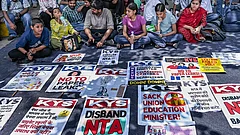

Picture this. Ten young BA and MA students, sitting around in a dormitory along with two activists, one sitting on the table and the other on the chair. On the wall is a world map, an anime poster and a line from the poetry of the great revolutionary poet Pash—‘most dangerous is the dying of our dreams’. A stream of questions; a rapid fire follows. “Is your organisation in favour of the Uniform Civil Code (UCC)? What about the caste census? Do you support Umar Khalid and Sharjeel Imam? Why? But what about Bangladeshi Hindus? Isn’t the free market a boon? The answers are often long and complex; you have to start by countering the various tags—anti-national, anti-work, anti-technology, anti-progress, etc. They gradually relate when you navigate them to their libraries, hostel rooms and their classroom and even the roads of New Delhi under the triple engine sarkar. “But tell us exactly, what is the difference between the Left and the Right? And the listeners are patient and curious. Is there a world beyond the politics of Left and Right?” The answer is a simple NO! Today’s politics has gone beyond the liberal dream of reconciliation. The divide is sharpening. The antagonism of today is clear. There are clear political questions raised in front of today’s youth and we have to make some choices.
Is there a world beyond the politics of Left and Right? The answer is a simple NO! Today’s politics has gone beyond the liberal dream of reconciliation.
The youth is being bombarded with new concerns, from citizenship to persistent assault on education to a hellish cityscape where everyone is pushed into the state’s favourite gig economy. The government is adamant about selling all the educational institutes under the National Education Policy (NEP) 2020, in the name of autonomy, rationalisation, and internationalisation. The thinning of government jobs, along with privatisation, is producing precarity and insecurity. The most marginalised among the youth, who were dependent on defence services for job security, were also left in despair by contractualising the defence services into the Agnipath scheme. From Bihar to Haryana, the public service commissions have only disheartened the youth by not curbing paper leaks or fraudulent evaluations.
The government is changing textbooks and manipulating collective memory. The NEP is keeping students busy yet unspecialised in their areas of interest, raising a sense of despair and alienation. The NEP emphasises fundamental duties, but does not mention anything about fundamental rights. It states that it will develop among the youth a deep-rooted pride in being Indian. This is contradictory to India’s history of forming global solidarities. One must state that this is a flawed pedagogy, which does not have a place for critical thinking. India has a history of youth mobilisation. The youth have mobilised against imperialism, colonialism and authoritarianism at different times. This becomes possible due to a pedagogy that gives freedom to critically analyse and question the prevailing national and global conditions.
For a group of people who have grown up knowing only this regime, the ever-intensifying disillusionment is an everyday process, which has pushed the youth into looking for an alternative idea of politics. The disregard towards people’s lives, the farmers, the labourers, and the youth; persistent silence on people’s demands has pushed the middle class on the road. Even though such instances are often scattered and last only a few days, the sparks of discontent are brighter than ever. The dipping economy and the current regime’s deep engagement with capitalists are being exposed by the very social media that made the ecosystem it thrived on.
The attacks on Muslims and Dalits by Hindutva forces, either by the State or with its impunity, are increasing. The attack is on the revolution that was declared with the chanting of ‘We the People of India’. Today, the BJP-RSS fascist counter-revolution is breaking that ‘We’ and the CAA-NRC, along with the Special Intensive Revision (SIR), exposes their conspiracy to strip individuals who are not willing to be a cog in their wheel of corporate loot of their sense of security.
Gen Z is clearly fed up with one person’s mann ki baat and is searching for dialogic possibilities. We can’t fight this regime in its language, when it has easily appropriated the language of social justice and translated it into the client patron system workable due to rising inequalities. The Left needs to change the everyday vocabulary and terms of politics. This new vocabulary, communicative of all the contradictions, should be able to translate the revolutionary possibilities of the Left for the masses, taking them towards a people’s democracy. Our idea of India must present a sharp contradiction to the RSS-BJP’s idea to ensure a strong resistance. It is required of the Left to persistently diagnose the conditions, form larger solidarities, and ensure that every issue is politicised. The assault is on politics itself and the struggle is to redeem it.
(Views expressed are personal)
Aditi is the JNU Students’ Union President
This article appeared as Where Are The Young Turks? in Outlook’s December 21, 2025, issue as 'What's Left of the Left' which explores how the Left finds itself at an interesting and challenging crossroad now the Left needs to adapt.