Despite its secular image, the CPI(M) has relied on symbolic Muslim issues and electoral balancing, alienating Muslim voters while inadvertently benefiting the BJP.
In West Bengal and Kerala, the Left’s silence on material issues like poverty, land loss and social exclusion has weakened its credibility among Muslims.
A lack of Muslim representation and insensitive leadership rhetoric has deepened the rupture, demanding a shift toward principled, justice-based solidarity.
The Left parties in India have comparatively speaking been the most secular in their stance. The Congress Party’s ‘secularism’ has been pragmatically communal, playing minority communalism off against majority communalism, for instance in 1986, when the Muslim Women (Protection of Rights on Divorce) Act was passed and preceded a few months by the government’s decision to open the locks of the Babri Masjid. Despite the more secular stance of especially the most important of the Left-wing parties, the Communist Party of India (Marxist), there has always been a Muslim problem that the Left seems to have ham-handedly and unimaginatively struggled with. This has been especially in evidence in two of the CPI(M)’s strongholds—West Bengal and Kerala.
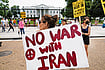
The CPI(M)’s Muslim problem is a bit like the Congress’ problem, albeit on a miniature scale and one of crude electoral calculus. How far can they woo the Hindu nationalist voter on the Right, while continuing to appeal to the sizeable Muslim electorate? The long-term result of this short-term approach has tended to be an alienation on both sides, with the Bharatiya Janata Party (BJP) benefitting handsomely from this supposedly smart and twisted ‘secular’ strategy that seeks an opportunistic both-sided securing of votes. This balancing attack is done by wooing Hindu majority voters on the Right by raising the usual bogeys of terrorism and Islamic radicalism, while at the same time raising cliched geopolitical concerns, such as the question of Gaza more recently, or back in 2008 when the West Bengal CPI(M) made its opposition to the India-US Civil Nuclear Deal into a Muslim electoral issue when it thought a demonisation of US President George Bush would reap electoral rewards by attracting Muslim votes.



While these largely symbolic Muslim issues have been played up, there has been a strange silence on more substantive issues that really should have been the forte of the Left. In the mid-2000s, the Muslim majority district of Murshidabad in West Bengal witnessed numerous starvation deaths, which were vehemently denied by the CPI(M)-led government. Around this time, the Sachar Committee Report had also made a note of the abysmal social and economic condition of Muslims in the state. It is worth recalling that by this time, land acquisition in Nandigram and Singur had already disproportionately affected the large Muslim population of these areas. Unsurprisingly, the Left lumbered to defeat in 2011.
While largely symbolic Muslim issues have been played up, there has been a strange silence on more substantive issues that really should have been the forte of the Left.
In Kerala, the surprise success of the BJP in wresting the Thrissur seat during the 2024 parliamentary elections would be an instance of how the two-sided wooing, mentioned earlier, works by default to the advantage of the Right-wing Hindu nationalist party. There is almost a sliding scale of how political parties relate electorally to Muslims across the country. The most extreme end of this scale is of course the BJP where the Muslim vote has been rejected and slid into redundancy. Then there are parties like the Congress, the Samajwadi Party (SP) in Uttar Pradesh and the Rashtriya Janata Dal (RJD) in Bihar, which have traditionally secured the Muslim vote, yet want to keep silent on this support as they are so wary of the accusation of ‘appeasement’. Finally, there is the CPI(M), especially in Kerala, which uses the Muslim vote as a kind of holding to ransom, warning that if the Muslims don’t vote for the CPI(M), then there is no one to save them from the BJP, effectively presenting themselves as the sole and default saviour of Muslims. The sliding scale explains the comparative secular superiority of the Left. This default saviour argument led Indian Union Muslim League (IUML) Political Affairs Committee Chairman and State President Syed Sadikal Shihab Thangal to complain: “The CPI(M) propaganda that Muslims will become second-class citizens if there is no Left is a joke”.
Beyond both-sided wooing, what makes matters worse for the Left and Muslims is when powerful CPI(M) leaders at the very top have insensitively commented on aspects of the Muslim presence in their respective states. Back in 2009, then West Bengal Chief Minister Buddhadeb Bhattacharjee made some remarks on the undesirable and radical nature of madrasas in the state. In 2010, V.S. Achuthanandan accused a Muslim political group of using marriage as an instrument to Islamise Kerala. This had an uncanny resemblance to the ‘love-jihad’ narrative of the Hindu Right. More recently, Kerala Chief Minister Pinarayi Vijayan has borrowed from the conceptual lexicon of the Bharatiya Janata Party (BJP) and the Hindu Right by insinuating the ‘anti-national’ activities of Muslims on the Malabar coast and especially in the Muslim-dominated district of Malappuram.
The CPI(M)’s Muslim problem arises from an unimaginative approach as to how to electorally woo Muslims. The best option that opens itself up is that of issues of global and symbolic Muslim significance, such as Israel’s atrocities in Gaza or the anti-Muslim foreign policy of the US. This is not to argue against the need to raise the Gaza issue and how the strip has been reduced to a wasteland, or the fact that Gaza has become the moral compass of the century. The problem arises when the Gaza issue is made out exclusively to be a Muslim concern and worse, to invoke it specifically to win the Muslim vote.
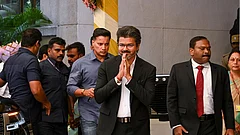
The lack of imagination stems from a lack of influential Muslims, especially at the organisational level of the top leadership which at times has resembled an elite Brahminical vanguard. While there are some significant and prominent Muslims at the top of the CPI(M) leadership at the level of the Politburo, such as Mohammed Salim, there does seem to be a failure of this influence to percolate downwards and affect the way the party relates to the Muslims masses at large. In West Bengal, Muslims have been moving consistently away from the CPI(M) for roughly the last two decades.
Recall that some of the central founders and organisers of the Communist Party of India when it was established in 1925, and shortly thereafter, were figures such as Muzaffar Ahmad (fondly referred to as Kakababu) and Abdul Halim. However, there seems to be a cleft in which Muslims have been left behind. The question remains: how and when were Muslims left behind?

One of the most readable accounts of the failures of Left-wing politics in Bengal that covers the period prior to independence, the Partition and the creation of Bangladesh is the Urdu writer Qurratulain Hyder’s novel which she herself translated with the evocative English title Fireflies in the Mist. It is a melancholic account of a failed romance between a sincerely motivated middle-class Hindu girl Deepali Sarkar who falls for the radical, revolutionary Rehan Ahmad. He is the son of a rural theologian and educated at the London School of Economics in the 1930s. What deepens the sad strains of the book is the backdrop of the verdant and suffering Bengali countryside that Hyder captures so well in her writing. As the Urdu title of the novel, Aakhir-e-Shab ke Humsafar, taken from a line by Faiz Ahmad Faiz suggests, there are the faithful who remain steadfast until the very end of the dark night, just as the day is about to dawn. The Left and Muslims must walk in that spirit of principled solidarity in the face of the blinding darkness of Hindutva.
(Views expressed are personal)
Amir Ali teaches at the Centre for Political Studies, JNU, New Delhi
MORE FROM THIS ISSUE


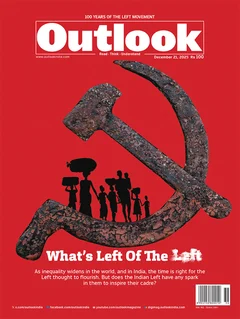
This article appeared as Left Behind The Muslims? in Outlook’s December 21, 2025, issue as 'What's Left of the Left' which explores how the Left finds itself at an interesting and challenging crossroad now the Left needs to adapt. And perhaps it will do so.