Iran and the United States have received a plan to end hostilities that could come into effect on Monday and reopen the Strait of Hormuz.
Mediators Pakistan, Egypt and Turkiye are working desperately at a temporary ceasefire.
Steve Witkoff and Jared Kushner are said to be exchanging messages directly with Iran’s foreign minister Abbas Araghchi
Amid the sound and fury of US President Donald Trump’s threatening tweets, and the continuous air strikes by US and Israel and counter attacks by Iran, a last-ditch attempt at a 45-day pause in the war is also on the works to save the region from a catastrophe of unimaginable proportions.
Back channel efforts headed by Pakistan are on. A Reuters report quoting sources involved in the mediation said that both Iran and the United States have received a plan to end hostilities that could come into effect on Monday and reopen the Strait of Hormuz. “A framework to end hostilities has been put together by Pakistan and exchanged with Iran and the US overnight,” the source said, outlining a two-tier approach with an immediate ceasefire followed by a comprehensive agreement,’’ the Reuters report said.
Mediators Pakistan, Egypt and Turkiye are working desperately at a temporary ceasefire. Trump’s special envoy Steve Witkoff and Jared Kushner are said, according to one report, to be exchanging messages directly with Iran’s foreign minister Abbas Araghchi. An agreement for a 45-day ceasefire is to give time to both sides to negotiate a permanent end to the war. The period would be extended if more time was needed to find a permanent solution.

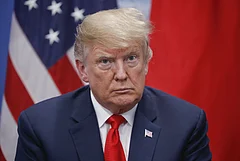


Trump is giving contradictory signals as he has done through this entire period. After a warning filled with expletives to Iran on Sunday, he has extended his self- imposed 10-day deadline by another 20-hours, to give negotiations a chance. The new deadline is Tuesday 8 pm eastern time. "There is a good chance, but if they don't make a deal, I am blowing up everything over there," Trump thundered.
Some hours later, he said to American reporters that Witkoff and Kushner were in talks with the Iranians and there could be a deal very soon. Trump also told Fox News he believes there is a "good chance" of making a deal with Iran on Monday.
"I think there is a good chance tomorrow, they are negotiating now," Trump said."If they don't make a deal and fast, I'm considering blowing everything up and taking over the oil," he added. Trump repeated much the same when he spoke to Axios. Claiming that the US is "in deep negotiations" with Iran and that a deal can be reached before the end of his Tuesday deadline.
Hopes of a ceasefire coming through, however, appear bleak at the moment as the two sides have stuck to the main points. Trump insists that Iran open the Strait of Hormuz if it wants to ensure that the country’s civilian infrastructure is not bombed to the stone age. Not that the US and Israel have not touched Iran’s civilian infrastructure. America started by bombing a girls’ school on the first day of the war. It has since expanded its lethal bombardment over bridges, health centres and university buildings. But if an agreement for a pause is not reached, Iran’s entire civilian infrastructure would be destroyed. Iran is already prepared and ready to strike as soon as Trump gives the green light.

“For Iran, the Strait of Hormuz is the only weapon it has as leverage in a war against a much stronger military, in fact the most powerful and technologically advanced fighting force in the world,” notes Talmiz Ahmad, former Indian ambassador to Saudi Arabia and an expert on West Asia. “The Strait is a weapon to put pressure in the global economy.’’ Trump wants reparation for damages paid in the form of levy by those who use the waterways.”
No one can foresee what will happen: there is no categorical answer to the question of a ceasefire. “US President Donald Trump is looking for a way out of the war, but it has to be on his terms, where he appears as the winner,’’ Ahmad adds. Opening the Strait of Hormuz now seems to be at the front and centre of US President Donald Trump. Iran too is in no mood to give in tamely to the opening of the waterways, knowing that this is the only effective card Tehran holds at the moment.
The strait handles around 20 per cent of the world’s energy needs. Its closure to vessels of the US and its allies had led to a steep hike in the price of oil in the international markets. The uncertainty over the war has resulted in a volatile global economy, something that is affecting not just the region but has world-wide implications.
``Iranians are using the war as the medium of a meaningful bargain with the Trump administration. They aim at securing a meaningful conclusion of the war with two objectives, a permanent ceasefire binding Israel and the United States to close the chapter of hostility, and second, to reset security relations with the region. The Iranian side is opposed to any temporary ceasefire. So far, the offers made by the Trump administration haven’t convinced Iran,’’ says Omair Anas, of Ankara’s Yildirim Beyazit University.
Will Pakistan and the other mediators be able to convince either the US or Iran? “Ceasefire appears rather tenuous as of now,’’ says Delhi-based Syrian analyst Waiel Awwad, who knows the region well. “It is difficult to know whether the latest proposal can work. Both sides have taken maximalist positions and Trump wants an honourable exit, but one that portrays him as the winner.
“Iran is not interested in a piecemeal arrangement and wants a permanent fix to the problem. Tehran will not agree to anything without a guarantee by Trump that another operation will not be launched either from Israel or the US, a few months down the line,’’ Awwad explains.
Israel is closely watching developments and carrying on with its deadly strikes to destroy as much of Iran as possible. Prime Minister Benjamin Netanyahu is keen that the war continues and Iran is so badly damaged that it can no longer be a threat.