In 1906, Persia’s Qajar ruler Mozaffar-od-Dīn Shāh established the Majlis and a constitution, marking a shift toward constitutional monarchy, but Russian intervention in 1911 crushed the constitutionalist movement.
Throughout the early 20th century, Iran became a strategic battleground for imperial powers due to its location and oil resources. Britain backed Reza Khan’s 1921 coup and later, in 1953, the US and UK orchestrated another coup that toppled Prime Minister Mohammad Mosaddegh.
Mohammad Reza Shah Pahlavi pursued rapid modernisation through the White Revolution while strengthening authoritarian control via the SAVAK secret police, creating social tensions among clerics, landowners, merchants, and conservatives.
In 1907, just like dividing a pie, Britain and Russia split Persia into two halves as their respective spheres of influence.
Persia—which would be known as Iran from 1935—had just started transitioning from absolute monarchy to constitutional monarchy. Facing popular protests, Mozaffar-od-Dīn Shāh of the Qājār dynasty established a national assembly called the Majlis (Iranian parliament) in 1906. The Constitution was promulgated in December that year, with legislative powers vested with the Majlis, which would be elected through biennial elections.

But the colonial powers robbed Iranians of their first taste of participation in decision-making—the Anglo-Russian Entente severely crippled Iran’s nascent parliament. In 1911, a Russian invasion forced the closure of parliament and crushed the constitutionalist movement.

Persia, the land of one of the world’s earliest civilisations and empires, was never directly colonised by European powers. But at the turn of the 20th century, its strategic location—between Russian and the British colonies of South Asia—turned it into a pawn in the game of the imperialists. Since then, the imperial powers have kept Iran disturbed at regular intervals—leading to a situation where anti-imperialism and opposition to Western civilisation and culture have become synonymous under a theocratic and oppressive regime.
One major aspect of Iran’s opposition to the West has been culture. Strict imposition of the Islamic dress code on women created a substantial internal and international outrage against the Islamic regime. But there is another aspect no less important than culture: sovereignty and resources. The West has its eyes on Iran’s oil—it has always had for a century now—and it is no less an important truth to the Iranians.

The Majlis was revived in 1914, but World War I (WWI) did not allow it to function. The Russian, British, and the Ottoman forces occupied different parts of the country. After the end of the war, Britain attempted to turn Iran into a protectorate through the Anglo-Persian Agreement of 1919, but failed due to intense public protests in Iran.
Britain then engineered a coup in 1921, bringing military officer Reza Khan to power. Khan quickly turned the Majlis into a rubber stamp. In 1925, he got the Majlis to depose Ahmad Shah, the last monarch of the Qajar dynasty. Then it elected Khan as the new hereditary king.
Following his coronation in 1926 as Reza Shah Pahlavi, he established an authoritarian rule with British help. He embarked on a modernisation, nationalisation, secularisation and Westernisation drive. Religious landholdings were confiscated. The ulema lost their judicial authority. Education was westernised. Men were mandated to wear western hats and suits. Women were prohibited from wearing the veil in public places.
However, his hard bargain with Britain over oil profit-sharing and the growing friendship with Afghanistan, Turkey and Germany, among other countries, left Britain concerned. When WWII broke out in 1939, Iran declared its neutrality. The allied forces invaded Iran in 1941 nonetheless—Britain from the south and the Soviet Union from the north. Their motive was ensuring a supply route to Russia and securing the crucial Abadan oil refinery and southern oil fields. Reza Shah Pahlavi was forced to abdicate.
Iran built the so-called Axis of Resistance against the US, Israel, Saudi Arabia and the Gulf monarchies.
The allied forces put his son, the young Mohammad Reza Shah Pahlavi, on the throne. After the war, despite British and Russian interests in Iranian oil, intense public pressure for nationalisation of oil industries led towards a sweeping mandate in favour of nationalist leader Mohammad Mosaddegh in the 1951 elections.
His nationalisation drive unnerved the US and Britain. In 1953, the US spy agency, the CIA, and the British spy agency, MI6, toppled Mosaddegh’s government by engineering a coup. They brought Pahlavi back to the helm of affairs. This marked the beginning of a new friendship—a close, strategic one, with the Shah acting as the US’ key ally in Western and Central Asia against Soviet influence.
“To many Iranians, Mosaddegh became a symbol of yet another moment in history when foreign intervention played a pivotal role in thwarting a democratic movement in Iran,” wrote Shiva Balaghi, a cultural historian of Central and Western Asia. This event shaped Iranian distrust of the West for decades.
Pahlavi took a two-pronged approach—modernisation and authoritarianism. In 1957, he established the SAVAK, a notorious secret police, with Israeli and US assistance. He used the SAVAK to enforce strict control and crush opposition, especially targeting deposed prime minister Mosaddegh’s allies in the National Front, clerics led by the ayatollah (high-ranking Shia clergy) Ruhollah Khomeini, and the Tudeh communists.
Around the same time, he started formulating the White Revolution—land redistribution, women’s suffrage and modernisation of education, healthcare and industries. However, its rapid and top-down approach created many social tensions. The landed gentry was fuming. The seizure of Waqf land, which was a major source of revenue for religious institutions, angered clerics and the ulemas. Allowing women to vote and hold public offices irked the conservatives, especially in the rural areas. The push for big industries had also impacted the bazaar merchants.
According to Ervand Abrahamian, a historian of modern Iran, Shah used the modernising rhetoric to consolidate personal power and prevent a genuine popular revolution. Nevertheless, it turned out to be still too fast, creating a wide range of resentments. This prompted many scholars to view the Shah’s ‘White Revolution’ as a direct catalyst for the politicisation of Shi’ism.
Ruhollah Khomeini emerged as the Shah’s most vocal critic. He called the enfranchisement of women as moral corruption. He dubbed the modernisation programmme as a foreign imposition designed to destroy Iran’s Islamic identity. He was arrested in June 1963 and exiled the next year.
As the perception of the Shah as a ‘US puppet’ grew, the SAVAK became synonymous with political repression. The 1973 oil crisis exponentially increased Iran’s oil revenues, which the Shah leveraged to speed up his modernisation, industrialisation and infrastructural development. However, increasing inflation and inequality also intensified dissent. Critics accused him of gharbzadegi—meaning blind imitation of the West. Mini-skirts, rock music, and alcohol emerged as the bones of contention.
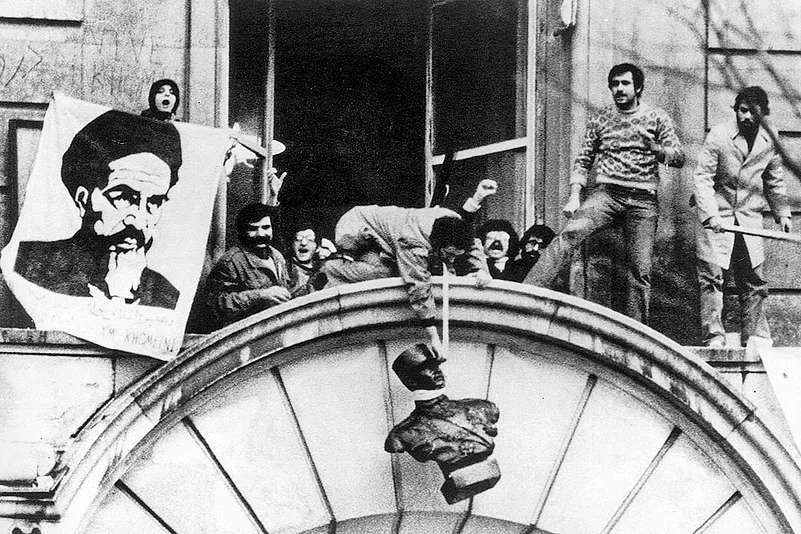
The mass protests of 1978-79 saw the participation of a wide range of the Shah’s opponents—Islamic clerics, Marxists, liberals, students and bazaar merchants. Ultimately, the Islamists gained the upper hand. The Shah left Iran in January 1979. The next month, Khomeini returned from exile. He managed to mould the anti-Shah uprising into a revolution for a theocratic state, the Islamic Republic of Iran.
Soon after the revolution, a group of Islamist students occupied the US Embassy, taking everyone inside, including diplomats, as hostages. They demanded the repatriation of the deposed Shah, who was in the US for cancer treatment. This hostage crisis dragged on for over 400 days, partly leading to Jimmy Carter’s loss in the 1980 US presidential election. It also consolidated Khomeini’s position as an anti-imperialist warrior and turned the US-Iran bonhomie into enmity.
Revolution and the Aftermath
Khomeini created a theocratic republic, in which a cleric outranked the president and the parliament. Rapid Islamisation started. A purge of liberals and Leftists and mass executions of political opponents brought back the same situation as under Shah’s SAVAK. Conservative authoritarianism replaced liberal authoritarianism.
The laws were Islamised. The school curriculum changed. Strict Islamic dress codes were imposed. Women’s solo singing was prohibited. Universities were completely shut from 1980 to 1983 to ‘de-Westernise’ them and rid them of Left-liberal influences. Since then, a large section of Iran’s people have been fighting this oppressive rule, while the rulers have been waging a relentless war against Western imperialism, culture being one of its most crucial components.

The Arab world became wary of Iran, perceiving it as a direct threat to Sunni Arab regimes. The eight-year war with Iraq during the 1980s exposed the fault lines. The West and the Arab world stood by Iraq, which had invaded Iran. Khomeini gave the war a religious overtone, equating it with the Battle of Karbala, and strengthened his position. Iran also started supporting Shia militant groups—Islamic Front for the Liberation of Bahrain (IFLB); Badr Brigade in Iraq; Hezbollah in Lebanon. Their ideological call was to thwart “corrupt monarchies”.
This marked the beginning of a new world order—characterised by Iran’s growing distance with the West and the Arab nations. Khomeini’s 1989 fatwa (religious edict) calling for British author Salman Rushdie’s death, accusing him of blasphemy, further isolated Iran.
When Ruhollah Khomeini died in 1989, Ayatollah Ali Khamenei took charge, and pursued the same path. Constitutional amendments elevated him to the position of Supreme Leader. He criticised women’s presence in the workplace. Dress codes became stricter. Khamenei’s fatwas banned online chats between unrelated men and women, online games, and men listening to female AI voices.
He also issued a fatwa prohibiting any insult to revered Sunni figures—a move seen as a bid to win support of the Sunnis. After all, Iran was supporting the Sunni militia, Hamas, in Palestine. But Arab mistrust of Iran remained. The news of Iran’s nuclear programme, which broke in 2002, only worsened Arab fears. The nuclear programme also drew UN and US sanctions.
Subsequently, Iran built the so-called Axis of Resistance against the US, Israel, Saudi Arabia and the Gulf monarchies. It involved Bashar al-Assad’s regime in Syria and the militias in Lebanon, Yemen, Iraq and Palestine. In response, the Abraham Accords (2020) normalised Israel’s ties with the UAE and Bahrain.
Since the beginning of Israel’s war on Palestine in October 2023, Iran’s support for Palestine once again exposed its loneliness. Its allies also suffered big losses, the biggest being the fall of the Assad regime. Iran’s isolation reached its nadir. Internally, Iran has been going through repeated waves of protests against oppressive laws despite the authority’s brutal crackdowns.
Just when it appeared Iran’s regime was coming under ever-increasing pressure, the US-Israeli alliance bombed Iran and killed not only Khamenei, but also many schoolchildren. They have handed the Iranian regime perhaps what they needed most—an anti-imperialist fervour.
Ayatollah Ali Khamenei is dead. But he may live longer than what many Iranians wanted him to.
Snigdhendu Bhattacharya is a journalist, author and researcher
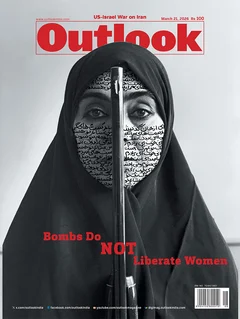




This article is part of Outlook 's March 21 issue Bombs Do Not Liberate Women which looks at the conflict in West Asia following US and Israel’s attacks on Iran leading to the assassination of Ayatollah Ali Khamenei, while the world wondered in loud silence, again, Whose War Is It Anyway?