



Directed by Himank Gaur, Lukkhe releases on Amazon Prime Video on May 8.
It stars Lakshvir Saran, King, Kritika Bhardwaj, Nakul Roshan Sahdev and Palak Tiwari in leading roles.
The story follows a young hockey player who, after an accident caused by his recklessness due to his consumption of a drug called Demon, infiltrates the gang that is suspected of manufacturing it.
In hindsight, Udta Punjab (2016) really seems like a film that permanently altered the cinematic language in which Punjab was articulated for the masses. It has been 10 years since its release, and these days, stories set in ‘real’ Punjab are dime a dozen. You get different versions of the same cocktail, where the ingredients are music, drugs, crime, masculinity and politics. You sometimes get a gourmet serving like a Kohrra (2023-2026) here and an Amar Singh Chamkila (2024) there, but the majority of these stories now land as imitations of the original formula in different glasses. Amazon Prime Video’s latest series Lukkhe arrives in this fatigue-prone cinematic landscape of ‘gritty’ Punjab, with the same set of ingredients. Does it succeed in saying something new? Not really. Does it succeed in making you care still? Yes.
Himank Gaur’s Lukkhe is the story of a young hockey player Lucky (Lakshvir Saran), who, after an accident caused by his recklessness due to his consumption of a drug called Demon, infiltrates the gang that is suspected of manufacturing it. This gang comprises of the rapper MC Badnaam (King), his producer and girlfriend Paddy (Kritika Bhardwaj), his right-hand Jazz (Nakul Roshan Sahdev) and his sister Sanober (Palak Tiwari). He is mostly being aided in his spying by police officer Gurbaani (Rashii Khanna), to whom he reports. He meets Sanober at the rehabilitation centre after his accident, where she is his recovery buddy. Romance blossoms between them, which leads to him entering her family space. The series then follows him as he tries to navigate his own guilt, his moral conundrums and his love for Sanober through a complex situation.

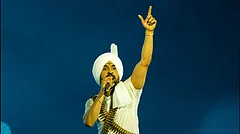

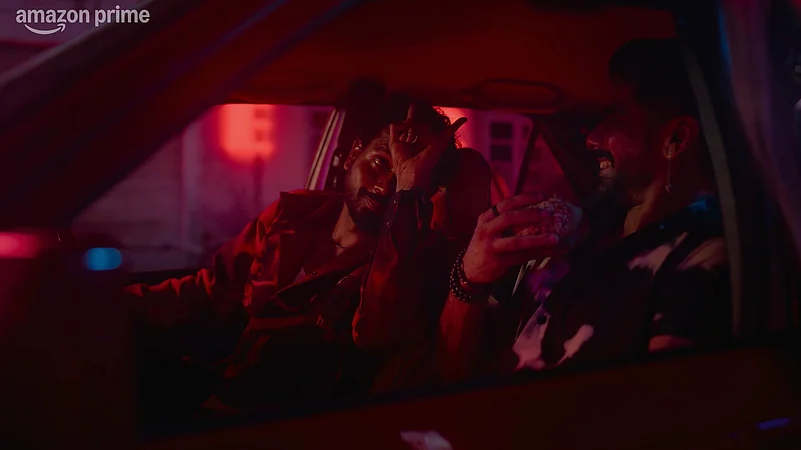
Right from the very first sequence of the first episode, which is set on a hockey field where Lucky is playing, you get a sense that the series wants to amplify the energy through kinetic camera movements. This is particularly true with action sequences in this episode and largely true for the others as well, with pacey editing akin to a music video or a film trailer. There is a flair to this editing by Dev Rao Jadhav that captures your attention at first. However, it quickly becomes exhausting. It also doesn’t help that the first episode covers a whole lot of story beats, ending in Lucky and Sanober falling in love. This relationship is too underdeveloped in the first episode to be bought as something profound. Nevertheless, things get much better from the second episode onwards, where each of the central characters get more breathing room and more time to sit with their actions and choices.
These pauses propel the show as a character-driven drama, which helps because the plot is fairly predictable for large stretches. One would also expect the music to be integral to the proceedings, but the show mostly treats rap as a cosmetic setting. There is one brutal rap battle in the series that shows some spark, but apart from that the music is mostly used as the background for the main story about the gang moonlighting as drug makers. Apart from some perfunctory nods to MC Badnaam’s story as a child, the series isn’t really interested in presenting a commentary on the complex social situation in Punjab and its relation to the drug scene.
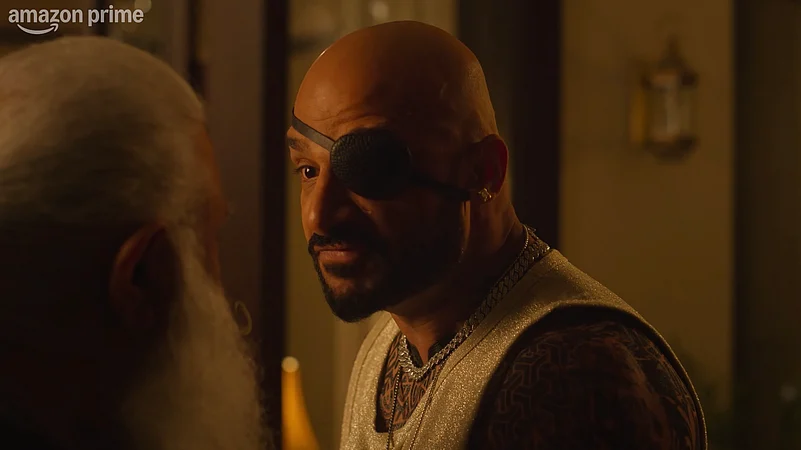
Most of the cast delivers potent performances, elevating their character types. Lakshvir Saran’s Lucky, whose character could have been a bland audience surrogate, brings a quiet vulnerability to the role, which is precisely the kind of anchoring this show needed to be interesting. He often lends this vulnerability to other characters around him. His performance becomes a lens through which the other men in the show are filtered. Lukkhe benefits a great deal from having Lucky as the protagonist because it reveals the show’s heart as one about the power of softness in the midst of all the violence. The women, too, are centred in the story—Gurbaani, Sanno and Paddy all have their moments to shine; so does Ayesha Raza Mishra as Bhabhi, a playful female rural don with an army of women. It is easy for such shows to devolve into the very thing that they are supposedly critiquing, but this one knows how to treat its women. Other than Lucky, most of the men in the show fall at different points on the other side of the moral divide, with rapper King, in his acting debut, getting the flashier role of the mercurial rapper with a penchant for violence.
As the moral foils for Lucky, MC Badnaam and Jazz are layered characters that have their own journeys within the show. The same cannot be said for the villains, OG (Shivankit Singh Parihar) and Yograj Singh as his uncle, who try to do as much as they can with the material they have, but are mostly one-note. It also doesn’t help that Yograj Singh’s dialogue delivery tends to the grunt of a native Punjabi speaker, while the other actors are mostly trying to adapt. A real surprise in the show is the guns-for-hire duo Sutti and Butti from Uttar Pradesh, with Pitobash’s Sutti, in particular, stealing the show in episode three (the best episode by far) as a wacky character that belongs in a Vishal Bhardwaj film.

For a show that aims for a heavily stylised visual palette (I was reminded of Bejoy Nambiar more than once), it is mostly the colourful cast of characters that gives Lukkhe its most memorable moments. There is perhaps some food for thought there. When the show is imagined not as a Fast and Furious film set in the Punjabi rap scene with a neon obsession, but as one which examines the specific toll of masculinity front and centre, it delivers. For example, a rape attempt in the series, which drives a lot of major character motivations, is given surprisingly tender treatment, so much so, that the show can be read almost entirely as a study of the masculine response to sexual assault. The problem is that there is so much additional noise around this central idea that the series has to keep searching for its own voice all the time. That doesn’t mean the noise isn’t watchable, but it is often derivative. Lukkhe, therefore, is not so much the same cocktail in a different glass, but the same ingredients with a different mixer, like one of those neon-coloured drinks that sell at molecular gastronomy bars.
















