Bait (2026) is a British television series created by and starring Riz Ahmed. It centres on a struggling actor navigating auditions for a career-defining opportunity: the role of the next James Bond.
The ensemble cast includes Guz Khan, Aasiya Shah, Sheeba Chaddha, Soni Razdan, Sajid Hasan, Ritu Arya and Weruche Opia among others.
The series premiered at the Sundance Film Festival 2026 and released on 25 March 2026 on Amazon Prime Video.
At a time when public figures face professional risk for speaking on Gaza, Iran or Sudan, a pressing question emerges: doesn’t greater visibility also mean greater power? The artists who speak up are facing exclusion from work opportunities for expressing solidarity with those affected by targeted wars. Others remain compliant—not entirely apolitical but carefully depoliticised, with their PR-rehearsed statements gesturing toward universal peace. Brown celebrities in this context become interesting figures—expected to be vocal and politically correct, while also facing the repercussions that accompany speaking out. Yet, visibility carries its own force, quickly shaping audience’s opinions in an economy where attention is the sole currency.
Within this context, Riz Ahmed’s Bait (2026) offers a compelling inquiry into the fraught relationship between politics and the Brown identity in the contemporary global context. The six-episode series is created and co-written by Ahmed and directed by Bassam Tariq and Tom George. Through performance and a keen awareness of performativeness itself, Bait gloriously revels in how Brown celebrities are presented and often dissected under public scrutiny. The series grants its characters grace for their missteps, depicting a flawed British-Pakistani family confronting internalised desi toxicity while still retaining a sense of dignity.

Meet Shahjehan “Shah Latif” (Riz Ahmed)—a rapper-turned-actor who wants to live up to a certain image he’s built up. As an up and coming artist, he’s charismatic, but plagued by an overthinking problem piggybacking on his imposter syndrome. When the opportunity of a lifetime strikes, he’s given an audition to be the next James Bond—that’s right, the first “Brown” James Bond. The synopsis of this series is an eye-catcher in itself: the summit is so ridiculously high up that even Shah’s father Parvez (Shajid Hasan) blurts out “Daniel Craig marr gaya kya saala?” (Did Daniel Craig die, or what?)



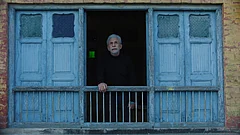

Upon the news quickly spreading like wildfire through paparazzi shots, some racist trolls throw a pig’s head through his parents’ window, threatening him to not play the next Bond. Felicia (Weruche Opia) is Shah’s agent, faithfully guiding him through the spectacle that becomes of fame. She temperamentally almost reminds one of Aasmaan’s (Lakshya Lalwani) manager Sanya (Anya Singh) in Ba***ds Of Bollywood (2025).
Shah appears willing to draw on his heritage for advancement, yet he does not stand as a representative of his community, nor has he confronted the internalised prejudice shaped by earlier experiences of bullying. His ex Yasmin (Ritu Arya) even charges him with conveniently accommodating himself within a neo-colonial framework and repackaging it for diasporic consumers, writing in a published opinion piece: “Shah is swapping out political art for vanilla distraction.”
The story spans four days, opening with Shah’s botched audition and closing on an unexpected callback driven by media attention. This is also happening during Ramadan as his family gears up for Eid al-Fitr. This brief stretch becomes a period of reckoning, pushing Shah to re-evaluate his ambitions and his identity. He weighs the prospect of playing James Bond against his experience as a Pakistani man in London.
His mother Tahira (Sheeba Chadha) is the quintessential aunty-next-door who finds herself in competition with neighbour Nalia (Soni Razdan) and her Dubai-return son Salim (Nabhaan Rizwan). Much of her sense of contentment depends largely on occupying the superior position: hosting more impressive Eid gatherings, raising a more accomplished son and above all, consistently preserving a steady emotional climate within her home.
The show’s reach expands further with the introduction of the Latif family’s history of mental illness, which sits in tension with Shah’s rising belief that the inevitable is closeby, as his struggles worsen. Amid his father’s affectionate yet teasing character and his mother’s familiar smothering archetype, he seeks solace in both cousins Q (Aasiya Shah) and Zulfi (Guz Khan). Ahmad commands attention as a character, moving between on-camera and off-camera spaces while grappling with fear, prejudice and the limits he has internalised. There is a clear tension in how he moves through a kind of constant performativeness that never quite leaves him, even when he opens up about his deepest feelings to Yasmin.

He lives in that strange in-between where being a British-Pakistani actor comes with an unspoken duty to represent “his people,” whether back home or those living in the UK. He is himself quick to agree with that idea, but also realises the costs that come with it. The whole notion of “being a hero” for his people feels slightly absurd to him, especially in a climate wherein Brown celebrities speak of their own marginalisation internationally, yet seldom engage with the broader issues facing the people they are presumed to represent (yes, that was a side glance, Priyanka Chopra).
In a hilarious scene, a passerby on the street stops him thinking he is Dev Patel. On one hand, it is a sign that Indian actors have carved out recognisable space. On the other, it shows how easily that space shrinks. Too often, one familiar face becomes the template, leaving little room for other Brown actors to exist as anything but a variation of the same idea.
Bond stands as a potent emblem of intellect, refinement and capitalist spectacle—one that sells watches, cars, fragrances and more. Within Shah’s constructed reality, this composed figure in a tailored suit emerges as a projection of the self that now pursues him. Beyond the glamour, action and tragedy, Bond also charts a man’s inner odyssey. It becomes a quiet negotiation with mortality and a destiny that feels almost predetermined. Ahmed’s shaky conviction—held together by resilient spirit—places him among the most striking presences in the contemporary scene.
The supporting cast leaves a strong impression, particularly Hasan and Chadha. Razdan appears briefly as Shah’s imperious aunt. Guz, as Zulfi, is a standout, playing an enterprising striver trying to make his mark with his “Muslim Uber” venture. The series thoughtfully examines mental health, digital culture and the often unseen burden of public visibility. At its core, it traces an individual’s effort to reckon with personal conflict between who they are and who they want to be. Here, that inner critic takes an unusual form, embodied in a stubborn old pig’s head (literally).

At its strangest, the series veers into the absurd. Ahmed leans in with confidence, sparing no one, least of all himself. What lingers is the unhinged nature of his fevered inner dialogues—rehearsing lines, sparring with a ruthless self-critic (with a Patrick Stewart voice) or drifting through imagined fears that feel uncomfortably real. The show adopts a more playful structure, using well-chosen tracks by South Asian artists to sharpen its rhythm and amplify its mood.
Despite the series occasionally neglecting deeper exploration of certain family members, particularly Parvez and Tahira, it retains a strong sense of sincerity. Stereotypes surrounding the diaspora are present yet are also directed toward perspectives that remain unseen or insufficiently empathised with. The experimentation with visual form, handheld camerawork and character journey is executed with precision and offers something for a wide audience to appreciate its madness. Overall, Bait emerges as an incisive portrait of the entertainment industry, standing among the year’s most vibrant and sharply funny series.