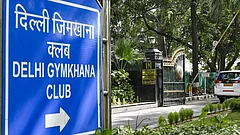
The Centre has initiated proceedings to reclaim the Delhi Gymkhana Club’s 27.3-acre Safdarjung Road property, citing defence, security and public-interest requirements.
It had directed the club to vacate the premises by June 5.
Founded in 1913, the Delhi Gymkhana Club is among India’s most exclusive institutions.
Delhi’s exclusive Gymkhana Club is facing a fresh set of issues after the Land and Development Office, functioning under the Ministry of Housing and Urban Affairs, issued a notice on Friday to the club’s secretary initiating proceedings for the “re-entry and resumption” of its premises at 2, Safdarjung Road.
A member of the Delhi Gymkhana Club on Monday moved the Delhi High Court challenging the Centre’s order concerning the club’s premises.
The Centre on Tuesday assured the Delhi High Court that it would not forcibly take possession of the Delhi Gymkhana Club premises and would follow all legal procedures before initiating any eviction process.
During the hearing, the government told the court, "It is not that Police will move in on June 5 and take possession of land. We will do it as per proper procedure."
The High Court was hearing two separate suits, one filed by Vijay Khurana, a long-time member of the club, and another by the Staff Welfare Association of the Delhi Gymkhana Club. Both petitions challenged the Centre’s May 22 order directing the club to vacate its 27.3-acre property in Lutyens’ Delhi by June 5.

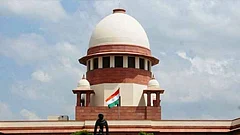
Justice Avneesh Jhingan declined to grant any interim relief against the government’s order after taking note of the Centre’s submission that no coercive action would be taken without prior notice and due process.
In its order, the court observed: "The issue is premature and presumptive. As on date, there is nothing on record to substantiate that action under Public Premises (Eviction of Unauthorised Occupants) Act has been taken and in case the need so arises, the plaintiffs can avail remedies in accordance with law."
The court further noted: "In view of the statements made by the SG, no further interim directions are called for. The statement is to the effect that the eviction, if so, will be done following a prior notice. At the cost of repetition, the apprehension that the club governing body may hand over the possession of the club is contrary to the stand taken by the club," Bar and Bench reported.
The observations came after concerns were raised that the club management could surrender possession of the property before legal remedies were exhausted. The court, however, held that such fears were not supported by the club’s stated position and that any future action by the government would remain subject to the applicable legal framework.

Notice to Gymkhana Club:
Centre’s notice invokes Clause 4 of the club’s lease agreement, which empowers the government to reclaim the property if the land, or any portion of it, is required for a public purpose.
If enforced, the provision would allow the Centre to take back possession of the iconic property from the club. The notice states that the 27.3-acre club should be vacated by 5 June.
The latest development comes after years of turbulence for the institution. In February 2021, the National Company Law Tribunal (NCLT) ordered the suspension of the club’s elected managing committee following allegations of financial irregularities and mismanagement of membership admissions, triggering a prolonged period of administrative upheaval and legal scrutiny, The Indian Express reported.
According to a report by Mint, the Centre justified its move by stating that the land occupied by the Delhi Gymkhana Club, located close to the Prime Minister’s residence and other high-security establishments, was "critically required for the strengthening and securing of defence infrastructure and other vital public security purposes."
The government’s notice to the club further said the land was needed to meet "urgent institutional needs, governance infrastructure, and public interest projects, integrated with the resumption of adjoining government lands."
The notice also made clear the implications of any re-entry order. It stated that upon re-entry, "the entire plot of land measuring 27.3 acres, along with all buildings, standing erections, structures, lawns, and fittings thereon, shall vest absolutely in the Lessor, i.e., the President of India, through the Land and Development Office."

Club’s History:
The Delhi Gymkhana Club, one of India’s oldest and most prestigious social institutions, traces its origins to July 3, 1913, when it was established as the Imperial Delhi Gymkhana Club. Spencer Harcourt Butler served as its first president. Following India’s independence in 1947, the word “Imperial” was dropped and the institution became known simply as the Delhi Gymkhana Club.
The club’s present building at Safdarjung Road was constructed in the early 1930s. The project was designed by renowned British architect Robert Tor Russell, whose other notable works in New Delhi include Connaught Place and the Commander-in-Chief’s residence, later known as Teen Murti House, the official residence of India’s first Prime Minister, Jawaharlal Nehru.
In its formative years, the Polo Club functioned as part of the Gymkhana before becoming a separate entity in the 1930s and relocating to New Delhi. Much of the club’s early history remains sparsely documented, with more systematic records only beginning to emerge after 1927. Despite these gaps, the Delhi Gymkhana Club has remained a prominent fixture of the capital’s social and cultural landscape for more than a century.
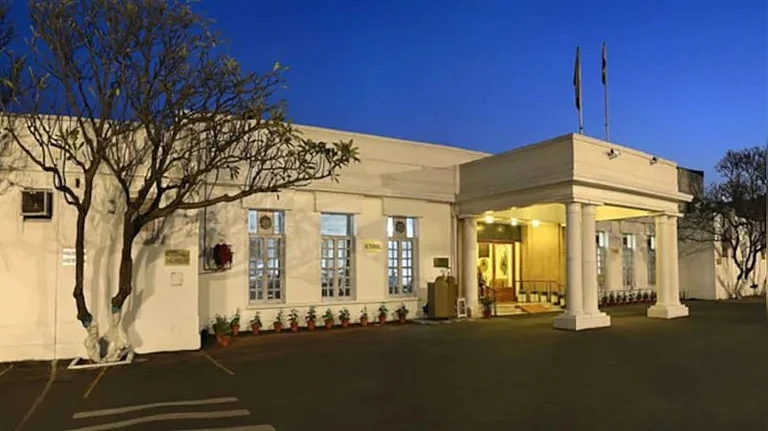
The Exclusive Club:
The Delhi Gymkhana Club’s membership has traditionally been dominated by senior bureaucrats, diplomats, police officers and military personnel, with many of its roughly 5,000 permanent members drawn from the upper ranks of the Indian Administrative Service (IAS), Indian Foreign Service (IFS), Indian Police Service (IPS) and the armed forces. The club also extends life and corporate memberships to distinguished figures from the legal, diplomatic and corporate sectors.
Among its best-known contemporary members is Congress leader and Member of Parliament Rahul Gandhi, whose admission to the club in 2006 attracted considerable public attention. Senior Advocate and Congress MP Abhishek Manu Singhvi, who has represented club members in the ongoing proceedings before the Delhi High Court, is also counted among its prominent members.
Beyond its permanent membership base, the institution serves a much larger community. The club is estimated to have around 14,000 members and users and employs more than 500 staff. Membership remains highly sought after, with waiting periods reportedly stretching up to a decade for prospective applicants.