






In a state where coalition negotiations usually drag on through sleepless nights, bruising egos, and endless rounds of black tea, the Congress-led United Democratic Front (UDF) managed the impossible.
The central stadium in Thiruvananthapuram was a sea of white and tri-colour flags, buzzing with an energy that the city hadn’t felt in a decade.
The division of power also highlights the internal power dynamics of the coalition.
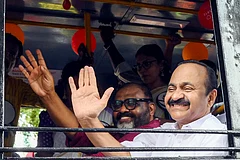
The central stadium in Thiruvananthapuram was a sea of white and tri-colour flags, buzzing with an energy that the city hadn’t felt in a decade. After ten long years in the political wilderness, the Congress-led United Democratic Front (UDF) was returning to power. For the thousands of grassroots workers who had travelled from the northern reaches of Malabar and the coastal villages of the south, this wasn't just a political transition—it was an emotional homecoming. The air, heavy with humidity, carried the deafening roar of slogans and the unmistakable scent of victory.
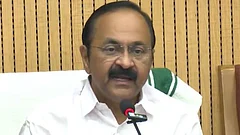
Inside the Cantonment House, the atmosphere carried the frantic energy of a newsroom operating on a hard deadline. VD Satheesan, Kerala’s newly designated Chief Minister, stood before a microphone, looking notably relaxed for a man who had just spent the last 24 hours pulling off a political Rubik's cube. In a state where coalition negotiations usually drag on through sleepless nights, bruising egos, and endless rounds of black tea, the Congress-led United Democratic Front (UDF) managed the impossible: finalizing a 21-member cabinet in less than a day. "This is the fastest in the history of Kerala," Satheesan told reporters, a hint of hard-earned pride in his voice. "Even after the election, Team UDF remains Team UDF. Our leaders respect each other."


Yet, behind the smooth talk of camaraderie lies the ruthless arithmetic of regional and social engineering. Striking a perfect balance in a state as socially complex as Kerala is no small feat. With 63 elected legislators, each carrying their own aspirations and regional backings, Satheesan had to make some heartbreaking omissions. The final blueprint submitted to Governor Rajendra Arlekar reflects a delicate tapestry. While veterans like Ramesh Chennithala, K Muraleedharan, and PK Kunhalikuty bring seasoned gravitas to the high table, the inclusion of three women—including a female Deputy Speaker—and two representatives from Scheduled Communities signals a conscious, modern pivot for the alliance.

The division of power also highlights the internal power dynamics of the coalition. The Congress party holds the lion's share with 11 cabinet berths, while its steadfast ally, the Indian Union Muslim League (IUML), secured five. The remaining spots have been carefully distributed among smaller coalition partners: two for the Kerala Congress, and one each for the Revolutionary Socialist Party (RSP) and the Communist Marxist Party (CMP). It is a cabinet built not just to govern, but to heal the regional and community fractures that naturally surface after a high-stakes election.
As twilight fell over Thiruvananthapuram, the Central Stadium was being transformed for a spectacular political gathering. The guest list reads like a who’s who of national politics. Congress heavyweights Mallikarjun Kharge, Rahul Gandhi, and Priyanka Gandhi are arriving to bless the new administration, flanked by a powerful contingent of southern Chief Ministers, including Karnataka's Siddaramaiah and Telangana's Revanth Reddy. In a characteristically graceful display of Kerala's democratic maturity, former Chief Minister and outgoing Leader of the Opposition Pinarayi Vijayan will also be in attendance, alongside BJP State President Rajeev Chandrasekhar. For Satheesan and his team, the celebration will be brief; the real test begins the moment the applause dies down and the challenges of governance take centre stage.
















