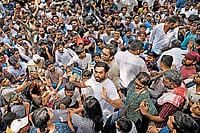
The Cockroach Janta Party deliberately avoided a political model. No political heavyweight shared Abhiheet Dipke’s stage the way Opposition leaders once flanked Anna Hazare in the India Against Corruption movement of 2011.
Nearly everyone seemed to be recording someone else, phones angled for a reel rather than a record, each YouTuber and Insta influencer hoping to capture the ten-second clip that might travel furthest
Displaying restraint, the police did not resort to baton-charge or mass arrest as most observers at the site had expected
The Anna Hazare protests of 2011 turned Ramlila Maidan into a small city of tricolour flags and "I am Anna" caps. Part of what gave the India Against Corruption movement its popularity and scale was the spectacle on the stage. Opposition leaders, retired bureaucrats, godmen and civil society veterans of every hue sharing space, lent the agitation a credibility that made it easy for crowds to read as something larger than one man's hunger strike.
The Cockroach Janta Party protest at Jantar Mantar of June 2026 has deliberately avoided a political model. Founder Abhijeet Dipke has insisted from the outset that the CJP is not aligned with any party. No political heavyweight has shared his stage the way Opposition leaders once flanked Hazare. What it has achieved instead is a following built almost entirely online and along with it the option to grow on its own terms.
The CJP, a political-satirical outfit, has been demanding the resignation of Education Minister Dharmendra Pradhan over irregularities and paper leak allegations linked to the National Eligibility-cum-Entrance Test (NEET)-UG conducted on May 3.


Dissent, the Gen Z way
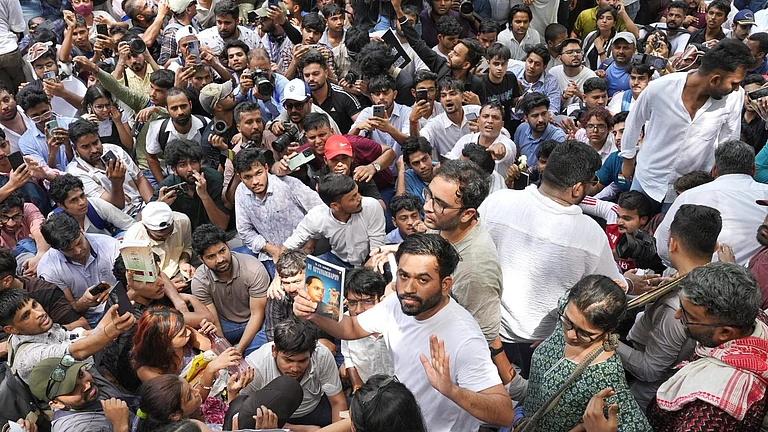
On Saturday, June 20, the CJP staged its second major protest at Jantar Mantar in New Delhi. At its core, it was a Gen Z protest. Young demonstrators handed flowers to police officers at the barricades instead of shouting at them. A transgender protester who had faced online abuse after the first protest returned, and was welcomed with an embrace. Caste and religious lines blurred seamlessly, with elderly Hindus, Muslim students and Dalit rights activists standing shoulder to shoulder for peaceful dissent. It was a protest in which memes flowed as fluently as irony.
By Saturday night, people were settling in for the long haul, and organisers kept appealing online through the dark hours for more supporters to join, vowing the sit-in would continue until Pradhan resigned. Founder Dipke was urging NEET re-exam aspirants to come straight from their examination centres, while appealing to the police to let more people reach the site and to restore water to the public restrooms.


A tale of two protests
Jantar Mantar was clearly not the same gathering it had been two weeks ago.
On June 6, the first time the CJP had taken this stretch of road, it had felt improvised. This time, there was a stage, properly rigged with speakers and a backdrop. There were volunteers and bouncers in badges weaving through the crowd. Whatever this movement was becoming, it had clearly decided it wanted to look like something more permanent than a meme.
That impulse to look “real” matters, because the CJP’s numbers have always lived mostly online, said a protester. It crossed a lakh sign-ups within three days of launching in May, and its Instagram following soon overtook the official handle of the BJP itself, a striking statistic for a “movement” barely weeks old.
But turning followers into people willing to stand behind barricades in Delhi’s June heat is another matter. This turnout, like the first protest’s, did not fully reflect the CJP’s vast social media following.
The protest was set to begin at 1 pm, and the crowd built steadily through the punishing afternoon heat, the kind that empties streets and turns standing still into an endurance test. And yet they kept coming until the road in front of the stage was a mass of people squinting into the sun.
What struck was how different the crowd looked from the first protest. Then, it had been a young, restless gathering of students, twenty-somethings and the terminally plugged-in. This time, there were elderly people in noticeable numbers, and even some parents, mothers and fathers in sensible sandals and dupattas pulled over their heads against the sun. An elderly man fanned himself with a folded newspaper while his daughter adjusted a placard beside him, adding another layer to a predominantly young crowd.
The Influencers in action
If there was one unmistakable feature of this protest, it was the creator economy in action. YouTubers and content creators were everywhere, weaving through the crowd with phones and tripods, livestreaming speeches and narrating events to their own audiences in real time. Nearly everyone seemed to be recording someone else, phones angled for a reel rather than a record, each hoping to capture the ten-second clip that might travel furthest. India’s influencer ecosystem is one of the fastest-growing globally, fuelled by more than 900 million internet users. Whether the CJP convert its online popularity into on-ground support is yet to be seen.
Curiously, mainstream television was largely absent, even as the creators documented the protest from every angle. TV crews were few and far between. Several protesters said they believed the movement was not receiving the attention it deserved from news channels.

Rebels need a cause and funding...
Sustaining a sit-in like this, night after night, costs money that nobody at the protest could clearly account for. Past movements at this scale survived as long as they did partly because someone, somewhere, was paying for the food, the tents, the water tankers, the loudspeakers. Whether the CJP has the funds to keep that going for weeks together remains an open question.
Volunteers moved through the crowd distributing water bottles and bananas. Among them was a Delhi University professor recognisable from the first protest on June 6, who had shown up again with bottles of water and packets of biscuits, quietly handing them to protesters who had been standing for hours.
Ashwameet Gautam, a 14-year-old student and political content creator from Lucknow who has built a following speaking on caste and related issues, was part of the protest. Gautam held a copy of Jyotirao Phule’s Gulamgiri, a nineteenth-century text on caste and emancipation. “I want to tell NEET students, you just study, we are here for you,” he said. “Unless we don’t protest, how will things change for better?” he asked. For him, and for many in that crowd, this had stopped being about just one minister or one exam.
That ambiguity sits at the heart of CJP’s challenge: is this a protest about NEET, about institutional corruption, about one minister’s resignation, or, as some opposition voices have quietly suggested, a proxy fight against the ruling BJP's brand of politics? Rather than answer it directly, Dipke has at times turned that question back on the audience. “Has Hindu-Muslim politics helped you?” he asked the crowd at one point, going on to argue that communal politics had done nothing to stop paper leaks.
The 2019 anti-CAA sit-ins, the years-long farm-law protests, the outrage cycles after Hathras and protests in the wake of countless paper leaks before this one, all drew large crowds at their peak. However, most of them eventually lost momentum without denting the BJP’s popularity with the electorate. Whether the CJP becomes an exception or simply the latest entry on that list is the real subtext of every chant at Jantar Mantar.
Before founding the CJP, Dipke was part of Aam Aadmi Party’s social media team. Dipke has publicly insisted CJP will not align with any political party. Whether that holds is a question this movement will keep being asked long after Jantar Mantar empties out.
Sonam Wangchuk needed no introduction to most of the crowd. Less than a year earlier, he had been detained without trial under the National Security Act after a hunger strike he led in Leh over Ladakh's demand for statehood and Sixth Schedule protections.
He opened his remarks at Jantar Mantar not with politics but with grief, laying flowers before photographs of examination aspirants who had died by suicide, before turning to the crowd. “Simply banging plates will not solve anything,” he told them, before the Ramcharitmanas was being quoted on the stage, about keeping one’s word even at the cost of one’s life.
Wangchuk used the stage to set a deadline for an indefinite hunger strike beginning June 27, if the government continued to refuse accountability for what he called the failures of the education system.
Humane policing, or smart strategy?
Permission for the protest had been granted till 5 pm. As that deadline approached, Dipke declared that the movement was prepared for a jail bharo andolan, courting arrest rather than dispersing. The police directed Dipke to vacate the site immediately, stating that the continuing protest breached the conditions of the permission granted and the framework laid down by the Supreme Court's 2018 ruling on demonstrations permitted at Jantar Mantar.
As evening fell, the crowd thinned, but the police presence only grew. Cameras stayed on the site throughout. Rather than moving in, the police officers relied on repeated public-address announcements declaring the gathering unlawful once the deadline passed.
Many saw it as a calibrated response, meant to put the illegality on record without escalating to lathi-charge or mass arrest that most observers at the site had expected. A baton charge or a mass arrest would have handed CJP's youth uprising claim an overnight boost.
The CJP alleged that they were denied access to drinking water after the 5 pm deadline and that the lights around the site were briefly disconnected.
Dipke appealed into the microphones for the lights to be switched back on. But the crowd's response was not of outrage. They began chanting: "Delhi Police, paani do" (Delhi Police, give us water). And once the supply of water bottles and electricity was restored, the same crowd switched, almost gleefully, to chanting: "We love you Delhi Police."
As night fell, the crowd showed no sign of dispersing. People were rolling out dupattas and shawls directly onto the road for the night ahead.
At a chai tapri near the site, the conversation turned to a couplet painted on one of the hand-painted hoardings by the barricades: har shaakh pe ullu baitha hai, anjaam-e-gulistan kya hoga… And to a harder question: how long can protests like these actually run on sheer willpower and water bottles alone? Someone brought up the farmers’ protest at Delhi’s borders, which stretched past a year before it got what it wanted.
As the protest enters its third day, it remains, for now, an indefinite sit-in, with organisers asking for an alternative site to continue the agitation.