Muslim women have faced targeted threats, from bulldozer demolitions to digital abuse, challenging older Left frameworks rooted in universalist approaches.
Despite fear and structural inequalities, women are asserting their rights, forming support networks, and navigating legal, social, and digital spaces.
The Left is recalibrating to engage with minority-specific challenges and support women’s agency in today’s hostile environment.
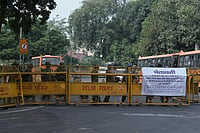
When bulldozers arrived in Jahangirpuri in April 2022, the police expected fear, not resistance. But before the JCB could advance deeper into the narrow lane, Rokiya, who was selling vegetables near the mosque, stepped forward. She told officers they could arrest her if they wished, but asked: “If homes were demolished, what would families eat?” Her defiance echoed down the street. Neighbours who had been silently watching gathered behind her. Someone shouted at the police to stop. Another began filming. What began as an arbitrary demolition became a protest led by a woman who had never attended any political meeting.
Across India, often undocumented moments like these have defined the political life of Muslim women over the past decade. Citizenship anxieties under the Citizenship Amendment Act/National Register of Citizens (CAA/NRC) created fears that went beyond documents, threatening histories and homes. Hijab bans in Karnataka forced students to choose between exams and identity. Digital mobs commodified Muslim women online. Bulldozer demolitions reduced kitchens, schoolbags, and certificates to rubble.
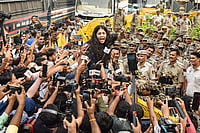
Shaheen Bagh became a national turning point, a moment when women long stereotyped as “burqa-clad and voiceless” refused to be erased. From the elderly dadi whose image travelled the world to the Jamia student who recalls her mother saying, “Jao, agar zaroori hai (go if you must)”, women refused to relinquish space in the face of tear gas, detentions, and suspicion.


Long before Jahangirpuri, Lucknow’s Ghantaghar had witnessed a different kind of vigil. Through nights that cut through bone, women arrived in layers of woollens and niqabs. Balancing toddlers on their hips. Carrying flasks of tea, they spread mats on the cold stone and waited. One woman, who had barely spoken publicly before, described the vigil as a kind of roza: “We are fasting for justice. For our children’s future. For our souls.” The vigil felt less like a demonstration than a spiritual act of devotion. Most of these women had never read a manifesto or attended a march before. But they arrived with a clarity that startled seasoned organisers. The state might control documents and police stations, but it could not control their farz. Their duty to speak.
The Left’s engagement with Muslim women, for decades, was shaped by the Shah Bano era. It was when personal law, secularism, and communalism defined the political terrain. But far beyond the earlier frame of family law, Muslim women today are compelled to confront issues of citizenship, surveillance, and bulldozer violence. So, how is the post–Shaheen Bagh surge in Muslim women’s agency, amid new vulnerabilities, reshaping the Left’s old frameworks?
Mariam Dhawale, national general secretary of All India Democratic Women’s Association (AIDWA), captures the breadth of the challenge. “The landscape facing Muslim women today is shaped by everyday hate, police bias, housing discrimination, surveillance, and the lingering effects of triple talaq and CAA/NRC. We take up these issues daily. Discrimination at ration shops, police stations, hospitals, even during childbirth, when Muslim women are questioned about why they have so many children.” She adds: “Women are pushed back into fundamentalist structures, even as the government presents itself as their saviour while simultaneously diluting laws meant for their protection.”
The triple talaq debate revealed this double bind starkly when women supported reform, but not the way the state imposed it. “We did not ask for our husbands to be jailed,” a legal activist explained. “We asked for maintenance, for dignity, for a life we could stand on. Jail does not give that.”
Sehba Farooqui, vice president of Janwadi Mahila Committee, situates this struggle in historical perspective. She recalls that communist women after Independence understood freedom as more than the British leaving. It meant reshaping systems of control and tackling labour, farm, and women-specific issues alike. “We always said women are one class, violence is violence, patriarchy is patriarchy. But the communalisation of society has changed the ground realities for Muslim women in ways older frameworks didn’t fully anticipate,” she reflects. Farooqui stresses that contemporary gender justice must confront communal hate directly: “We have to think of gender justice today not as an add-on, but as central.”
Founder of Anhad, activist Shabnam Hashmi elaborates, “Like every democratic institution, the space for the Left has also shrunk. Women experiencing domestic violence often cannot approach police stations without fear. They are judged, dismissed, or even treated as suspects before speaking. Applications for welfare are delayed, documentation is scrutinised, and routine complaints can trigger intrusive questions about family or madrasa affiliations.” Hashmi stresses the need for institutional support, legal access, and feminist work at the neighbourhood level, noting that in today’s political climate, funding for NGOs has dwindled, causing many grassroots organisations to shut down.
Activists suggest that older Left frameworks, grounded primarily in class and secular feminist ideals, must adapt to meet the intersectional pressures Muslim women now face. Through these years, Muslim women have developed a political language distinct from the secular frameworks the old Left grew up with. In Udupi, a hijab-wearing student walking to class during protests stated simply: “It is not Islam versus education. It is my right to both on my terms.”
Young Muslim women navigate digital and social landscapes with care, adopting pseudonyms online to evade screenshot-to-FIR, sharing contacts for lawyers, counsellors, and bail volunteers. Surveillance may thicken, but so do their networks. One Jamia student summed it up plainly: “Dar lagta hai, par koshish karni hogi.”
Political scientist Zoya Hasan captures the shift: “For decades, public conversations about Muslim women were narrowly confined to personal law and reform as though their lives began and ended with family disputes. What we’ve seen in the past few years is a complete transformation of that frame. Muslim women themselves have expanded the terrain. Their political engagement now spans citizenship, bureaucratic vulnerability, policing, digital abuse, education access, livelihood insecurity the full spectrum of what it means to live with dignity in a climate that increasingly marginalises them.”
Feminist and women’s organisations, in response, have begun paying greater attention to issues like education, health, and livelihoods. Muslim women are now recognised as a vital site of political mobilisation and feminist assertion, with the anti-CAA movement playing a pivotal role in reshaping how these organisations engage with their concerns, she notes.
These strategies reveal a new grammar of resistance. One that merges constitutional rights, feminist principles, and Islamic ethical frameworks. For decades, Left organisations assumed that defending secularism would automatically safeguard minorities. But in an India marked by bulldozer demolitions, FIRs for slogans, and hijab bans, secularism without attention to targeted vulnerability is hollow.
The Lucknow woman who described her vigil as a fast for justice, a roza, was not confused about politics. She had found a language deeper than any manifesto.