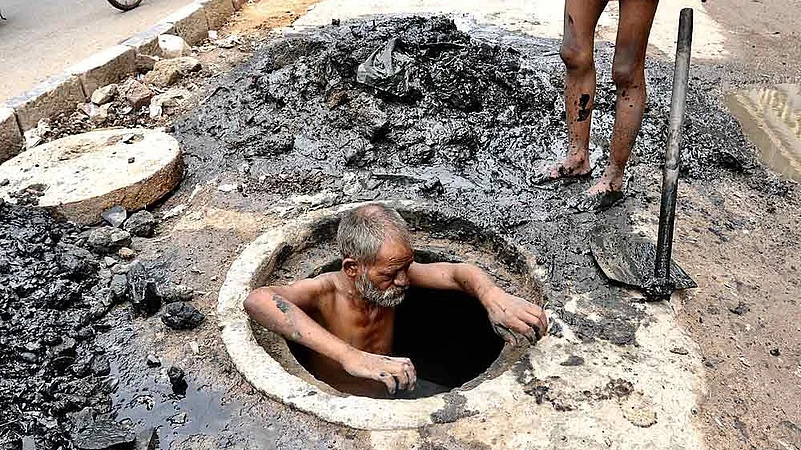
About 498 sanitation workers died during sewer and septic-tank cleaning, yet no deaths were officially classified as manual scavenging-related.
Legal bans remain ineffective as workers continue entering sewers without safety equipment, facing toxic gases, risks, and preventable deaths.
Poor accountability persists with incomplete compensation, weak enforcement, and delayed mechanisation leaving workers and families vulnerable.
Nearly 500 sanitation workers lost their lives while cleaning sewers and septic tanks across India over a period of seven-and-a-half years, yet none of these deaths has been officially classified as resulting from manual scavenging.
Government data presented in the Lok Sabha showed that 498 workers died during sewer and septic-tank cleaning between January 1, 2019, and June 30, 2026. The figures were shared by Minister of State for Social Justice and Empowerment Ramdas Athawale in a written reply to a question raised by Congress MP Rahul Gandhi.
The data added that 132 deaths were reported in 2019, followed by 34 in 2020, 62 in 2021 and 88 in 2022. The number of fatalities stood at 65 in 2023, 54 in 2024 and 47 in 2025. In the first six months of 2026, another 16 workers died, taking the total number of deaths to 498.
Despite these fatalities, the government maintained that “no death has been reported due to manual scavenging.”

The Difference In Classification
The gap between the number of deaths and their official classification lies in how the work is defined.


As per government’s definition, manual scavenging refers to the manual handling of human excreta from insanitary toilets, open drains, pits, railway tracks or other notified locations before the waste has fully decomposed.
Hazardous cleaning, on the other hand, refers to the manual cleaning of sewers or septic tanks without the required protective equipment, safety devices and prescribed precautions.
The 498 deaths have therefore been recorded as fatalities during hazardous sewer and septic-tank cleaning, rather than deaths caused by manual scavenging.
The government also stated that a nationwide survey conducted across all districts during 2024-25 did not identify any manual scavengers. Following the survey, all districts declared themselves free of manual scavenging.
However, this claim differs from earlier government surveys. The 2013 and 2018 surveys had identified 58,098 manual scavengers across 17 states.
Uttar Pradesh accounted for more than half of those identified, with 32,473 people recorded. Maharashtra reported 6,325 manual scavengers, Uttarakhand 4,988 and Assam 3,921.
A Dangerous Reality On The Ground
Manual scavenging remains banned under the Prohibition of Employment as Manual Scavengers and Their Rehabilitation Act, 2013.
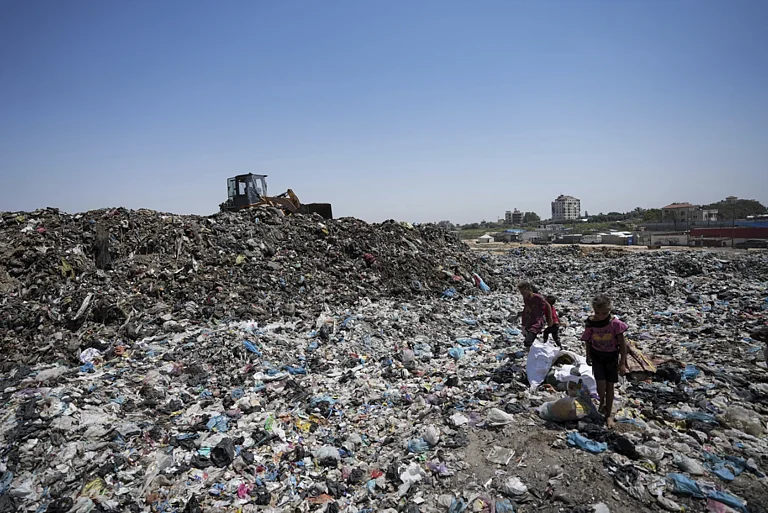
Yet workers continue to enter sewers and septic tanks, often without protective equipment, exposing themselves to toxic gases and unsafe conditions.
Earlier in April 2026, Outlook India reported that despite repeated claims of progress, little had changed for those working in sewers and septic tanks. Workers continued to die in preventable circumstances, while the practice remained widespread despite legal bans and government assurances.
In the first four months of 2026 alone, 52 people had lost their lives while cleaning sewers and septic tanks.
Bezwada Wilson wrote in a post on X: “Parliament will never have a special session to discuss and eradicate this barbaric, caste-based practice.”

'Should We Starve?'
For many workers, leaving the occupation is not a simple choice. Jaypal, now in his 50s, has spent more than three decades in the trade.
“Hum bhooke mare kya? (Should we starve?)” he asks.
“No one forced me into this, but there was no other option. I entered through friends and have done it for 30 to 35 years, never once being given gloves or safety equipment. Some days I earn ₹400–₹500, some days nothing, and there is no regular work,” he said.
He questioned what would happen to workers if the practice stopped without alternative employment.
“What can I do, and who will give me the chance to leave this profession? If this work stops, what would people like us do? We are not sitting at home; we need to survive. People talk about machines, but how will they work everywhere? And life is not valued for people like us. If I die, it is just another person’s death. If there were another option, who would choose this work? The government should give us other jobs,” he said.
Another worker said he continued to work without protective equipment.
“I am a dihadi (daily wage) worker. Sometimes I get work, sometimes I don’t,” he said. “Some days I earn around ₹1,500. If there is no work, I do other labour, plumbing, field work — whatever I can find.”
“I am an old man. If the government says it should be banned, then it should be,” he added.

Dr Renu Chhachhar earlier told Outlook India that while modern technology is used across many sectors, it is still not deployed for cleaning sewers and septic tanks.
“Everyone knows it is illegal, but it continues openly, largely because no serious action has been taken against those responsible,” she said.
She added that because of the stigma attached to the work, many workers do not tell their families what they do. Families often learn the truth only after a worker dies.
The government’s National Action for Mechanised Sanitation Ecosystem (NAMASTE) Scheme has profiled 89,915 sewer and septic-tank workers. The programme provides safety equipment, training, health insurance and financial support for mechanised sanitation machinery.
However, the government has not provided a deadline for completely mechanising sewer and septic-tank cleaning, nor has it announced a time-bound plan for identifying affected workers and rehabilitating them and their dependants.
Outsourcing And The Question Of Accountability
Amit Sahni, who filed a Public Interest Litigation in the Delhi High Court in 2019 seeking strict implementation of the Prohibition of Employment as Manual Scavengers and Their Rehabilitation Act, 2013, told Outlook India, practice continues because of poor enforcement, denial by authorities and failure to properly identify and rehabilitate workers.
“Manual scavenging may be legally banned under the Prohibition of Employment as Manual Scavengers and Their Rehabilitation Act, 2013, but it continues widely in cities like Delhi due to poor enforcement, denial by authorities to evade accountability, chronic underreporting, and the failure to identify and rehabilitate workers properly,” he said.
He said a major issue was the outsourcing of sanitation work without proper monitoring or accountability.
While authorities may not directly instruct contractors to employ manual scavengers, he said, they are aware that sewers and manholes continue to be cleaned manually and often ignore it as long as the work is completed.
“In most cases, responsibility is denied until a death brings attention,” he said.
“When a sewer worker dies, criminal liability is usually pushed onto the contractor or immediate supervisor, while government departments distance themselves by claiming no permission was given for manual entry.”
He argued that such a defence does not remove the responsibility of officials who are legally required to supervise work and prevent hazardous cleaning.
Compensation Gap
The government said compensation for sewer and septic-tank cleaning deaths was increased from ₹10 lakh to ₹30 lakh following a Supreme Court judgment in October 2023.
Of the 498 cases, 345 were placed in the full ₹10 lakh payment category and 75 in the full ₹30 lakh category.
Partial compensation was reported in 22 cases, while payment could not be confirmed in 56 cases.
This means that in 78 cases, the data either showed partial payment or did not confirm that compensation had been paid.
Payment could not be confirmed in 20 of the 47 deaths reported in 2025.
For 2026, full payment of ₹30 lakh was confirmed in six of the 16 cases reported until June 30. The status of compensation for the remaining 10 cases could not be confirmed.

Families Left Behind
Although the Supreme Court has directed compensation for sewer and septic-tank deaths, many families say they have received little support.
Raj Kumari said she lost her husband, Ajit, nearly 30 years ago in a sewer death.
“He was not even a sanitation worker; he was a plumber. Someone took him, saying he could earn money like others. He went in without gloves or safety gear. He never came back,” she said.
She said she received no compensation.
“I was left alone with three children. I had no choice but to start cleaning work and did it for nearly 20 years to raise them. Even today, nothing has come — no help, no recognition,” she said.

The Law Exists, But The Practice Continues
Amit Sahni said the Prohibition of Employment as Manual Scavengers and Their Rehabilitation Act, 2013, is clear on paper.
“Sections 5 and 8 expressly prohibit manual scavenging, including insanitary latrines and the employment of people for such work, with penalties for violations,” he said.
According to him, the problem is not the law itself but its enforcement. He said authorities often bypass the law by outsourcing hazardous cleaning, misclassifying sewer work as routine maintenance or citing urgency when no mechanised alternative is available.
“These are not loopholes in the statute, but methods of circumvention in the gap between law and enforcement,” he added.
He called for stronger legal action, personal criminal liability for negligent officers and contractors, mandatory FIRs under the 2013 Act, independent investigations into sewer deaths, time-bound surveys to identify and rehabilitate workers, annual social audits of local bodies and blacklisting of contractors involved in hazardous cleaning.
Bezwada Wilson, National Convener of Safai Karamchari Aandolan, told Outlook India earlier, the focus had shifted towards compensation and safety kits, while the real issue should be the complete abolition of the practice.
The law promises abolition, but the reality remains stark. Workers continue to enter sewers without protective gear, contractors continue to rely on manual labour instead of mechanisation, and authorities continue to deny, delay and deflect responsibility.