Every year, thousands of Indians die waiting for an organ that never arrives. Behind every transplant lie two families—one coping with an irreparable loss, the other clinging to hope for a second chance at life.
While India has made remarkable strides in expanding transplant services over the past decade, the shortage of deceased organ donors continues to remain one of the country's biggest public health challenges.
Against this backdrop, the Centre on Monday unveiled a series of reforms to strengthen the country's organ donation ecosystem, including the National Brain Stem Death Certification Guidelines and the National Guidelines on Swap Transplantation, aimed at standardising practices, improving transparency and making organ transplantation more accessible across the country.
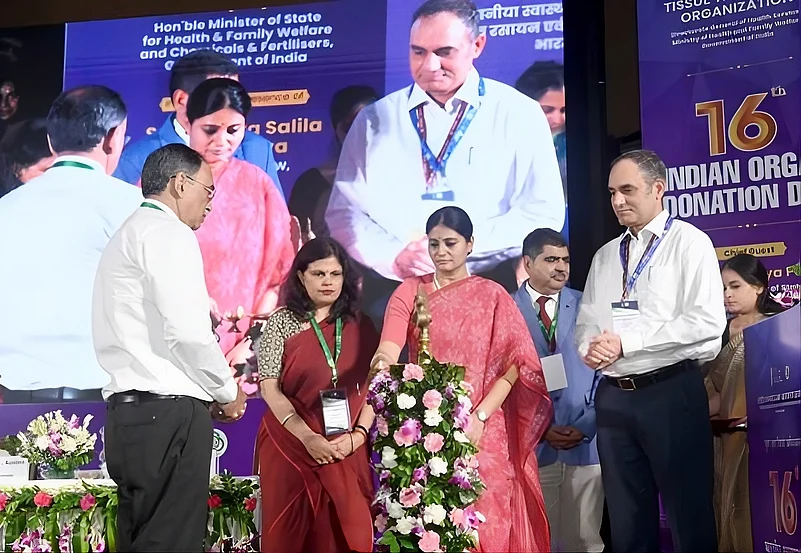
The initiatives were launched at an event on the occasion of the 16th Indian Organ Donation Day by Union Minister of State for Health and Family Welfare Anupriya Patel, who described organ donation as "the highest expression of compassion" and urged people to overcome misconceptions surrounding the practice.
The new guidelines are expected to address one of the most sensitive and critical aspects of deceased organ donation—brain-STEM-death certification. Experts have long maintained that delays or inconsistencies in certifying brain stem death often result in missed opportunities for organ retrieval, reducing the number of organs available for transplantation.
The National Brain Stem Death Certification Guidelines seek to bring uniformity in diagnosis and certification across hospitals, thereby strengthening public confidence in the process, while the National Guidelines on Swap Transplantation provide a standard framework for kidney swap transplants, where two incompatible donor-recipient pairs exchange donors to enable successful transplantation.



Such exchanges significantly improve transplant opportunities for patients who otherwise have no compatible living donor.
Launching the initiatives, Patel also unveiled the 'Jug Jug Jiyo Abhiyaan', a year-long nationwide awareness campaign that aims to take the message of organ donation to every village in the country.
The government simultaneously rolled out 'e-Pratyaropan', a unified digital platform integrating hospitals, transplant teams, donors and recipients into a single national network. The platform will digitise registration, waiting lists, organ allocation and monitoring, replacing fragmented systems with a transparent, technology-driven ecosystem.
A dedicated NOTTO mobile application was also launched to make organ donation-related services more accessible to citizens and healthcare professionals.
According to the NOTTO Annual Report 2025-26, the country performed 20,138 organ transplants in 2025, the highest number ever recorded in a single year. This represents a four-fold increase from 4,990 transplants in 2013 and a 6.5 per cent rise over 18,911 transplants performed in 2024.
India now ranks third globally, after the United States and China, in the total number of organ transplants while retaining the highest number of living donor transplants in the world.
Deceased donor transplants in India has increased from 837 in 2013 to 3,526 in 2025, reflecting growing public awareness as well as improvements in organ retrieval systems, yet, deceased donation still accounts for only a fraction of the country's transplant needs.
India's deceased organ donation rate remains below one donor per million population, far lower than rates reported in many developed countries.
Consequently, thousands of patients with liver, heart, lung and kidney failure continue to spend years on waiting lists.
According to the doctors, one deceased donor can save up to eight lives through organ transplantation while improving the quality of life of many others through tissue donation, including corneas, skin, bones and heart valves.
Recognising the continuing shortage, Patel said bridging the gap between organ demand and availability remains a national priority.
She noted that more than five lakh Aadhaar-verified organ donation pledges have been registered since the launch of the national digital pledge portal in 2023, attributing the rise to sustained awareness campaigns and the Prime Minister's repeated appeals encouraging citizens to pledge their organs.
However, she observed that myths surrounding organ donation continue to discourage many families from consenting after the death of a loved one.
"No major religion prohibits organ donation. Every faith upholds compassion, service and saving lives," she said, urging citizens to view organ donation as a humanitarian act.
The Minister highlighted that the Government has created an extensive institutional framework comprising NOTTO, five Regional Organ and Tissue Transplant Organisations (ROTTOs), 26 State Organ and Tissue Transplant Organisations (SOTTOs) and nearly 1,200 registered hospitals to strengthen transplantation services across the country.
Financial support is also being extended under the National Organ Transplant Programme for strengthening transplant infrastructure, organ retrieval and transportation.
She further noted that kidney transplantation has been included under the Ayushman Bharat-Pradhan Mantri Jan Arogya Yojana, while economically weaker patients receive assistance through the Rashtriya Arogya Nidhi. The expanding network of Jan Aushadhi Kendras is also helping improve access to affordable post-transplant medicines.
Health Secretary Punya Salila Srivastava said the newly launched digital platform, mobile application and national guidelines would simplify processes while improving coordination among hospitals.
She also highlighted the expansion of transplant services in newly established AIIMS institutions. Besides AIIMS New Delhi, 10 new AIIMS now perform kidney transplants, while AIIMS Jodhpur, Bhubaneswar, Patna and Rishikesh have begun liver transplantation and AIIMS Bhopal has started heart transplantation.
Director General of Health Services Dr. Loveneesh G. Krishna said, "The initiatives launched today will strengthen awareness, coordination and transparency across the organ donation ecosystem.”
The occasion also recognised the human stories that make transplantation possible.
Donor families from across the country were felicitated for their extraordinary decision to donate the organs of loved ones during moments of profound grief.
Awards were presented to states, hospitals and healthcare professionals for their contribution to organ transplantation. Tamil Nadu was recognised as the best-performing State for deceased organ donation, Assam received the award for the best-performing State in the North-East, Delhi was honoured as the best Union Territory, while PGIMER Chandigarh was named the best Regional Organ and Tissue Transplant Organisation in northern India.