Udhayanidhi Stalin’s arrest revived debate over Tamil Nadu’s political vendetta cycle.
Power shifts have repeatedly brought arrests, raids and cases against Opposition leaders.
Jayalalithaa, Karunanidhi and other leaders faced police action after regime changes.
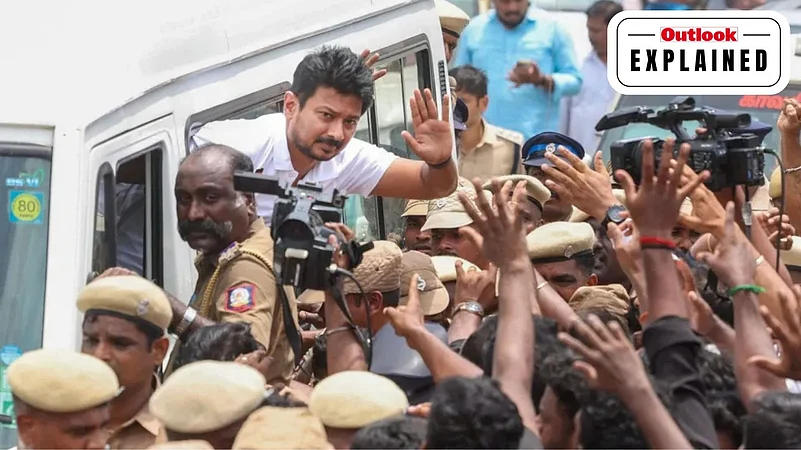
Tamil Nadu Leader of Opposition Udhayanidhi Stalin was arrested on August 4 over allegedly objectionable remarks made during a protest in Thanjavur. The Madras High Court later directed the police to release him after questioning and instructed him to cooperate with the investigation whenever required. The Tamil Nadu government told the court that it did not intend to seek his remand.
The DMK has described the action as political vendetta by Chief Minister C Joseph Vijay’s TVK government. The police action, however, followed a formal complaint and an FIR over Udhayanidhi’s alleged remarks. This distinction is important: the timing of an arrest may raise political questions, but it does not by itself establish that the underlying case is false.
The arrest of Udhayanidhi Stalin has revived the repetitive pattern of political arrest after the power shift in Tamil Nadu.
Why Regime Changes Often Produce Legal Action
For decades, Tamil Nadu politics was dominated by an intense rivalry between the DMK and the AIADMK. Each change of government transferred control of the state administration, police and vigilance machinery to a party that had spent the previous term accusing the incumbent of corruption, misuse of power or political violence.
Once elected, the new government would often reopen complaints or investigate decisions taken during the previous administration. The government would describe this as accountability, while the Opposition would call it revenge.




The cases were not always similar. Some involved allegations of corruption and disproportionate assets, others concerned land disputes, public protests, political speeches or clashes between party workers. Their legal outcomes also varied.

1996: Jayalalithaa Arrested After The DMK Returned
One of the most consequential episodes followed the DMK’s return to power in 1996 after defeating the Jayalalithaa-led AIADMK government.
Jayalalithaa was arrested on December 7, 1996, in connection with corruption allegations. The DMK government subsequently established three special courts to try 47 cases involving Jayalalithaa, former ministers and others.
The former chief minister and the AIADMK described the proceedings as politically motivated. The DMK maintained that the investigations were necessary because of alleged corruption during Jayalalithaa’s 1991–96 government.
The episode established a template that would repeatedly appear in Tamil Nadu: an incoming government pursuing cases related to the previous administration, followed by accusations that investigative agencies were being used to weaken political rivals.
Some proceedings continued for years and travelled through multiple courts, demonstrating that the existence of political rivalry did not automatically determine the legal merits of every allegation.
2001: Karunanidhi’s Midnight Arrest
The political cycle turned in 2001 when Jayalalithaa returned to power.
In the early hours of June 30, former chief minister M Karunanidhi was arrested in connection with an alleged flyover construction scam. His son MK Stalin was also arrested, while Union ministers Murasoli Maran and TR Baalu were detained after allegedly attempting to intervene.
Television footage of the 77-year-old Karunanidhi being taken into custody triggered widespread criticism and transformed the arrest into a national political controversy.
The crackdown extended beyond the senior leadership. A US State Department human rights report recorded that around 23,000 Opposition leaders and workers, mostly belonging to the DMK, were placed in preventive detention following Karunanidhi’s arrest. Opposition parties and rights activists alleged that the mass detentions were intended to intimidate the DMK, while the state cited concerns about possible disorder.
Karunanidhi’s midnight arrest remains the most powerful symbol of Tamil Nadu’s politics of retaliation. It reinforced the belief among political parties that electoral defeat could quickly be followed by police action.
2011: Land-Grab Cases Against DMK Leaders
A similar confrontation followed the AIADMK’s return to office in 2011 after five years of DMK rule.
The Jayalalithaa government established special police cells to investigate complaints of land grabbing. Several senior DMK leaders, former ministers and district-level functionaries were subsequently arrested or faced cases.
Those arrested included former ministers Veerapandi S Arumugam and NKKP Raja, while other prominent DMK leaders were booked in cases involving alleged land grabbing, intimidation, mining violations and other offences.
The DMK approached the Madras High Court alleging that the special cells had been formed to target people associated with the party. Court records show that the DMK characterised the action as “regime targeting” and political witch-hunting.
The state denied the allegation. In submissions recorded by the court, the government argued that complaints ignored during the previous administration needed investigation and maintained that action was being taken irrespective of political affiliation. It said thousands of complaints had been scrutinised, with cases registered only where a prima facie basis was found.

2021: Former AIADMK Ministers Face Raids And Cases
After the DMK returned to power under MK Stalin in 2021, the direction of scrutiny changed again.
Within six months, at least five former AIADMK ministers faced searches or cases involving allegations of corruption, disproportionate assets and irregularities in government tenders. The Directorate of Vigilance and Anti-Corruption conducted searches linked to leaders including SP Velumani, MR Vijayabaskar and P Thangamani.
The AIADMK accused the Stalin government of pursuing political revenge. The DMK rejected the charge and argued that the investigations were based on complaints and documentary evidence.
Former AIADMK minister D Jayakumar was also arrested in February 2022 over an alleged assault on a DMK worker during the urban local body elections.
Once again, the ruling party presented the action as law enforcement, while the Opposition viewed it as an attempt to pressure and discredit its leadership.
2026: Has TVK Inherited The Same Political Pattern?
The TVK’s rise to power in 2026 appeared to break the decades-old DMK-AIADMK cycle. However, the early months of the Vijay government suggest that Tamil Nadu may not yet have escaped the politics associated with regime changes.
Former minister and DMK MLA Anitha R Radhakrishnan was arrested in July after the Madras High Court refused him anticipatory bail in a case concerning alleged derogatory remarks against Chief Minister Vijay. DMK MLA GV Markandeyan was later arrested over an allegedly threatening speech directed at the Chief Minister.
Udhayanidhi Stalin’s arrest is therefore not being viewed by the DMK as an isolated case. The party argues that multiple actions against its legislators indicate a broader attempt to intimidate the principal Opposition.