The ICRC has made its first publicly confirmed visit to Aung San Suu Kyi since Myanmar's 2021 military coup
The meeting marks a rare humanitarian breakthrough but does not indicate a broader political shift by the junta
The visit restores limited independent oversight of one of Myanmar's most prominent political detainees after years of isolation
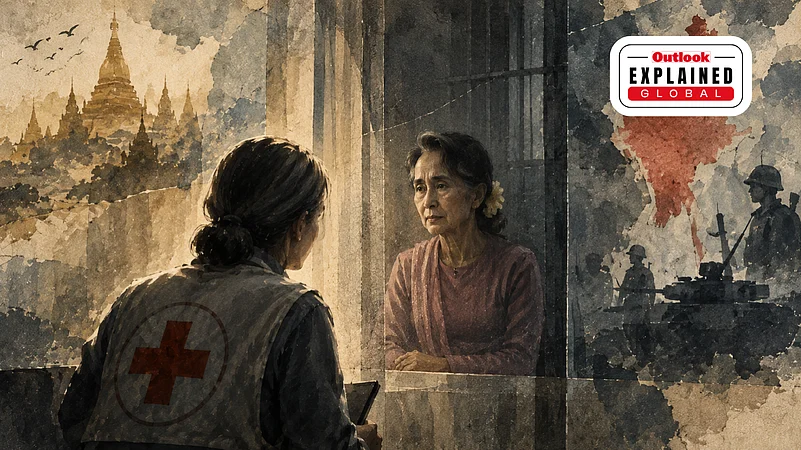
The International Committee of the Red Cross (ICRC) has visited Myanmar's detained civilian leader Aung San Suu Kyi for the first time since the military seized power in February 2021, marking the first publicly confirmed independent humanitarian access to one of the country's most prominent political prisoners in more than five years.
The ICRC confirmed that one of its delegates met Suu Kyi on Monday under its standard detention procedures, including the opportunity to speak with her privately. As is customary, the organisation did not disclose details of her health, the location of the meeting or its observations, saying any findings would be shared confidentially with Myanmar's authorities.
The visit comes as Myanmar's military government remains under international sanctions and diplomatic pressure over its treatment of political detainees. Although the meeting represents a significant humanitarian development, it does not indicate any change in the junta's broader political position or its approach to the country's ongoing crisis.



A Rare Humanitarian Opening
Since the military overthrew the elected National League for Democracy (NLD) government on 1 February 2021, Suu Kyi has remained largely isolated from the outside world.
Independent organisations have had virtually no access to her during years of detention, while information about her health and conditions has remained scarce. In May 2026, UN Secretary-General António Guterres expressed concern that neither Suu Kyi nor former President Win Myint had been seen independently and that little information had been made available regarding their welfare.
Against that backdrop, the ICRC visit represents the first publicly confirmed opportunity for an internationally recognised humanitarian organisation to assess her welfare directly.
Although the ICRC does not publicly release its findings, such visits provide detainees with an independent humanitarian channel and, where appropriate, allow limited contact with family members through the organisation's established procedures.
Why The ICRC's Role Is Different
Unlike political organisations or human rights monitoring bodies, the ICRC operates under a strictly humanitarian mandate derived from the Geneva Conventions.
Its detention visits focus on the treatment and welfare of people deprived of their liberty rather than the legality of their detention. Confidentiality is central to that approach. Instead of issuing public reports, the organisation privately shares its observations and recommendations with detaining authorities, arguing that confidential dialogue helps preserve long-term access to detainees.
That neutrality has enabled the ICRC to work in conflicts and detention systems where many other international organisations have limited or no access.
The organisation has continued engaging with Myanmar's authorities since the coup in an effort to expand humanitarian access, though opportunities have remained extremely limited.
A Symbolic Moment Amid Diplomatic Pressure
The visit comes as Myanmar faces sustained international isolation.
The European Union has extended sanctions against the military authorities until April 2027, while the United States continues to maintain sanctions over alleged human rights violations.
In December 2022, the UN Security Council adopted Resolution 2669, calling for an immediate end to violence and the release of all arbitrarily detained prisoners, including Suu Kyi and former President Win Myint. The UN Human Rights Council has also repeatedly urged Myanmar to release political detainees and investigate alleged violations of international law.
Regional diplomacy has produced few tangible breakthroughs. ASEAN's Five-Point Consensus, adopted in 2021 to encourage dialogue and humanitarian access, has seen limited implementation. Myanmar's Foreign Ministry reiterated in July that it continues to object to aspects of the consensus, arguing it was issued without the agreement of all member states and does not sufficiently respect national sovereignty and non-interference.
Against that backdrop, allowing an ICRC visit represents a limited humanitarian concession rather than evidence of broader political engagement.

Why Suu Kyi Remains Central
Although removed from public life since the coup, Suu Kyi remains Myanmar's most internationally recognised political figure.
She was arrested alongside President Win Myint and senior members of the NLD when the military overturned the results of the 2020 general election. Since then, Myanmar courts have convicted her on multiple charges, including corruption and violations of the Official Secrets Act, proceedings that the United Nations and rights organisations have criticised over concerns about transparency and due process.
Her continued detention has become one of the defining symbols of Myanmar's political crisis and remains a central issue in international discussions about the country's future.
What The Visit Means
The ICRC visit should not be interpreted as a sign that Myanmar's military government is preparing to release Suu Kyi or reopen political dialogue.
Rather, it demonstrates that the authorities have allowed limited humanitarian access by a neutral international organisation while maintaining their broader political position.
Whether the visit leads to expanded humanitarian engagement with other detainees remains uncertain. The ICRC has not indicated that it reflects a wider change in access, and the military government has given no public indication that its stance on political prisoners has shifted.
For now, the visit is significant because it restores a measure of independent humanitarian oversight after years of isolation. In a country where access to detainees has been exceptionally restricted since the 2021 coup, that alone makes it one of the most important humanitarian developments involving Aung San Suu Kyi in recent years.