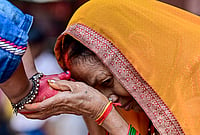
The Bill narrows legal recognition, excluding trans men, trans women, and gender-queer individuals.
Recognition now hinges on costly medical procedures and approval from multiple authorities, putting survival and dignity at stake.
Broadly drafted penalties may affect shelters and chosen families providing care and support.
Noor, 22, remembers the weight of the bag she carried when she first arrived in Delhi. It was not heavy by ordinary measure, containing a few clothes, some documents, and a tentative admission letter to a journalism programme.
But it held everything she owned and everything she hoped for. “It carried the emotional residue of a life I had been forced to leave behind,” she says.
She had left Kashmir, from Pampore, a town better known for its saffron harvests than stories like hers, because staying there had become impossible.
Growing up, the discomfort came in small, persistent corrections. The way her gestures were policed, the silences that followed when she tried to speak about who she was, and the quiet but constant pressure to conform.
At school, classmates mocked her voice and her mannerisms. Teachers rarely intervened and often reinforced the same expectations through indifference or subtle discipline. At home, conversations about gender were either shut down or met with anger or denial.
Over time, silence became a survival strategy, and leaving became an act of necessity.




Delhi, in her imagination, was supposed to be a place where she could exist without explanation. “I thought anonymity could translate into freedom.” What she found instead was a different kind of endurance test, she says.
Landlords asked questions she could not safely answer. Some refused her outright. Others withdrew offers the moment they sensed she did not conform to their expectations. The search for housing became a negotiation of identity. “How much to reveal, how much to conceal?” was the dilemma.
In professional spaces, she encountered what she describes as subtle humiliation of misgendering, invasive questions, the persistent sense of being evaluated not for her work but for her existence. Every interaction carried the possibility of exposure, she recalls.
Visiting clinics meant bracing for interrogations that went far beyond the medical need that had brought her there. Doctors asked personal questions unrelated to treatment, and staff stared.
“Every institution I encountered seemed to operate on the same premise that before you can access services, you must first explain yourself,” she says.
It wasn’t any institution that saved her in the end. It was people.
Over time, Noor found others like her: transgender and queer individuals who had also left homes that could not hold them, or where they did not fit. Some had travelled across states, others across social boundaries, and all carried similar stories of exclusion and resilience.
Together, they built what she calls a chosen family.
This network became her emotional, financial, and social safety net. They share rent, meals, contacts, warnings about unsafe spaces, and moments of joy that feel hard-won. It is a fragile structure that lacks legal recognition and depends on informal arrangements, but it is real in ways that formal systems had never been. It’s this “fragile stability” that Noor now fears is at risk.
The threat comes not from violence or personal crisis, but from a piece of legislation moving through Parliament: the Transgender Persons (Protection of Rights) Amendment Bill, 2026.

From NALSA To Now
In 2014, a landmark judgment altered the legal landscape for transgender persons in India, recognising their right to self-identify and asserting protections under the Constitution.
The judgment in National Legal Services Authority v. Union of India, commonly called the NALSA ruling, was celebrated as a historic affirmation. For the first time, the Supreme Court formally recognised gender identity as a matter of personal autonomy and dignity.
Individuals had the right to self-identify their gender. The court grounded this principle in constitutional protections under Articles 14, 19, and 21, making gender identity not merely an administrative category but a fundamental right.
Before NALSA, transgender persons in India existed largely outside formal legal recognition. Access to identity documents, employment protections, education, and healthcare depended on arbitrary bureaucratic discretion. The ruling changed that landscape, at least in principle, says Ritu from Queers for Constitution.
In 2019, the Transgender Persons (Protection of Rights) Act, India’s first comprehensive legislation on transgender rights prohibited discrimination across education, employment, healthcare, housing, and public services.
Crucially, it defined ‘transgender person’ broadly, encompassing trans men, trans women, gender-queer individuals, persons with intersex variations, and those with socio-cultural identities such as hijra, kinnar, aravani, and jogta. Section 4(2) guaranteed the right to self-perceived gender identity.
The 2026 Amendment proposes to dismantle this framework in ways that activists describe "deeply troubling".

Stalled By Bureaucracy
If Noor’s story is one of escape and fragile rebuilding, Kabir’s is one of being held back by systems that refuse to recognise him.
A Dalit trans man with aspirations of becoming a teacher, Kabir has spent years navigating documentation processes that do not reflect his identity. Every certificate including school records, identity documents, application forms carry a gender marker that does not align with who he is. Correcting these documents has meant repeated visits to government offices and frequent humiliation.
“Sometimes they laugh,” he says. “Sometimes they just refuse.”
For Kabir, discrimination is layered, shaped by both gender identity and caste. “You are already at the margins in more than one way,” he says.
The Amendment, he fears, will deepen these barriers. If recognition becomes more complex, documentation becomes more difficult. Without accurate documents, access to education and employment becomes increasingly restricted.
“I just want to teach,” he says quietly. “But everything depends on papers.”

Who Counts As Trans?
Raghavi Shukla, recognised as one of India’s first trans lawyers to practise before the Supreme Court, says that the Amendment’s most contested change is “deceptively simple in language, but seismic in implication. Who qualifies as ‘transgender’ under Indian law?”
Under the proposed revision, legal recognition would extend primarily to individuals belonging to specific socio-cultural identities: hijra, kinnar, aravani, jogta, or persons with certain intersex variations. Trans men, trans women, and gender-queer individuals are removed from the definition entirely.
The Bill leaves little ambiguity about its intent as the law “was and is not to protect each and every class of persons with various gender identities, self-perceived sex/gender identities or gender fluidities,” but only those facing exclusion “due to biological reasons for no fault of their own.”
For trans men, the exclusion has a particular quality of erasure, Raghavi explains. Unlike hijra communities, which have long-established socio-cultural structures and histories of recognition, trans masculine identities in India rarely correspond to specific cultural labels.
With the exception of a small Manipuri community known as Nupamanba, trans men have no widely recognised socio-cultural identity in India. If legal recognition depends on belonging to such a category, an entire segment of the community simply vanishes from the law’s imagination.
Fiza Sultana, a trans activist and founder of the Trans Muslim Rights Forum, South Asia, says the Bill fails to capture the realities of particularly disadvantaged communities. Fiza points to Kashmir: “Years of militarisation, the abrogation of Article 370, and ongoing restrictions have already placed transgender people under severe stress often pushing them into begging or sex work for survival. The Bill does not account for these nuances. It lumps people into broad categories, focuses narrowly on begging, and adds bureaucratic hurdles without understanding the lived conditions of trans communities here.”
Activists warn that the Bill’s proviso, stating that persons with self-perceived identities ‘shall never have been so included,’ puts existing identity cards at risk.

For Noor, who fought to obtain her legal documents, this means the stability she painstakingly built could vanish overnight.
Five Stages To Prove You Exist
Under the 2019 Act, a transgender person could obtain an identity certificate with a self-affidavit and an Aadhaar card. The individual remained at the centre of the process.
The 2026 Amendment replaces this with what activists describe as a multi-layered institutional gauntlet. As outlined by Raghavi, the process now requires prior medical intervention such as surgery or hormonal treatment, followed by evaluation by a medical board. The board’s recommendation is then forwarded to the District Magistrate. If the Magistrate is not satisfied, the case may be referred to additional, unspecified medical experts. Only then is a certificate issued, or denied.
Each stage introduces discretion and delay, and the process shifts authority away from the individual. “It is no longer about who you say you are,” Raghavi argues. “It is about whether the system agrees.”
Gender-affirming health care in India is already limited, as hospitals lack trained specialists. Costs are prohibitively high, especially for those from marginalised economic backgrounds. For many, the requirement of medical intervention is just impossible. In effect, legal recognition becomes contingent on access to resources that most do not have.

The Surveillance Architecture
Beyond the certification process, the Bill introduces a provision that trans researcher and activist Krishanu describes as a medical surveillance architecture. Amended sections would require medical institutions to report details of gender-affirming procedures directly to district authorities.
The earlier option to retain a transgender identity document after surgery is also removed. Everyone who medically transitions must now apply for a binary male or female marker, erasing, in administrative terms, any middle ground.
For Noor, the implications are deeply personal. “In smaller systems, information travels,” she says. “Once it becomes part of official records, you don’t know who might access it.”
Krishanu warns that such reporting requirements could discourage individuals from seeking health care altogether. “If patients know their medical decisions will automatically be reported to government authorities, some may avoid accessing care. In a community that already faces significant barriers to healthcare, discrimination, lack of trained providers, and financial constraints, this is not a theoretical concern.”

Criminalising Care
Section 18 of the Amendment introduces criminal penalties for what it calls “forced transgender identity.”
Under the proposed language, kidnapping a child with the intent to compel them to assume a transgender identity could incur mandatory life imprisonment, while compelling any person to present as transgender or to engage in begging or servitude may attract five to ten years’ imprisonment.
Activists agree that coercion, trafficking, and exploitation must be addressed. But their concern is with the breadth and ambiguity of the drafting.
“The language is so broad that it could sweep in shelters, non‑governmental organisations, doctors, and even the gharana system, which are the centuries‑old network of chosen elders, mentors, and peers that has sustained gender-diverse people pushed out of their natal homes,” says Ritu.
Community organisations and support groups report that they are already hesitating in cases because of fears around false kidnapping accusations. What was once a lifeline, offering refuge to someone escaping family violence, abandonment, or abuse, could now be perceived as a punishable offence.
“Existing criminal laws already cover exploitation and trafficking,” Shukla adds. “There is no indication of evidence, data, or documented cases showing that we lacked legal tools to address such harms. This isn’t a gap that needs a sweeping new provision. It risks criminalising care.”
For Noor, this section of the Bill is not an abstract legal theory. “The relationships that have made my survival possible,” she says, “could be reframed as something to be questioned.”
The Constitutional Question
Legal experts say the Amendment will face constitutional challenge if it is enacted. The NALSA ruling explicitly linked gender self-identification to fundamental rights to equality, dignity, freedom of expression, and personal liberty. Any law that appears to undermine that principle invites scrutiny.
Ritu says that the Bill attempts to impose rigid categories on identities that are far more complex. If your identity fits the categories recognised by the state, you are legitimate. If it does not, you may be excluded. More than a decade after NALSA, the question remains: Who ultimately has the power to define identity, the individual, or the state?
Noor says she left her trauma and stigma behind and built a home, a community, a sense of self that did not require anyone else’s certification. “And now it feels like everything could become difficult again.”
For Noor, Kabir, and thousands of others across India, the outcome will not just define the ability to access housing without fear, to seek healthcare without interrogation, to work without constant scrutiny, or to exist without explanation, says Ritu.