The BJP-led Mahayuti consolidated its dominance in Maharashtra’s local body polls, winning nearly 72% of presidential posts.
The MVA suffered a major defeat.
Congress emerged as the standout gainer within the opposition, especially in Vidarbha and Nagpur, signalling a partial grassroots revival and renewed cadre confidence.
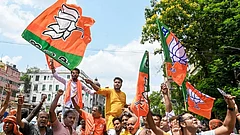
The results of Maharashtra’s local body elections for municipal councils and nagar panchayats were declared on December 21. The polling was conducted into 2 phases on December 3 and December 20. The results have clearly underlined the BJP-led Mahayuti’s dominance in the state, with the BJP emerging as the single-largest party. Mahayuti alliance won 207 of the 288 presidential posts of local bodies, nearly 72 % of the total.
While the BJP won 117 presidential posts, the Shiv Sena (Eknath Shinde faction) won 53. NCP Ajit Pawar faction won 37 posts. Maha Vikas Aghadi (MVA) won 57 posts altogether. Among the MVA, Congress emerged as the largest party with 41 posts; its allies, Shiv Sena (UBT), won nine, and NCP (Sharad Pawar faction) won seven. MVA's massive defeat in the 2024 assembly elections has invited many critical enquiries into grassroots-level organisational issues, last-mile messaging, lack of coordination among allies, BJP poaching of leaders, opposition allegations of a level playing field, and many other problems.


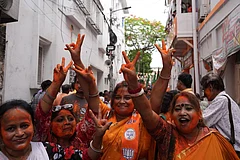

Ahead of the 2025 local body polls, fault lines within the BJP-led Mahayuti became visible when Eknath Shinde held a 50-minute closed-door meeting with Union Home Minister Amit Shah, reportedly raising concerns over the BJP’s alleged poaching of Shiv Sena (Shinde faction) leaders, particularly from his stronghold Thane. The tension had already spilt into the open when Shinde’s ministers boycotted a cabinet meeting on November 18, signalling growing unease after the polls were announced.
The other BJP ally, Ajit Pawar, had been increasingly sidelined and cornered within the alliance. Scrutiny over his son Parth Pawar’s involvement in the alleged land deal scam in Pune put him in an uncomfortable position.
At the grassroots, the churn has been dramatic, with hundreds of local leaders switching parties in November alone, blurring political lines. But the results favoured the BJP and Mahayuti.
What worked in favour of the BJP and Mahayuti
Devendra Fadnavis led the BJP’s campaign on the ground from the front and made a significant impact. He addressed development issues and underlined the BJP and NDA’s agenda for development, including civic hyperlocal problems such as water shortages, solid waste management, public health, and many others. Chief minister's rallies energised the cadre.
“We ran a positive campaign, and the people responded positively. Instead of attacking opponents, we focused on development and our delivery on the ground. After 25–30 years, the BJP has secured 48 per cent of councillor posts on its own. Our allies, Eknath Shinde and Ajit Pawar, have also performed well,” Chief Minister Devendra Fadnavis said at a post-victory press conference.
CM Fadnavis thanked voters of Maharashtra and added “I went to the smaller villages with a population of 10,000 for the campaign, because it was our duty to strengthen our local leaders.”
The top BJP leaders and allies, including both deputy chief ministers, Eknath Shinde and Ajit Pawar, ran aggressive campaigns on the ground. Eknath Shinde delivered speeches capitalising on Ladaki Bahin scheme, assuring farmers' welfare, ‘80 per cent social engineering and 20 per cent politics’, the famous dialogue of Balasaheb Thackeray. In his development of the state, welfare schemes were a talking point in his speeches and campaigns.
Ajit Pawar spoke about both rural and urban development, as well as converting semi-urban Nagar Parishads into municipalities.
The redistribution of reserved land plots for urban development projects delivered by the NDA was well-highlighted by Pawar in his speeches. Pawar also underlined his command over administration as a finance minister and as the guardian minister of Pune while addressing hyperlocal issues such as solid waste management in the Fursungi and Uruli Devachi areas of Pune.
Shivsena (UBT) and NCP (SP) did not conduct statewide aggressive campaigns. It did conduct campaigns beyond its specific pockets, addressing broader issues. Shiv Sena UBT leaders Uddhav Thackeray, Aditya Thackeray, and Anil Parab didn’t conduct campaigns in rural Maharashtra. Among Shivsena’s first-line leaders, Ambadas Danve is an exception who conducted campaigns in the Marathwada region of Maharashtra.

“The opposition left the battleground without a rigorous fight in the local body polls. Congress gained significant success in Vidarabha because of the people. People wanted to vote for Congress as they see the party as a strong opposition force.” Sushilkumar Shinde, founder of the Strelema- political consulting and research company, told Outlook.
Shinde and his team conducted grassroots research using quantitative, qualitative, and other tools, providing political consultancy services. Shinde tries to decode the analysis further, saying, "According to our data and research, the BJP has been a powerful party in Maharashtra with its arithmetic, strategy and seat sharing. At the same time, Congress is again emerging as a strong opposition force within the MVA. People do have more faith in Congress than the other two parties in MVA.”
However, with the ruling power in the hands of Eknath Shinde, Ajit Pawar gave them a space for promising people about development - be it bringing MIDC in any district or proposing public health care centres, not officially declared in the public due to the code of conduct. Still, leading the communication with relevant stakeholders, sources from both parties told Outlook.

Striking performance of Congress in Vidarbha
Of the 41 presidential posts in local body elections (Nagaradhayaksha), 24 are from Vidarbha alone. It contested 153 presidential posts, out of which winning 41 seats is a satisfactory and energising performance, said Congress activists. Across the state, the party contested 3207 seats for corporators, winning 1006. The congress secured victories for 340 corporators and 14 city presidents in Nagpur, Chief Minister Devendra Fadnavis’s stronghold.
“We are happy and satisfied with the results, because the BJP used all its money and muscle power to dismantle Congress by poaching our leaders all across the state. BJP has the ruling power and all the machinery, yet we managed to secure good numbers in Nagaradhyakshas and corporators. It sends the message that Maharashtra is not ‘Congressmukta’ as BJP wants it to be,” says Bhausaheb Ajbe, general secretary of Maharashtra Pradesh Congress Committee.
Ajbe believes this performance by the Congress will empower the cadre to work passionately in the upcoming municipality elections.

Many attribute this revival of Congress to the party’s Maharashtra chief, Harshwardhan Sapkal. He addressed 67 rallies. Sapkal attacked the RSS and the BJP in his speeches while addressing hyperlocal issues. Along with him, Congress leaders in Vidarbha, Vijay Wadettiwar, Pratibha Dhanorkar, Nana Patole and Yahsomati Thakur conducted well-planned on-ground campaigns.
“Harshwardhan Sapkal’s image and his fearless narratives regained trust among people.” We are told by the social activist in Vidarbha who doesn’t wish to be named. While Sharad Pawar’s stand on local body elections wasn’t well received among MVA cadres, they were confused by the NCP (SP)’s few alliances with the rival NCP (Ajit Pawar faction).
When the VB-G-RAM-G bill (now Act) was tabled in Lok Sabha, NCP (SP) chose MP Nilesh Lanke from the party to argue against the bill. His arguments were not as nuanced or aggressive as those of Supriya Sule, who also represents the semi-rural Baramati constituency. Though local body elections in Maharashtra were never about a single central narrative, they have always featured hyperlocal combinations and alliances, and the larger party image can’t be overlooked.
“The opposition’s significant absence on the ground does send a message to the masses and impact the results,” says Shinde of Sterlema.

What were the central issues that played a crucial role in local body elections?
After speaking to the cadre and top officials of the parties, listening to the speeches of the top leaders across the parties and Outlook’s own research about the campaigns, we found there was no single specific central narrative in these local body elections, and it never was a part of Maharashtra’s local body poll agendas.
All these elections were fought in the past with local political and economic power dynamics, unprecedented alliances, and to strengthen second- and third-line leaders.
Shiv Sena (UBT) leader Sanjay Raut was asked about the absence of top leaders during campaigning at a press conference. He said, “These elections are for local activists, leaders of the party; we leave it up to them.”
On the contrary, Ajit Pawar made the same argument but with a significant difference in action, saying, “I am here to appeal to you (people) for voting for my local leaders,” in his campaign speech at Fursungi in Pune.
The relatively significant performance of the Congress in Vidarbha can’t be attributed to agitated farmers in Vidarbha, as seen in the Lok Sabha results, since Nagar Parishads and Nagar Panchayats have limited scope to address farmers' issues. The vote-bank of farmers is more relevant in Zilla Parishad elections, we learnt after speaking to farmers in Vidarbha.

However, chief minister Devendra Fadnavis and top leaders of the BJP underlined the narrative of ‘development projects’ while citing deliveries of it by the NDA in urban Maharashtra.
“The BJP is very aggressive and well prepared for any elections, that from yesterday (results day itself), leaders started talking about correcting the recourse in Vidarbha for local body elections in 2029. That's the key to the BJP’s success,” a source in the BJP told Outlook.
The narrative around ‘Vote Chori’, misuse of central machineries didn’t work in favour of MVA, which needs significant realignment in its election strategies, including grass root reach, last mile delivery of narratives, better coordination in alliance and wise seat sharing.