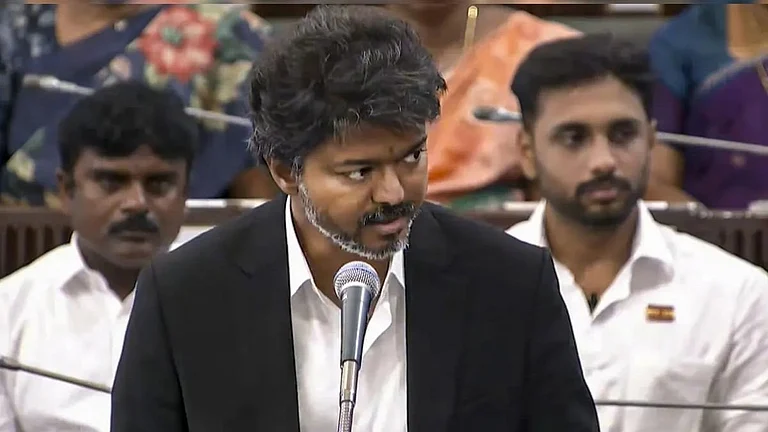
A horse-trading row has erupted in Tamil Nadu after the April 2026 election. The ruling TVK has alleged that up to eleven of its MLAs were offered crores to defect and topple Chief Minister Vijay’s government, three people have been arrested and an FIR names former DMK minister. The DMK has denied the charges and fired back with counter-complaints, pointing to six AIADMK MLAs who have already crossed over to TVK.
TVK won 108 seats in April’s historic election, the first time in nearly six decades that a non-Dravidian party has led the state. The DMK, which won 59 seats, finds itself in unfamiliar territory: in opposition.
Against this backdrop, DMK national spokesperson Salem Dharanidharan spoke with Fozia Yasin on what actually drove the result, how the party reads Vijay's long-term prospects, the BJP's ceiling in Tamil Nadu, the fraying of Centre-State relations, and whether dynasty politics is becoming an electoral liability. Excerpts:
How do you respond to TVK’s horse-trading allegations?
The public can see which party the elected legislators are resigning from and which party they are joining. That itself indicates where the real horse-trading is taking place. Anyone can make an allegation, but allegations must be backed by evidence.
What, in your view, explains the recent election result most: anti-incumbency, Vijay’s appeal, or gaps in the DMK’s campaign?


Electoral outcomes are inherently complex and difficult to predict with precision. Incumbents face a notably higher risk of losing power when conditions like drought precede an election, so analysing any single result requires nuance.
Having evaluated the DMK government’s performance over the past five years against the last twenty-five, I consider it among the strongest in recent Tamil Nadu history for governance and welfare delivery.
While anti-incumbency is often cited, it doesn't fully explain this result. If traditional fatigue were the dominant factor, the AIADMK would have benefited. Instead, voters gave a new party, TVK, a decisive chance, breaking conventional assumptions about money power, grassroots organisation, and caste arithmetic. That points to an anti-establishment wave, particularly among the youth.
Youth unemployment is a pressing challenge across the Global South, sharpened by the disruptions of the Fourth Industrial Revolution. Tamil Nadu produces the highest number of engineering graduates in the country, over 3.3 lakh in 2020–21 alone, and a significant section of that educated youth has struggled to find quality white-collar work. That discontent appears decisive.
Vijay, with his cinematic image as an "angry young man" fighting systemic injustice, channelled that sentiment effectively. It mirrors a pattern seen in many Western democracies, where voters punish established parties by backing outsiders even when the system itself isn't the primary cause of their hardship. His personal appeal clearly amplified the anti-establishment mood.
Does the DMK see Vijay as a long-term challenger or more as a short-term vote splitter?
I’m neither an astrologer nor a believer in astrology, so I won't predict the future. What I can say with certainty is that the DMK will continue functioning as a robust, constructive, responsible opposition, committed to Tamil Nadu's interests while holding the government accountable.
As Moisés Naím argues in The End of Power, it has become far easier to rise to the top quickly in modern politics and business, but much harder to stay there. History is full of movements that achieved meteoric success only to fade once the realities of governance set in.
For TVK and Vijay, the real test is translating campaign promises into outcomes, above all, tackling youth unemployment. Today's youth are more impatient and aspirational than previous generations, and unemployment is a "super wicked" problem driven by automation, skill mismatches, and structural economic shifts. Unless the new government shows visible progress on jobs and opportunity, the same voters who propelled Vijay to power could turn against him just as quickly.
It's worth remembering the previous DMK government delivered roughly 11 per cent economic growth in Tamil Nadu. Ultimately, Vijay’s trajectory will depend on his administrative performance, how parties like the AIADMK evolve, and a range of external factors. Governance, more than charisma, will determine whether this new political force endures.
How serious is the BJP’s organisational expansion in Tamil Nadu today?
The BJP cannot establish a meaningful presence here. It never has, and it never will. In Tamil Nadu, Tamil identity is dominant; religious identity doesn't override it. Any party built on religious polarisation has no future in this state.
The RSS has been explicit about its ideology, a homogenous vision built around Hindu, Hindi, and Hindutva. That is fundamentally at odds with the interests and ethos of Tamil people. We uphold a pluralistic, inclusive idea of India that respects linguistic, cultural, and regional diversity.
As long as the BJP and RSS pursue this majoritarian, centralising agenda, they'll remain politically irrelevant here. Tamil Nadu's political culture, rooted in Dravidian principles of social justice, federalism, and secularism, is a strong bulwark against that.
1. Have INDIA bloc tensions affected the opposition's credibility and the DMK's own calculations?
Preserving the foundational idea of India, pluralism, federalism, democracy, is paramount, and defeating the current government's authoritarian tendencies at the earliest opportunity is essential to protecting that vision. I remain confident that like-minded parties across the country will come together to dislodge the BJP from power.
2. Has the Centre-State relationship become more confrontational under the current Union government?
Yes, markedly so. We’ve seen a shift away from cooperative federalism toward greater centralisation, which isn't surprising given the BJP's consistent reluctance to uphold the Constitution's federal ethos.
This plays out across fiscal policy, political representation, and administrative overreach, and it has hit southern states like Tamil Nadu disproportionately. The indiscriminate rise in cess and surcharge, for instance, shrinks the divisible pool of taxes available to states.
The looming delimitation exercise is another flashpoint. Southern states that curbed population growth through investment in education and healthcare risk losing Lok Sabha seats if redistribution is based purely on current population, effectively penalising good governance while rewarding higher fertility rates elsewhere. Critics see this as concentrating power in the Hindi heartland and diluting the voice of states that contribute disproportionately to GDP and tax revenue.
Fiscal tensions compound this: southern states often receive far less in tax devolution than they contribute. Bodies like the GST Council, where the Centre wields outsized influence, draw criticism for central dominance, and rigid centrally sponsored schemes continue to erode state autonomy.
Politically, frequent interventions, Governors' actions, selective use of central agencies against opposition-ruled states, unilateral decisions on education, agriculture, and language, have deepened distrust. A one-size-fits-all approach ignores India's diversity and risks pitting region against region. Genuine federalism requires real consultation, equitable resource sharing, and respect for what different states have achieved. Without correction, this could do lasting damage to national unity.
3. Is Tamil Nadu now moving toward a multi-cornered contest, and how does that change DMK strategy?
Since 1967, the two major Dravidian parties, DMK and AIADMK, have governed Tamil Nadu. That duopoly has spawned many smaller identity-based parties; Tamil Nadu has historically had the highest number of parties contesting elections of any state, which I see as a healthy sign for democracy. Many of these figures are, in effect, political entrepreneurs. But their significance has been shrinking over the years. I still expect a two-party system to persist, with a small third front floating around its edges.
4. Does the DMK think dynasty criticism carries real electoral cost?
It wasn't just the DMK that took a hit this election. The AIADMK lost badly, for the first time since its founding, it's neither the ruling party nor the opposition. The BJP won just one MLA. Against that, the DMK has done well. As I said, this election was about anti-establishment sentiment and youth anger over unemployment, a protest vote born of unhappiness. The reasons behind our setback are different from what dynasty critics suggest.
5. How is the party adapting to younger voters and digital campaigning?
The DMK comes out of a hundred-year-old movement. Few movements stay this relevant for this long, and that's down to the party's ability to adapt. We came to power in 1967 using cinema, films were the vehicle for spreading our ideas of social justice. In the 1990s, we were first to capitalise on the television boom. In 1991 the DMK won just two seats; by 1996 we returned with a thumping majority. We'll go back to the drawing board and come back stronger.
6. What is the single message the DMK wants voters to remember when compared with the BJP, AIADMK, and Vijay's party?
The DMK isn't a political party. It's a socio-economic movement that has altered the course of this country for the better, more than once.
7. Does Vaiko’s departure alter the DMK’s arithmetic, or is it mainly a symbolic setback in Dravidian politics?
The future of most smaller parties in Tamil Nadu is effectively over. Even in the 2026 election, the vote shares of many smaller allies didn’t meaningfully transfer to the main coalition partner. I expect the MDMK to leave the DMK alliance, but that departure will have zero practical impact, it’s increasingly unclear what the MDMK stands for today or what relevance it holds. Over the medium-to-long term, it’s Vaiko’s son who’s more likely to carry social weight going forward