A video played at the Press Club of India on 19 February set the tone for a press conference by the United Christian Forum (UCF): the body of a Christian woman being dug out of her grave in Chhattisgarh. Wrapped in a white shroud, the remains were placed on the ground and covered in plastic as villagers stood around, a burial undone.
The footage, UCF members said, was not an isolated incident but part of a growing pattern in which Christian families are allegedly forced to exhume their dead and transport the bodies 50 to 100 kilometres away for reburial, sometimes to locations unknown even to relatives.
Against this backdrop, the Supreme Court’s interim order staying further exhumations in the State has brought immediate relief to several Adivasi Christian families who, even in mourning, had been drawn into legal battles for the right to bury their dead with dignity.
A Bench of Justices Vikram Nath and Sandeep Mehta directed that “in the meantime, no further exhumation of buried bodies shall be permitted” while issuing notice to the Chhattisgarh government on a public interest petition filed by the Chhattisgarh Association for Justice and Equality.
At the press conference, UCF president Michael Williams described the order as “a decisive step in protecting the dignity of the dead,” saying the practice had turned mourning into a site of intimidation. “You are not only making their lives miserable while they are alive, but even after death their dignity is not being tolerated,” he said.



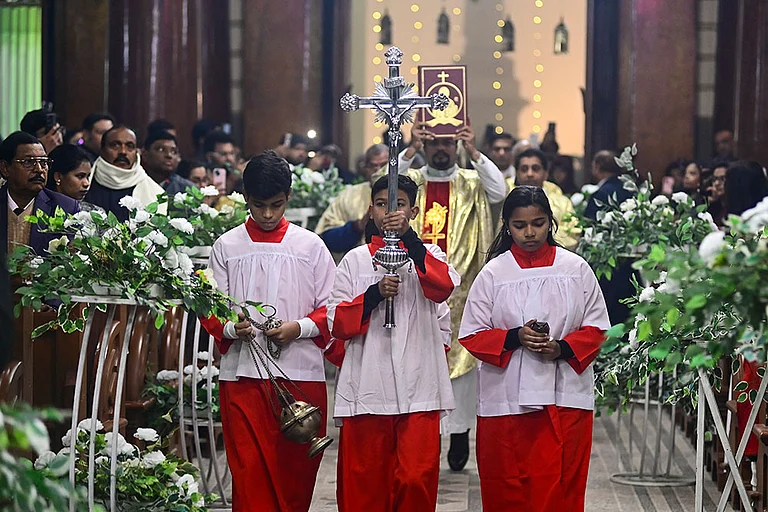
The conversation at the conference in Delhi on 19 February suggested that the order addresses only one layer of what activists describe as a widening pattern of violence, exclusion and coercion targeting Christian communities in tribal regions.
According to the petition, burial spaces that were historically shared by all villagers are increasingly being informally restricted along religious lines. Families are allegedly told that unless they abandon Christian rites and follow the dominant religious customs, they cannot bury their dead in their own villages, even where generations of their relatives are already buried.
One of the most disturbing incidents cited is from Benur village in Bastar district, where the remains of a tribal Christian man were allegedly exhumed, cremated and scattered. Activists termed it an act intended to terrorise the community and added that the pattern is now being seen in places including Rajasthan, Madhya Pradesh, Chhattisgarh, Jharkhand, Odisha and even up to Assam, where there is a growing call to delist Christians from their tribal identity.”
Speakers also drew attention to a parallel political campaign seeking to delist Christian Adivasis from Scheduled Tribe status in several states. While the Constitution does not link tribal identity to religion, activists said the burial disputes are feeding a growing fear: that being forced to bury relatives in distant “Christian” graveyards could later be used to question their tribal identity and land rights.
“This creates a dangerous situation,” Williams said. “If you adopt the dominant religion, you are protected. If you remain Christian, you face exclusion.”
Increased violence
Data shared by the UCF indicates that burial-related conflicts are part of a broader rise in targeted incidents. The organisation documented 4,959 cases of violence and discrimination against Christians between 2014 and 2024, with more than 700 incidents recorded in 2025 alone. Of nearly 580 incidents documented last year, only 45 resulted in FIRs, a conversion rate of about 7 percent.
At the same time, over 1,000 Christians are facing criminal cases or are in jail under allegations of forced conversions, the group claimed, even as it asserted that no complainants have been produced in court in many such cases despite legal requirements.
Human rights activist John Dayal said the intensity of attacks was unprecedented in his decades of documenting anti-Christian violence. He linked the atmosphere to a rise in hate speech and the aggressive use of anti-conversion laws, which, he said, have created conditions where “people are prevented from praying even inside their homes”.
The UCF has demanded a time-bound rehabilitation package for displaced families, disciplinary action against police officers accused of failing to act, the creation of religion-neutral common graveyards in every panchayat, and the appointment of district-level officers to ensure protection during funerals.
The press conference also named organisations such as the Bajrang Dal, Vishva Hindu Parishad and Janjati Suraksha Manch as being repeatedly mentioned in complaints from affected areas. These allegations could not be independently verified. The Chhattisgarh government has yet to respond to the Supreme Court notice.
Advocate Tehmina Arora underlined the human cost of such disputes. Recalling the case of Ramesh Baghel, she said his family had buried their dead in the same village for decades, yet he was stopped from burying his father there. “At the moment when a family is most vulnerable, they are told: this is not your place,” she said.