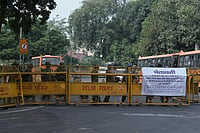
The killing of a student leader, who was set to contest from Dhaka, has triggered violence as Bangladesh prepared for February elections.
Islamist radicals are suspected of hijacking protests, with minorities and media houses among those targeted.
Instability in the neighbouring country poses serious security and economic risks for India, especially in the Northeast.
Just as a volatile Bangladesh appeared to be edging back towards stability, with elections announced for February 12 next year, the death of student leader Sharif Osman Hadi has unravelled another dangerous bout of violence that if unchecked could destroy the gains and the very principles for which the movement was launched. Hadi himself was to contest elections from Dhaka. The attack on Hadi occurred a day after the Election Commission announced the dates for the general elections.
Hadi was a senior leader of the student group Inqilab Mancha or the “Platform for Revolution”. He was also a trenchant and outspoken critic of India. He often accused New Delhi of interference in Bangladesh’s politics. Students’ dislike of India has much to do with the fact that like the opposition political parties, they regard New Delhi as an “enabler’’ for Sheikh Hasina. Previously, the Bangladesh Nationalist Party (BNP) had labelled her as an Indian stooge. But radical elements are now seizing the opportunity to shape Bangladesh’s future.
The Inqilab Mancha realising that the radicals have infiltrated the protests have distanced itself from the violence. “They essentially want to turn Bangladesh into a dysfunctional state through vandalism and arson,” the group stated. “They want to endanger the independence and sovereignty of this country.”




An outpouring of grief at the loss of a popular young leader is understandable. The anti-Awami League and by association anti-India sentiments are also a given. But the interim administration of Muhammad Yunus, looked on helplessly as the rampaging mobs took to the streets. Yunus has been accused by his critics of being soft on radicals that the Awami League believes have emboldened these elements.

Mindless attacks have targeted minorities. A Hindu man was lynched on allegations of blasphemy. There have been attacks on Indian interests as well its diplomatic missions. Significantly, the media has not been spared. The Daily Star and Prothom Alo, are said to be close to the Nobel Laureate and yet they were targeted. Yunus’s press adviser Shafiqul Alam has apologised for the government’s inability to protect the media. “I wish I could dig up a piece of earth and bury myself in shame.’’
The flare-up raises unsettling questions. What is the endgame, and who is stoking both anti–Awami League and anti-India sentiment? Are these elements opposed to the electoral process itself, seeking to derail the February polls?
With the picture growing increasingly murky, concerns are mounting over whether Islamist radicals are attempting to seize control and whether they will succeed. Since liberation from Pakistan in 1971, Bangladesh has been a deeply polarised country. The current violence has once again exposed the deep fault lines in a nation already gripped by political turmoil, since former Prime Minister Sheikh Hasina’s ouster.

India’s concern: For India an unstable Bangladesh is a matter of grave concern. One where radical elements operate freely is dangerous, as Bangladesh borders India’s sensitive north-eastern states. One of Sheikh Hasina’s first moves after taking office in 2009 was to hand over militants of the United Liberation Front of Asom (ULFA) back to India. She also cracked down on extremists and secessionist outfits from various north-eastern states that operated from Bangladeshi soil. New Delhi has always been grateful to Sheikh Hasina for her action against northeastern militants.
The fear now is that these elements would once again be allowed to take refuge in Bangladesh. The north-east has been at peace since Hasina came to power. But that is no longer a given. Pakistan’s spy agency the ISI would also perhaps be given a free hand to encourage India’s militant groups.
After Hadi was shot in the head on December 12, and succumbed to his injuries on December 18, allegations and suspicion was on the Awami League and India. Rumours that the conspirators had crossed the border to India, has fuelled anger. Authorities have accused Faisal Karim Masud of carrying out the shooting and named Alamgir Sheikh as his alleged accomplice, both are suspected Awami League activists.
Bangladesh is well-aware of India’s vulnerability in the north-east, which is why, Hasnat Abdullah, a leader of the National Citizen Party, made up of former student activists warned India: “If Bangladesh is destabilised, the fire of resistance will spread beyond borders. Since you are housing those who destabilise us, we will give refuge to the separatists of seven sisters too,” Abdullah said. India wants a stable neighbourhood for development and instability and chaos in Bangladesh will not serve New Delhi’s interests.
“Some fallout will be mainly economic because of goods transit. Pakistan will also try to use chaos and have its agents send fake Indian currency notes across the border. We have to tighten our border security and guard against infiltration of terrorists. China may also try to grab projects in Bangladesh,’’ says Pinak Ranjan Chakravarty, former Indian High Commissioner to Bangladesh. But for now, one has to wait and watch for further developments.