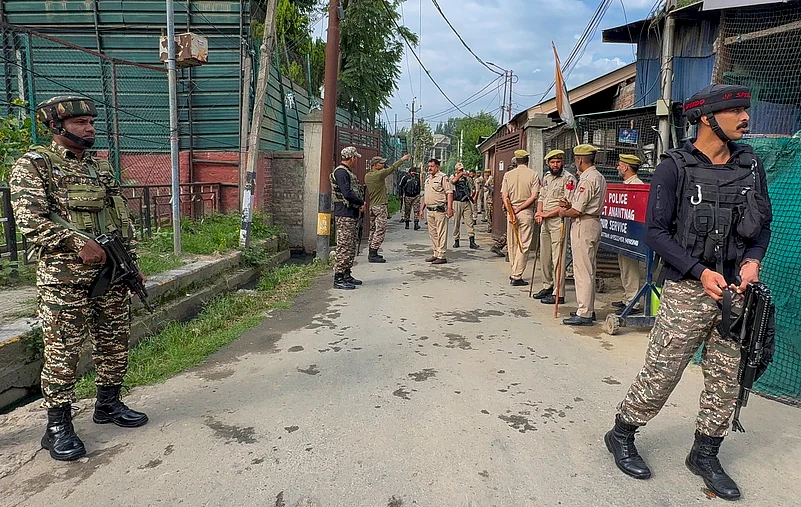
Security was intensified across Jammu and Kashmir as the Union Territory marked seven years since the abrogation of Article 370.
CRPF and police increased highway checks and surveillance, while authorities barred protest demonstrations at several locations.
Political leaders marked the anniversary with contrasting remarks on the impact of Article 370's revocation and the demand for statehood.
Security was intensified across Jammu and Kashmir on Wednesday as the Union Territory marked the seventh anniversary of the abrogation of Article 370, with authorities putting in place a multi-layered security grid across the Union Territory to maintain law and order and prevent any disruption to public order.
The anniversary marks seven years since the Centre, led by Prime Minister Narendra Modi, revoked Article 370, ending the special status of the erstwhile state of Jammu and Kashmir and bifurcating it into the Union Territories of Jammu and Kashmir and Ladakh. According to ANI, security has also been strengthened in the border areas of the Union Territory, while authorities have not granted permission for protest demonstrations at several locations.
Reported ANI, personnel of the Central Reserve Police Force (CRPF) conducted security checks along the Jammu-Srinagar National Highway in Ramban. In Kulgam, police intensified vehicle checking and identity card verification on National Highway-44 as part of the heightened security measures.


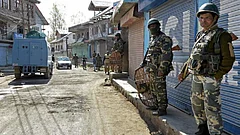
Officials said security agencies were maintaining close vigil to prevent any disruption to public order.
On August 5, 2019, Union Home Minister Amit Shah tabled a resolution in the Rajya Sabha to scrap Article 370. During the debate, he launched a scathing attack on opposition parties, including the National Conference, Peoples Democratic Party and Congress, accusing the "three families of looting" Jammu and Kashmir.
Shah had said, "Under the umbrella of Article 370, three families looted Jammu and Kashmir for years. Leader of Opposition (Ghulam Nabi Azad) said Article 370 connected Jammu and Kashmir to India, but it's not true. Maharaja Hari Singh signed the Jammu and Kashmir Instrument of Accession on October 27 1947. Article 370 came in 1954."
According to ANI, Article 370 had granted special status to Jammu and Kashmir, barred people from the rest of India from buying land in the former state and limited Parliament's powers to make laws for Jammu and Kashmir.
Speaking on the seventh anniversary, BJP MP Ghulam Ali Khatana said, "After PM Narendra Modi took command, he understood the Jammu and Kashmir situation. He fixed the loopholes. He fixed the underlying problem. Because of 370, the police were under the state. If women married outside, they had no rights to their parents' property. OBCs had no status... So today you have seen that everywhere, be it religious pilgrim tourism, other tourism, the visit of G20 countries, and the arrival of international investors. Many things have been simplified and made easy. And recently, elections were held in which Omar Abdullah Sahab won with a plus 60 percent voter turnout...So, in a broad sense, people's mental stability and confidence have increased. Development has occurred all around."
Shiv Sena (UBT) spokesperson Anand Dubey said he hoped the Centre would grant statehood to Jammu and Kashmir so that it could develop more rapidly in the future.
"There was an atmosphere of joy and jubilation throughout the country, and years of hard work were fulfilled that day, because it had been the dream of our supreme leader, the Hindu Hriday Samrat Balasaheb Thackeray, to have Article 370 removed from Jammu and Kashmir. Today, seven years have passed. First, I congratulate the people of Jammu and Kashmir for their tremendous progress. Tourism has significantly increased, and a full-time government is slowly being formed there. We only wish that the differences that have arisen between the Governor and the Chief Minister are reduced, and Jammu and Kashmir is granted full statehood, so that it can develop more rapidly in the future," Dubey said.
(With inputs from ANI)