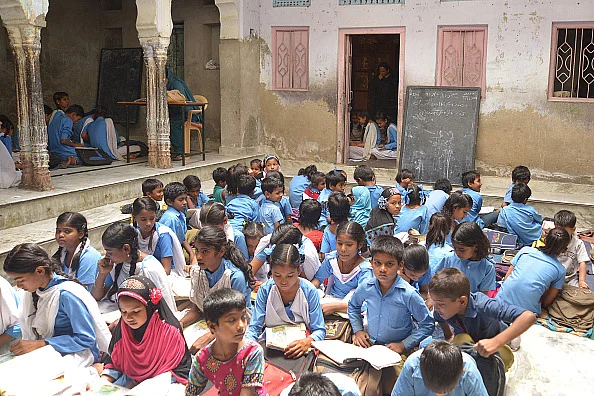
Nearly 94,000 government schools have declined over the past decade amid demographic changes, lower enrolment and school consolidation.
States are merging under-enrolled schools to improve infrastructure, teacher availability and learning opportunities.
The success of school consolidation depends on balancing better education with safe and equitable access for every child.
Nearly 94,000 government schools have been shut, merged or consolidated over the past decade, raising questions about whether India is losing neighbourhood schools or reorganising its public education system to reflect changing demographics and enrolment patterns. The figure has fuelled political debate, but it captures only one part of a much broader transformation underway in India's school education system.
While government schools have declined in number, private schools have expanded, the country's school-age population has fallen, and several states have merged schools with low enrolment into larger campuses. According to The Indian Express, government data points to three broad shifts over the past decade: fewer government schools, declining enrolment in government institutions alongside rising private school enrolment, and an increase in the number of teachers despite fewer schools and students.
The issue entered the political spotlight after the Congress cited a NITI Aayog report highlighting the decline in government schools over the past decade.
The debate, however, extends beyond the headline figure.




The key question is not simply why schools are disappearing, but whether the changes are improving education without leaving some children behind.
Why are government schools closing?
The reduction in government schools is linked to several long-term changes rather than a single national policy.
India has seen a steady decline in birth rates over the past three decades, resulting in fewer school-age children. The country's total fertility rate has fallen from more than three children per woman in the early 1990s to around 2.0 today, below the replacement level of 2.1. Rising female literacy, better healthcare, wider access to family planning, delayed marriages, urbanisation and rural-to-urban migration have all contributed to this demographic shift.
According to reporting by The Indian Express, many village schools that once enrolled more than 100 students now have only a few dozen. Another factor is changing parental preferences, with more families opting for private schools, contributing to a decline in government school enrolment.
Together, these trends have led many states to reassess whether maintaining separate schools with very small student populations remains sustainable.
Why are states merging schools?
Many states are choosing to consolidate schools instead of running multiple institutions with very low enrolment.
The idea is straightforward. A school is more than a place for classroom teaching. It also supports children's intellectual, social, emotional and physical development through age-appropriate classrooms, interaction with teachers and peers, group learning, sports and co-curricular activities. According to The Indian Express, these opportunities become difficult to provide in schools with only a handful of students or a single teacher.
In many such schools, one teacher is responsible for teaching multiple grades and subjects while also handling administrative work. Although these schools continue to implement welfare measures such as the mid-day meal scheme, they often struggle to provide subject-specific teaching, laboratories, libraries and meaningful peer learning.
Consolidation aims to bring students into larger composite schools that can share teachers, infrastructure and academic resources. The approach is also reflected in the National Education Policy (NEP), 2020, which promotes school complexes and clusters to make better use of educational resources. Supporters argue that the objective is to improve educational quality rather than simply reduce expenditure.
Are fewer children studying in government schools?
Yes, although the picture is more complex than a simple fall in enrolment.
According to figures cited by The Indian Express, the total number of schools in India declined from around 15.16 lakh in 2014-15 to 14.71 lakh in 2024-25. However, the overall reduction of about 45,000 schools was driven entirely by government schools, whose numbers fell from roughly 11.07 lakh to 10.13 lakh during the same period. Private unaided schools continued to expand.
Overall student enrolment also declined by around 2.26 crore between 2014-15 and 2024-25 as the number of school-age children fell.
More recent government data shows that enrolment in government schools dropped from 13.62 crore to 12.16 crore between 2022-23 and 2024-25, while private school enrolment increased from 8.42 crore to 9.59 crore.
Even so, government schools continue to educate millions of children, particularly at the elementary level. Nearly 70 per cent of students are enrolled between Classes I and VIII, making neighbourhood schools particularly important for younger children who may not be able to travel long distances independently.
Does consolidation improve education?
There is no simple answer.
Larger schools can provide facilities that smaller schools often cannot. More teachers make it easier to offer subject-specific instruction, while higher enrolment creates opportunities for peer learning, sports, laboratories, libraries and co-curricular activities.
This suggests teacher availability has improved overall, although the gains remain uneven across states.
However, national averages conceal significant differences. Some rural schools continue to function with very low enrolment and limited staff, while many urban schools remain overcrowded.
Whether consolidation improves education depends less on the act of merging schools and more on what happens afterwards. If students gain better teachers, facilities and learning opportunities without losing access to education, consolidation can strengthen the system. If not, it risks becoming little more than an administrative exercise.
Whose loss when a neighbourhood school disappears?
The biggest concern is access.
For young children, travelling longer distances can become a barrier to attending school regularly. The challenge may be even greater for girls, children living in remote or tribal regions, and families with limited transport options.
This means that consolidation can create unintended disadvantages unless governments provide safe and reliable transport and ensure that children can continue attending school without added hardship.
As The Indian Express notes, the success of school mergers depends on balancing educational quality, efficiency and equitable access, rather than pursuing consolidation for its own sake.
What does this mean for India's education system?
The closure and consolidation of government schools reflect a public education system adapting to demographic and social change rather than simply shrinking.
Rather than viewing the decline in schools as an isolated statistic, it is more useful to consider three developments together: fewer government schools, changing enrolment patterns and an increase in the number of teachers. These suggest that the education system is being reorganised rather than simply reduced.
The long-term success of this approach will depend on how well governments balance quality with accessibility. According to The Indian Express, decisions on school consolidation should be guided by enrolment trends, demographic projections, geography and local accessibility rather than administrative convenience alone.
Ultimately, the success of school consolidation will be judged not by how many schools disappear, but by whether every child can safely access a well-resourced school that delivers meaningful learning opportunities. If consolidation improves both learning outcomes and equitable access, it represents a meaningful educational reform. If it fails to do so, it risks becoming little more than an administrative exercise.