



Zelensky will urge NATO allies to provide more air defence systems at the Ankara summit.
Ukraine says Russia's missile attacks highlight the urgent need for additional Patriot interceptors.
Kyiv believes its drone strikes inside Russia are increasing pressure on Moscow to enter peace talks.
Ukraine's President Volodymyr Zelensky will use this week's NATO summit in Ankara to make a renewed appeal for more air defence systems, arguing that Ukraine urgently needs additional protection as Russia steps up its missile campaign. The request comes after Russian strikes on Kyiv twice in less than a week killed more than 50 civilians, while Ukraine continues to expand its own long-range drone attacks deep inside Russia.
The summit, which runs on Tuesday and Wednesday, is also expected to give Zelensky an opportunity to meet US President Donald Trump as Kyiv seeks to convince its allies that sustained military support can increase pressure on Moscow and create conditions for meaningful peace talks. According to BBC, Zelensky argues that Russia's latest attacks demonstrate weakness rather than strength and that Vladimir Putin should be pushed towards negotiations for a "dignified" peace.
Ukraine's president plans to use the NATO meeting in Turkey to urge Kyiv's allies to deliver the air defence systems it urgently needs to protect the country from escalating Russian attacks.


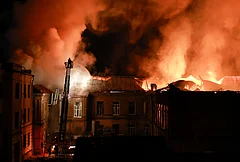

His appeal comes with added urgency after Russian missiles struck the Ukrainian capital twice in less than a week, crashing into blocks of flats and killing more than 50 civilians.
The latest Russian strikes come as Ukraine has been stepping up its own long-range drone attacks against Russia, hitting oil refineries and military targets and causing significant fuel shortages and power cuts.
BBC reported that Moscow Mayor Sergei Sobyanin said Russian anti-air defences intercepted "most" of the 430 unmanned aerial drones launched by Ukraine towards the capital overnight. The full extent of the damage was not immediately clear.
Russian social media accounts have been filled with videos showing people queuing for hours to buy petrol and arguing over the limited quantities they are allowed to purchase.
On the eve of the NATO gathering, Zelensky said he hoped the meeting in Turkey would not be "empty".
NATO Secretary General Mark Rutte urged member states to "pull their weight" and ensure Ukraine receives what it needs "to defend its sovereignty".
He also said Kyiv was "changing the dynamic on the battlefield", referring to efforts to stall Russian ground troops in the east.
According to BBC, that assessment also reflects Ukraine's recent drone strikes, which appear to be giving Kyiv an edge. The phrase of the month, the broadcaster noted, is "window of opportunity".
However, as the war in the skies has intensified, Russia's ballistic missiles are creating serious problems for Ukraine.
Ukraine's air force releases a daily tally of the weapons launched by Moscow alongside the number intercepted.
On Monday, almost all drones were successfully intercepted, but the failure rate against missiles was striking.
Ukraine did not stop a single ballistic missile in that attack.
It is not easy. Ballistic missiles travel at several thousand kilometres an hour and Ukraine simply does not have enough US-made Patriot air defence missiles to counter them.
"It is simply absurd that, in today's world, production has still not been scaled up to the level actually required to protect people from ballistic terror," Zelensky said in a video address on Monday.
He has been calling on European allies to hand over their own stockpiles of Patriot missiles, arguing that they are of little use in storage while civilians are being killed in Ukraine.
"Russia is placing its bets on ballistic weapons, and those who want peace must place their bets on protection against ballistic attacks," Zelensky said, setting out his case ahead of the meetings in Ankara.
Patriot systems remain in short supply worldwide, and it is unclear how many would be enough if Russia were to escalate its ballistic attacks further.
That is why Zelensky has also spoken about Ukraine producing its own equivalent with NATO support.
The Russian attacks, however, also suggest that Ukraine's deep strikes are getting under the Kremlin's skin.
After years of Russia targeting civilian infrastructure in Ukraine, including power stations during the middle of winter, Moscow now accuses Kyiv of "terrorism" for striking its oil refineries with drones.
Zelensky describes that as an "influence campaign" and is expected to share details with NATO allies.
The objective is to pressure Putin into peace talks on terms Kyiv could accept, which do not include surrendering the entire eastern Donbas region, as Moscow continues to demand.
The campaign has targeted several high-profile sites.
An oil terminal in St Petersburg was struck by drones ahead of Putin's economic forum in the city in June. That was followed by strikes on a refinery in Moscow itself, producing explosion videos that spread widely online.
There has now also been a confirmed strike on an oil refinery in Omsk, Siberia, around 2,500 kilometres from Ukraine's border. According to BBC, the drone must have flown undetected for many hours, illustrating how stretched Russia's own air defences appear to be.
Ukraine's campaign also extends to Crimea, the peninsula seized by Putin in 2014 and one that remains deeply important to him personally.
Ukrainian drones are now striking military logistics, oil refineries and power plants there almost every day, causing power cuts, fuel shortages, food shortages and prompting authorities to declare a state of emergency.
A local resident told the BBC the situation was "catastrophic", comparing it with the turbulent 1990s after the collapse of the Soviet Union.
One of Putin's longstanding claims is that he "saved" the country from that chaos, raising Russia "from its knees".
Now, Ukraine argues, Russia's full-scale war has brought danger even to Moscow through drone strikes and widespread fuel rationing.
Zelensky is expected to tell NATO leaders, and seek to persuade Trump, that Ukraine has turned the tide in the war and that continued pressure, with allied support, can compel Russia to engage in proper negotiations for peace.
Trump has appeared impressed by Ukraine recently, although he also spoke to Putin by phone for 90 minutes this week, giving the Russian leader a chance to get his war story in first.
Above all, Kyiv wants to end the war quickly, through "strength or diplomacy", before another gruelling winter begins.
But to have any chance of achieving that, Zelensky argues, Ukraine needs more interceptor missiles to protect its cities and civilians.















