






The war reflects the pursuit by governments of policies contrary to their own interests, where wisdom is less operative and more frustrated than it should be.
The 2015 nuclear deal had given the IAEA full access to the nuclear activities of Iran, but Trump walked out of it in 2018 and re-imposed economic sanctions.
It does not appear that the judiciary or the legislative is either willing or able to correct the president, while only Trump can stop it in a war with worldwide consequences.
Contemplating the war on Iran started by Prime Minister Benjamin Netanyahu on February 28, joined in with alacrity by President Donald Trump, I recall a quotation from Barbara Tuchman’s The March of Folly: From Troy to Vietnam (1984): “A phenomenon noticeable throughout history regardless of place or period is the pursuit by governments of policies contrary to their own interests… In this sphere, wisdom, which may be defined as the exercise of judgment acting on experience, common sense and available information, is less operative and more frustrated than it should be.”
Trump claims that he attacked Iran threatening to send it back “to the Stone Age” to ensure that Iran does not make a nuclear weapon. We all know that the 2015 nuclear deal—JCPOA (Joint Comprehensive Plan of Action) concluded when Barack Obama was president—gave the International Atomic Energy Agency (IAEA) full access to the nuclear activities of Iran, a signatory to the Treaty on the Non-Proliferation of Nuclear Weapons (NPT).
Candidate Trump denounced the treaty to seek support from the powerful Jewish lobby, and as president, he walked out of it in 2018 and re-imposed economic sanctions on Iran.
By now it is known that Netanyahu sold to Trump an assessment by Mossad that Iran was about to make a bomb and that with decapitation of the top leadership, followed by intense bombing, Iran would surrender and a new regime of Trump’s choice could be installed.

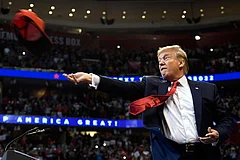


It is noteworthy that US Director of National Intelligence Tulsi Gabbard has assessed that Iran was not making the bomb.
Here, we need to raise a question: How come that Israel, the largest recipient of America’s military aid and diplomatic protection, is able to practically dictate to Washington its policy towards West Asia?
In other words, how and why is it that the tail is wagging the dog?
That was not always the case. On August12, 1982, President Ronald Reagan made a blunt phone call to Israeli Prime Minister Menachem Begin and made him stop the bombing of Beirut within minutes. President Dwight D. Eisenhower, during the Suez Canal crisis (1956-57) threatened to cut off aid to Israel to compel it to withdraw from the Sinai Peninsula of Egypt. Israel complied.
Obviously, Netanyahu has a chokehold on Trump as John Mearsheimer, a professor at the University of Chicago University, has put it. Why? We can only put forth a hypothesis as evidence might be classified. Could it be anything to do with the Jeffrey Epstein files? The US Department of Justice, presumably, has the full files. It has been releasing parts with deletions, partly to save Trump. But deletions do leave a trace.
Is the ghost of Epstein visiting the corridors of power in the US?
The 21-hour long talks in Islamabad were sterile. Why? If Vice President J. D. Vance were serious, he would have had talks for two or three days lasting five or six hours a day considering the complexity of the issues between the two countries without diplomatic relations since 1979.
The invisible elephant in the room, Netanyahu, wanted the talks to fail. The Iranian foreign minister holds that Netanyahu had spoken to Vance. Did the former offer support to the latter for his presidential bid?
Trump is desperate to end this asymmetric war where the weaker side is not destined to lose. Hence, he imposed the 10-day truce on Israel and Lebanon.
Any democratic polity should be able to correct itself. The American constitution is based on the doctrine of separation of powers among the executive, judiciary, and legislative, propounded by the 18th century French philosopher Montesquieu. It does not appear as of now that the judiciary or the legislative is either willing or able to correct the president.
The same thought applies to the international community. When a member state of the United Nations commits aggression, its peers should step in. It might be argued that America the superpower is peerless.
That argument is wrong. When Trump threatened to impose tariffs on European countries that sent a token military force to Greenland, the European Union (EU) threatened to retaliate and Trump ate the humble pie.
In the current case, Europe has demonstrated its inability to get its act together and punch its weight. It is true that a few countries—Spain and Italy—refused overflight permission to the Pentagon. Why didn’t the EU take a collective decision in the matter? Even if Hungary’s Viktor Orbán had opposed the message, it would have been clear.
The Gulf Cooperation Council (GCC) has suffered much from the attacks by Iran. The GCC had told Trump not to use the American bases in their territory to attack Iran. Trump ignored and the bases were used.
Iran hit the GCC countries for another reason also. It wanted to tell the whole world that if anyone thought Israel and America can go bombing Iran, and the rest of the world can go on with business as usual, that person is naïve. I am not saying this to justify Iran’s action, only to draw attention to the need to look at the bigger picture.
Have the bases given any protection to the GCC? The GCC needs to take a hard look at the policy it has followed in the light of what Tuchman has said.
India could have and should have played its cards more smartly—by aligning with Israel in the beginning and correcting its policy timidly, it has confused itself and the rest of the world.
Pakistan is doing mediation. It might or might not succeed.
There was a time when India under Jawaharlal Nehru, without claiming to be a Vishwaguru, contributed to conflict resolution in Korea, Indo-China, Suez Canal and elsewhere when V. K. Krishna Menon engaged with the belligerents.
This is not yet a world war, but it is a war with worldwide consequences.
Only Trump can stop it. But he is disconnected with the real world. As the Bhagavad Gita says anger deranges memory, followed by deranged judgement, leading to ruin. In this case, arrogance and ignorance have generated anger.
Let us all pray to the Almighty to restore Trump’s connectivity to reality as soon as possible.
Trump is desperate to end this asymmetric war where the weaker side is not destined to lose. Hence, he imposed the 10-day truce on Israel and Lebanon. Netanyahu is desperate to resume the war. Iran is keen, not desperately keen, to end this war. It is my assessment that Trump has decided to declare ‘victory’ within days or weeks and then ‘move on to Cuba’, despite the ‘chokehold’ mentioned above. Netanyahu has to fall in line if Trump orders. However, Trump’s invocation of the Bible is most disquieting.
(Views expressed are personal)

MORE FROM THIS ISSUE



K. P. Fabian was the first secretary in iran from 1976 to 1979. The former ambassador is now professor, at Symbiosis University
This article appeared in Outlook’s May 1 issue, 'Dravida Banga Ltd' which looked at the states going into elections and the issues facing them including delimitation and special intensive revision.
















