
The DMK has backed temple reform, social welfare and priests from all castes while resisting communal mobilisation.
Stalin has emerged as a leading critic of Hindi imposition, gubernatorial overreach and the Centre’s delimitation plans.
Despite challenges from rivals old and new, Stalin has strengthened the DMK’s imprint on Tamil Nadu politics.
Why Tamil Nadu strongly resists the politics of the Hindu right? Writing in 2012, historian M.S.S. Pandian revisited his earlier view that the Hindu right would expand easily in the state because Dravidian parties such as the DMK had diluted core commitments to atheism, rationalism and anti-Brahminism.
He later argued that such expansion would be far less straightforward. The long political struggle of Dravidian movements against caste discrimination within Hinduism had made Muslims potential allies. The DMK’s ideological compromises did not amount to surrender; instead, they helped produce a non-Brahmin Hindu religiosity that was self-critical and tolerant.
Over the past few decades, the DMK’s approach to religion has not been one of outright opposition, but an attempt to redefine it. Rather than reject faith outright, it has sought to foreground religion’s egalitarian possibilities while resisting its use as a tool of social domination. Periyar E.V. Ramasamy, founder of the Dravidar Kazhagam and the Self-Respect Movement, once urged those unable to abandon religion but seeking escape from untouchability to consider conversion to Islam. He saw it as a powerful lever against caste oppression.

Departing from Periyar’s more radical position, the DMK has, during its periods in power, sought to cultivate a politics of tolerant religiosity. It has tried to prevent religion being used to justify social inequality while respecting popular faith. When M.K. Stalin came to power amid rising communal polarisation across the subcontinent, the party faced sharper pressures than before. So far, his government has not only withstood them but asserted its principles more firmly.

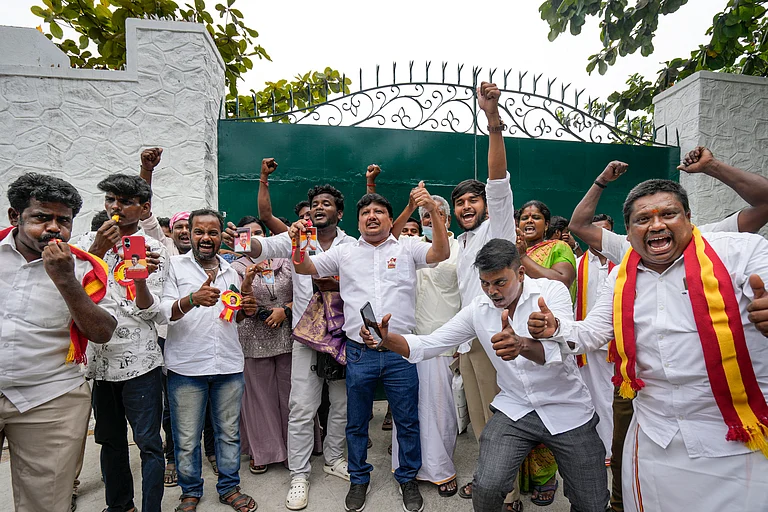
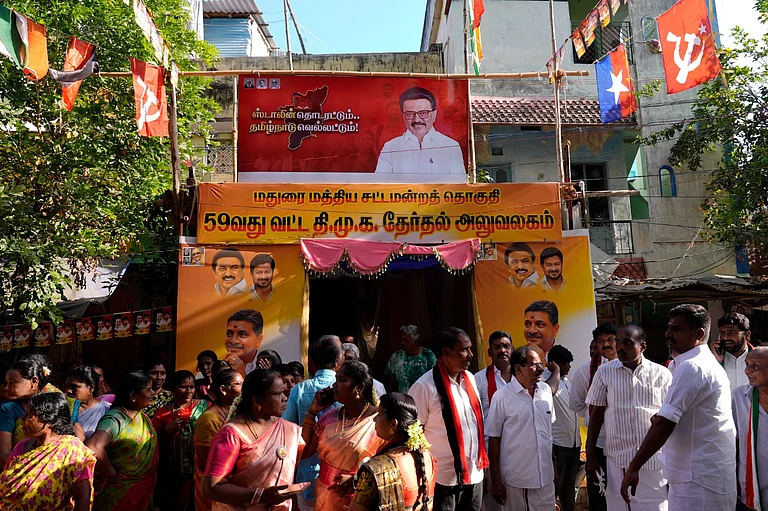

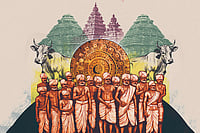
While Hindu right politicians demanded that temples be removed from state control, the DMK sought to turn them into sites of inclusive devotion. Over the past five years, hundreds of medieval temples across Tamil Nadu have been renovated and kudamuzhukku (consecration). Temple resources have also been directed towards social welfare, including mid-day meals for the urban poor and educational initiatives. In keeping with its social justice agenda, the government has promoted worship through Tamil Bhakti songs and legalised the appointment of trained priests from all castes, including men and women.
Therefore, from the temple entry movements spearheaded by Periyar and others in the early twentieth century to the appointment of non-Brahmin priests today, the Dravidian movement has consistently sought to bring the egalitarian dimensions of religion to the fore.
Above all, M.K. Stalin has not hesitated, at key moments, to speak out against communal violence against civilians, including Muslims. He has also been among the few Indian political leaders to strongly condemn the war in Gaza and Israel’s strikes on Iran.
In recent years, at least two episodes tested the DMK’s non-communal stance. The suicide of a girl at a mission school in Michalepatti was seized upon by the Hindu right and portrayed as a case of forced conversion. The Tamil Nadu government rejected the claim and filed complaints against those accused of inciting the girl’s parents. The case was later transferred to the CBI, whose inquiry supported the state’s position.

Last year, at the Murugan temple in Thiruparankundram, Hindu right-wing groups sought to light a deepam on a stone within the adjoining mosque premises, in breach of established practice. The DMK said the move was an attempt to create an Ayodhya-like flashpoint, and the state used legal and administrative measures to contain tensions.
When the groups later obtained a favourable court order and tried to proceed, police stopped them. The officer, when warned that his action could amount to contempt of court, responded, “we will face the consequences”, a remark that later went viral on social media.
The DMK government took extraordinary efforts to contest this case on the ground, in court, and even in Parliament through initiating impeachment proceedings against a Madurai High Court judge. Recently, the Madras High Court refused to entertain a PIL seeking action against the officials. Similarly, the state has made sustained efforts to de-communalise public spaces and curb political mobilization during events such as the Ganapathi Yatra and the newly initiated Vel Yatra.
The government’s stance on communalism was viewed positively by large sections of the Tamil population. In response, many long-forgotten shared practices among religious communities began to re-emerge (for instance, the joint celebration of the Pongal festival by people from different faiths). These were local yet powerful manifestations of secularism. In fact, the DMK’s model of tolerant religiosity is aimed at such coexistence with dignity and peace, not hatred.
The DMK government has undertaken what may be described as a movement of counter-monumentality, offering an alternative to temple-centric politics. In particular, the construction of large libraries across the state has marked a renewed library movement, reflecting the Dravidian vision of a society shaped by rationalist thought. At a conference of educators, M.K. Stalin announced that his administration would work towards pahutharivu (rationalist thinking) and samuganeethi (social justice). He has largely remained true to these commitments, reflected more visibly in the welfare schemes introduced by his government.
Similarly, M.K. Stalin has not compromised on the autonomy and rights of states. Despite the loss of central financial assistance, his government has refused to accept the three-language formula, which he terms Hindi imposition. Instead, it has introduced short-term free language courses in Japanese and German, aimed at enhancing the employability of Tamil graduates abroad.
He has also engaged in long, tedious legal battles against the Tamil Nadu Governor, accusing him of stalling government initiatives and undermining state rights. On several occasions, he has rallied like-minded leaders and chief ministers from other states to defend federal autonomy. He has now emerged as a leading voice against the Centre’s delimitation exercise, widely seen as harmful, particularly to southern states.
Yet the DMK and Dravidian ideology have faced as much resistance from within Tamil politics as from outside it. Alongside its traditional rival, the AIADMK, the party has also confronted two newer challengers offering sharp critiques.
One is the Naam Tamilar Katchi (NTK), led by Seeman. Once active in Periyarist circles, Seeman later shifted towards an LTTE-inspired political framework and has since launched sustained attacks on Periyar and Dravidian thought. During the Erode East by-election, that critique became especially sharp. Many political opponents of the DMK keenly watched how such an anti-Periyar stance would play out in Tamil politics. As the NTK did not secure significant electoral gains, it limited expectations of the Hindu Right.
A second challenge has come from actor Vijay. Although his party, Tamizhaga Vetri Kazhagam (TVK), invokes Periyar among its influences, his rhetoric has largely been directed at the DMK government. More than his criticism, what has unsettled the DMK and sections of the public is the scale of youth mobilisation around him and the often disorderly nature of these gatherings. There have also been claims that some crowds are carefully staged and linked to film promotions. Whatever the truth, their civic tone has raised concern.
The Karur incident, in which 41 people, many from Dalit and Backward Class communities, died in a stampede, has raised wider questions about the implications of such mobilisations and their challenge to decades of Dravidian efforts to shape a progressive, rationalist society. There are, of course, many legitimate criticisms of the DMK government.
Stalin, during his tenure as Chief Minister, has shown exceptional maturity and statesmanship. He has treated political opponents with respect while firmly opposing their politics. He gave a dignified farewell to former Tamil Nadu Governor R.N. Ravi, despite sharp differences throughout Ravi’s tenure. H. Raja, the BJP leader, had once remarked that ‘Stalin is more dangerous than Karunanidhi’, reflecting his firm stance towards the politics of the Hindu Right. When Raja was later hospitalised, Stalin visited him, extending a gesture of friendship beyond politics.
Irrespective of the election result for the Tamil Nadu Assembly on May 4, M.K. Stalin has already left a strong imprint on the history of Tamil Nadu and the Dravidian movement, which is very difficult to undermine.