Australia and India signed an administrative arrangement to implement their 2014 civil nuclear cooperation agreement.
The deal clears the way for Australian uranium exports to India's civilian nuclear programme.
The agreement comes as India plans to expand nuclear power capacity to 100 gigawatts by 2047.
Australia and India have signed an administrative arrangement that clears the way for Australian uranium exports to India's civilian nuclear programme, bringing into effect a civil nuclear cooperation agreement the two countries signed in 2014. The move ends years of delay in implementing the pact, which had remained stalled over concerns that Australian uranium could be used to make nuclear weapons.
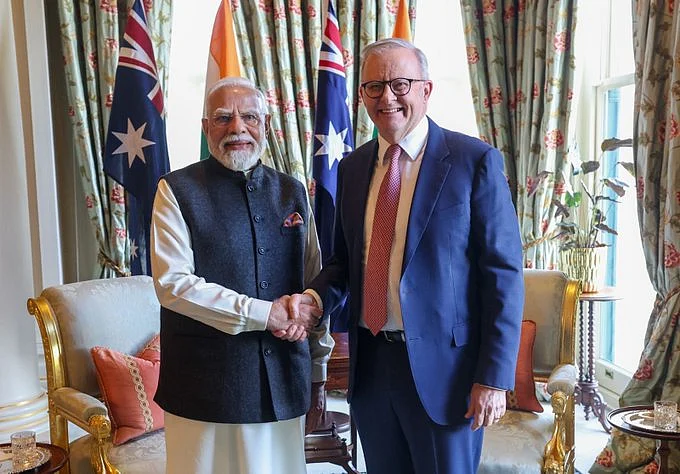
The administrative arrangement does not create a new agreement but is expected to remove the remaining obstacles to implementing the 2014 pact. While Prime Minister Anthony Albanese and Prime Minister Narendra Modi did not announce when uranium exports would begin or how much uranium Australia would supply, the agreement comes as India seeks to expand nuclear power generation to meet growing energy demand.
The announcement came after Albanese and Modi met in Melbourne during the Indian Prime Minister's visit to Australia for the annual leaders' summit.
Agreement finally implemented
Australia has the world's largest known uranium resources but does not use nuclear power or maintain nuclear weapons. All of its uranium production is exported. India, with a population of 1.4 billion people and a growing middle class, plans to install 100 gigawatts of nuclear power capacity by 2047, enough to power nearly 60 million Indian homes each year.


Although India has doubled its installed nuclear power capacity over the past decade, nuclear energy still accounts for only about three per cent of the country's electricity generation. Expanding capacity has also required securing uranium supplies, a process that has not been straightforward.
The two leaders did not provide details on when exports would begin or the quantity of uranium Australia would supply. Thursday's administrative arrangement is expected to remove the remaining obstacles to implementing the earlier agreement.
Why the deal was delayed
Australia's uranium export policy has long been tied to the Nuclear Non-Proliferation Treaty (NPT). As a signatory, Canberra has traditionally refused to sell uranium to countries that are not members of the treaty.
India is not a signatory to the NPT and has consistently argued that the treaty is discriminatory because it recognises only the United States, China, Britain, France and Russia as nuclear weapon states based on countries that tested nuclear devices before January 1967. India says that framework permanently disqualifies it from being recognised as a legitimate nuclear weapon state.
The country faced international technology sanctions and uranium trade bans after conducting nuclear tests in 1998, making access to uranium and nuclear technology more difficult.
The situation changed in 2008 when the Nuclear Suppliers Group granted India a waiver allowing it to buy uranium from member countries. Since then, India has pursued bilateral agreements permitting uranium sales and signed one such agreement with Canada in March.
Australia had historically ruled out a similar arrangement until India signed the NPT. That position later eased and Canberra agreed in 2014 to permit uranium exports, subject to International Atomic Energy Agency safeguards and the separation of India's civilian and military nuclear programmes. Thursday's administrative arrangement is expected to remove the remaining obstacles to implementing the earlier agreement.
Broader cooperation
In their joint statement, Modi and Albanese pledged greater defence and security cooperation in the Indo-Pacific, "reflecting a step-change in the depth and ambition" of the relationship, the text of the statement read.
The announcement came days after Australia criticised China for test firing a long-range ballistic missile from one of its nuclear-powered submarines into the South Pacific Ocean, an area protected by an anti-nuclear treaty.
The two leaders did not cite China while announcing the strengthened ties and did not take questions from reporters after delivering their statements.
Thousands of people turned out in Melbourne in the hope of seeing Modi during his visit.
Before arriving in Australia, Modi visited Indonesia. On Friday, he will travel to New Zealand for his first visit to the country after India and New Zealand signed a free trade agreement in April.
India is Australia's fifth-largest trading partner, with two-way trade in goods and services valued at 54.4 billion Australian dollars during the 2024-2025 financial year, according to Australian government figures.
(With inputs from AP)