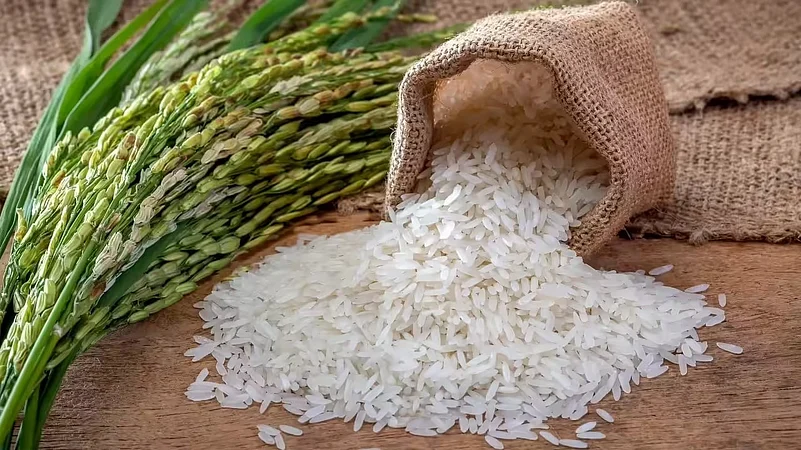
Madhya Pradesh Police are probing the alleged diversion of government’s custom-milled rice (CMR) meant for an ethanol plant, with an SIT investigating suspected misuse under the CMR scheme.
Investigators suspect subsidised FCI rice was diverted to a private mill while cheaper broken rice may have been used for ethanol production.
The case comes as India expands its ethanol programme after achieving 20 per cent blending, despite concerns over the transition to higher blends.
Madhya Pradesh Police are investigating the alleged diversion of government's custom-milled rice (CMR) meant for an ethanol plant before it reached its destination.
According to The Indian Express, the probe centres on a consignment of the government's CMR, which investigators said never reached its designated ethanol plant in Chhindwara.Instead, officials found the consignment parked inside a private rice mill in Waraseoni, where the accused allegedly "intended to recycle rice under the 2025-26 Custom Milling Programme and re-deposit it under the same scheme".
The Union government has permitted the supply of surplus foodgrain, including rice, held by the Food Corporation of India (FCI) to ethanol manufacturers to boost ethanol blending and reduce dependence on imported fossil fuels.
According to the report, Police have alleged that Rahul Pratap, an authorised representative of AVJ Agrico Pvt Ltd, "intended to divert the rice received from the FCI to a local rice mill and purchase cheaper rice for use in ethanol production at the Chhindwara ethanol plant, thereby causing direct financial loss to the Government".
Apart from Pratap, police have booked truck driver Durgesh Shendre and Sancheti Rice Mill proprietor Saurabh Sancheti. AVJ Agrico Pvt Ltd and Sancheti Rice Mill did not respond to calls and messages seeking comment, the report said.
"The truck carrying government rice appears to have been brought into the mill premises for the purpose of recycling it into custom milling and depositing it again under the CMR programme," the FIR filed last month alleged.





Rice Diversion Probe
Under the Open Market Sale Scheme (OMSS), only ethanol distilleries registered with Oil Marketing Companies and holding ethanol supply contracts are eligible to purchase FCI rice. The reserve price for rice supplied for ethanol production is Rs 2,320 per quintal, below the government's estimated economic cost of procuring, milling, transporting and storing rice, which is around Rs 4,100 per quintal.
Investigators are examining whether some ethanol operators, instead of processing the subsidised government rice into ethanol, allegedly sold it to rice millers at higher rates while procuring cheaper broken rice, available in the open market for around Rs 2,100 per quintal, for ethanol production instead.
"We have formed an SIT to probe the case. The allegations are being investigated," a senior police officer from Balaghat said.
According to investigators, records relating to paddy supplied for milling, stock verification, electricity consumption at rice mills, labour deployment and other operational indicators are being examined. Police also suspect that rice millers allegedly repacked the government rice in fresh gunny bags and deposited it back into government warehouses as freshly produced CMR under their milling contracts.

Inspection Findings
The inquiry began after officials received information that "government rice meant for an ethanol plant had allegedly been diverted". Acting on the complaint, the Tahsildar, Naib Tehsildar and the Junior Supply Officer conducted a surprise inspection at Sancheti Rice Mill in Waraseoni.
During the inspection, officials found a truck carrying 490 bags containing 242.55 quintals of government rice. Investigators noted that the vehicle was parked deep inside the mill premises despite sufficient open space and covered sheds near the entrance.
The truck driver told officials the rice had been loaded from the FCI depot at Navegaon in Balaghat and was meant for an ethanol plant at Borgaon in Chhindwara. He said he had not been given any documents relating to the vehicle or the rice consignment when he left the depot and had stopped near his residence for the night before continuing the journey.
The proprietor of the rice mill, however, told investigators that the truck owner knew him and had parked the vehicle inside the mill because it was raining and the truck could be kept under a tin shed.
"The statements of the driver and the rice mill proprietor are inconsistent. The driver stated he had gone home, whereas the proprietor stated the truck had been parked because of rain," the FIR stated. It also noted that the truck had already been covered with a tarpaulin and was one of three consignments dispatched together for the same ethanol plant.
Officials subsequently seized the truck and its cargo and handed them over to Waraseoni police. The inquiry also relied on the statement of the FCI depot manager at Navegaon, who told investigators that the rice had been officially released under the government's ethanol scheme and handed over to the ethanol company's authorised representative.
"After the rice leaves the FCI depot, there is no responsibility on the FCI to ensure its transportation to the ethanol plant," the depot manager's statement, quoted in the FIR, said.
India's Ethanol Push
Ethanol has remained in focus as the government continues to promote its use. India achieved its 20 per cent ethanol blending target in 2025, five years ahead of the original 2030 deadline.
The government has since announced excise duty exemptions for fuel blends containing between 22 per cent and 30 per cent ethanol, placing them on the same tax footing as E20. If the current trajectory continues, India could reach E25 within the next two to three years, with E85 and E100 emerging as niche fuel markets.
The transition, however, has not been without challenges. India moved from E10 to E20 in just three years, with little advance notice to vehicle owners. Many users reported a 5 to 12 per cent drop in mileage, although the government described the decline as "marginal".