Co-sponsoring the UNSC resolution is in New Delhi’s national interest.
Around 28 Indian ships and tankers are stuck on the east and west side of the Hormuz Strait.
The safety of around 9,000 Indian nationals in Iran is a big concern for New Delhi.
As the war in West Asia continues unabated with no signs of an early end, India co-sponsored a resolution in the U.N. Security Council that condemned the “egregious” attacks by Iran against Gulf Cooperation Council countries and Jordan and denounced Tehran for its threats and action on the Strait of Hormuz. The 15-nation Security Council, currently under the presidency of the United States, adopted the resolution on Wednesday with 13 votes in favour and abstentions by permanent members China and Russia.
Explaining the rationale behind India’s backing of the anti-Iran resolution MEA spokesman Randhir Jaiswal said, "We have 135 countries, who have co-sponsored this particular resolution. The resolution reflects several of our positions. As you know that we have a large diaspora in the GCC countries and their well-being and welfare is of utmost importance. The Gulf is also very important for our energy security needs.’’
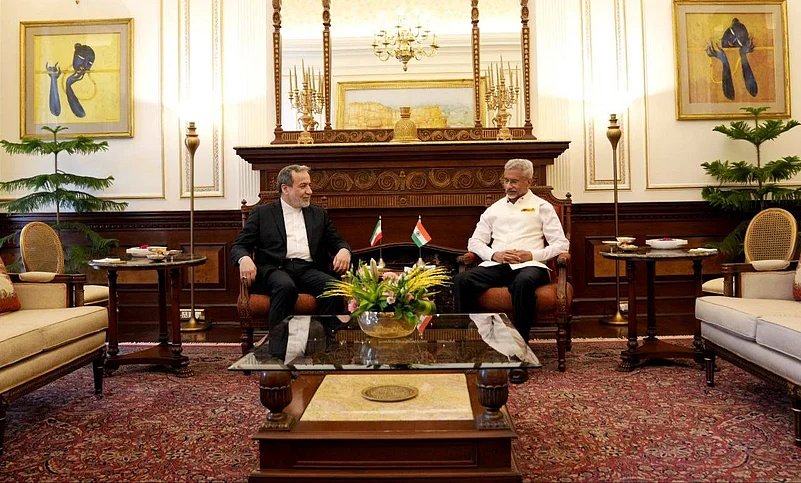
While criticising Iran at the UNSC in New York, New Delhi is simultaneously keeping its diplomatic channels open to Tehran. Foreign minister Subrahmayam Jaishankar is in touch with his Iranian counterpart Abbas Araghchi, and spoke to him three times in the last few days to secure India’s interests. During their most recent call, Jaishankar discussed “issues pertaining to the safety of shipping and India’s energy security. Beyond that, it would be premature for me to say anything,’’ Jaiswal said in his weekly briefing on Thursday. He gave no further details perhaps because no decision has yet been made by Iran.


The fact is that around 28 Indian ships and tankers are stuck on the east and west side of the Hormuz Strait. Vessels have been blown up here, and the 161 km stretch has become one of the world’s deadliest maritime choke points.
According to the ministry of ports,shipping and waterways, 24 vessels are West of the Strait, and four on the east. There are altogether 788 crew members aboard these ships. Jaishankar is pushing for allowing the vessels' safe passage. Till Iran gives the green signal and the logistics of those operations are in place the government is not in a position to do more than this at the moment.

Jaiswal also gave an update on Indians in Iran. "We have some 9,000 Indian nationals or thereabouts in Iran. They comprise students, seafarers, business people, and pilgrims. We issued an advisory some time back and, following the advisories, several, including a lot of them students – left the country and reached home."
The embassy in Tehran shifted several Indian nationals to safer locations outside the capital city. Those who want to leave Iran are being assisted in getting visas and land border crossing to Azerbaijan and Armenia, from where they are taking commercial flights back home.
India is being forced to walk a diplomatic tightrope as the war in West Asia deepens. New Delhi has so far failed to condemn the illegal war unleashed by the US and Israel on Iran. Initially it did not condemn the death of the Supreme Leader or the attack on a school that killed more than 170 children and teachers, but has since done so. Foreign secretary Vikram Misri signed the condolence book at the Iranian embassy on March 5 on behalf of the government, and on Thursday a condemnation of sorts for civilian deaths was in place. "As far as the schoolchildren you talked about are concerned–as I have said, we have issued several statements on the ongoing conflict. We have underlined the need for prioritising the safety of all civilians. We regret the precious lives lost and express our grief in that regard,’’ Jaiswal said in answer to a reporter's question on the US strike on a school. Analysts believe India could have done so right in the beginning,
Co-sponsoring the UNSC resolution is in New Delhi’s national interest. In fact, it has no choice but to back the GCC, with more than ten million Indians living and working across these countries. New Delhi cannot ignore the anxieties of governments and economies closely tied to the region.
Yet it is careful not to shut the door on Tehran. Despite Iran’s awareness that India did not immediately condemn the killing of Supreme Leader Ali Khamenei and has appeared closer to the positions of the United States and Israel than many in the Global South, Tehran too has kept channels open. The result is a curious diplomatic mosaic, a balancing act driven as much by geopolitics as by the need to safeguard India’s ships, energy lifelines and diaspora.