Tamil Nadu and West Bengal remain key resistors to Hindutva politics, drawing on enduring icons like E. V. Ramasamy and Rabindranath Tagore, even as Narendra Modi expands influence elsewhere.
M. K. Stalin and Mamata Banerjee are positioning themselves as defenders of federal autonomy, welfare politics and regional identity against the BJP’s electoral push.
From food and attire symbolism to campaign performances, the BJP’s cultural outreach faces questions over whether it can counter deeply rooted welfare models and identity-driven politics in these states.
With India's map turning a lot more orange in the recent years, three states in these assembly elections pose ideological challenges in terms of culture and language politics and icons that have long dominated the way these states have resisted the right-wing Hindutva forces that has gained a lot of traction across the country. E.V. Ramasamy or Periyar in Tamil Nadu and Rabindranath Tagore in West Bengal remain relevant and Prime Minister Narendra Modi's wave might not be enough to take over these last frontiers.
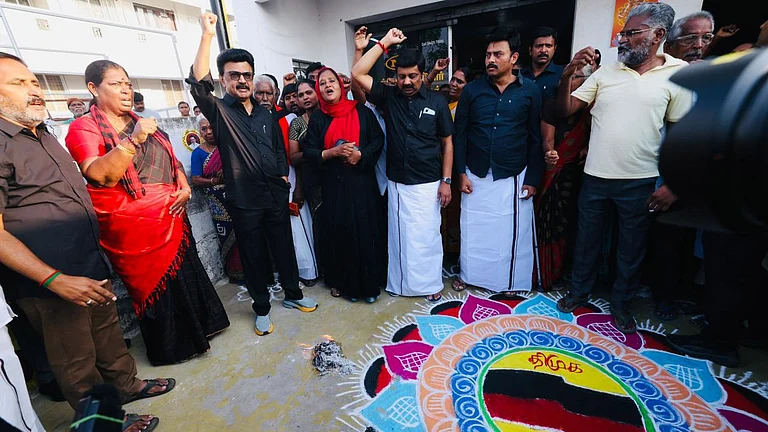
In Tamil Nadu, Chief Minister M.K. Stalin of the Dravida Munnetra Kazhagam (DMK) has challenged the Bharatiya Janata Party (BJP), which is fighting hard to create a government in the state, asserting that the state will never yield to New Delhi’s control. Taking a direct swipe at the Centre, Stalin said that the delimitation bill introduced by the BJP-led Union Government appeared to be an “attempt to punish” Tamil Nadu, a state that has controlled population growth and is among the best-performing in industrial development.
“As soon as this bill was introduced, I was the first to oppose it and lead protests, including burning copies of the bill. The fire we lit has reduced that bill to ashes,” he said.



In West Bengal, Chief Minister Mamata Banerjee is fighting hard against the erasure of voting to retain Bengal. Ahead of the ongoing elections, Banerjee continued attacking the BJP over the alleged deletion of names from electoral rolls and attempts to divide people on religious and caste lines. West Bengal has 294 constituencies, with the first phase covering more than half, while Tamil Nadu has 234 constituencies, unchanged since 1965, and an electorate of 5.73 crore voters, including 2.93 crore women, 2.83 crore men, and 7,728 third-gender persons.

As five states in India head toward major Assembly elections, three are considered strong bastions for resisting Hindutva ideology; the challenge is also through icons, popular culture, and regional and national figures. In Tamil Nadu, Periyar continues to shape the state’s welfarism politics in order to give dignity to the backward caste, expanded in the form of inclusion politics to Dalits.
In West Bengal, Banerjee’s welfarism, although of a different kind, also continues to be a fierce force. The politics of cultural appropriation speaks loudly during the ongoing elections, with PM Modi eating jhalmuri, spicy puffed rice, and politicising fish by not just holding it but also eating it, in order to challenge the perception that the BJP will ban meat if it comes to power. At the same time, Maithili Thakur, Bihar’s youngest MLA and a professional singer, performs Bengali songs during the BJP’s campaign before the Bengal elections.

Moreover, PM Modi’s recent visit to Tamil Nadu also sparked widespread discussion online, with several social media users commenting on his change in attire and appearance, raising questions over skin tone. While he departed Delhi in formal clothing, he appeared at his Tamil Nadu event dressed in traditional South Indian attire, including a cream shirt and a dhoti-style shawl.
Recently, Stalin said that the BJP is trying to enter the state wearing an “AIADMK mask,” but the DMK would “tear it open” and expose the “saffron brigade.”
“The saffron brigade is bent upon swallowing Tamil Nadu, but that will never happen as long as our black and red brigade is there,” he said.
Is cultural appropriation and mere speeches enough to dismantle welfarism, a long-standing legacy in these states?