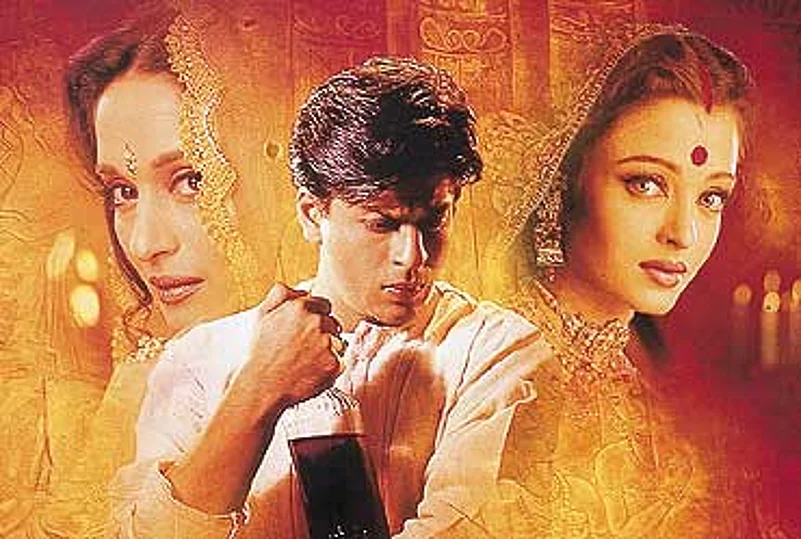
The first frame of the picturesque, flaming red tree effortlessly captures what Bhansali wants to do with his Devdas—turn an intimate tragedy into a glitzy spectacle. There are no spartan sentiments and resonant silences of a Bimal Roy here. No exploration of tangled relationships, no probing into romantic dilemmas. Bhansali intentionally delivers a film of gloss and excesses, a cinematic equivalent of the calendar art born of Raja Ravi Varma. The stained glass facades, the musical fountains, the faux Bengali ambience, the garish chandeliers, the heavy drapes, the never-ending stairways, the gaudy ghagras and saris, the Chor Bazar hukkas and binoculars, even a train compartment that screams luxury—Devdas drowns the senses with an in-your-face opulence. It wallows in its own visual vulgarity and is never apologetic about it.
In keeping with the extravagant setting, the emotions too are forever heightened. Each feeling is carefully choreographed, each teardrop so beautifully orchestrated. One populist dramatic confrontation follows another and the intrusive song-'n-dance set pieces, particularly the pulsating Dole re dola, make the screen tingle with hyper-kinetic energy. The dialogues are declamatory with mixed metaphors and play of words aplenty, a throw back to Mughal-e-Azam and Pakeezah. Sample this: "Gaonwalon ne kaha gaon chhod do, Bauji ne kaha Paro chhod do, Paro ne kaha sharaab chhod do, Ma ne kaha ghar chhod do, Ek din woh (read God) kahega duniya chhod do." In such a larger-than-life design, the gravitas of Dilip Kumar had to get replaced by the flamboyance of SRK. But Devdas is not about Devdas alone. Bhansali turns it into a tale of female bonding, between a head-strong Paro (Aishwarya's competent replay of Nandini in Hum Dil De Chuke Sanam) and Chandramukhi (Madhuri, ever graceful in her affectations). The weakest link is Jackie. His intolerable Chunibabu is a far cry from Motilal's dignified act in the Roy film.

Seeing Devdas is like witnessing an exhausting opera. It's all about the sheer self-indulgence, ego and audacity of its maker. Bhansali is a man in complete control, knows exactly how he wants to twist a familiar tale of unrequited love: by spinning Karan Johar-kind of fantastic Scottish castles in 19th century Bengal. However, in an age when the depth of love gets measured by the inane lines of an Archies card, when love can be simulated with the click of the mouse, when it can be bought off the shelf from a department store, Bhansali's Devdas is so entirely apt. Losing in love might be an anachronism in the 21st century, but Bhansali wraps Indian literature's biggest loser in toothpaste glam. Consume it.