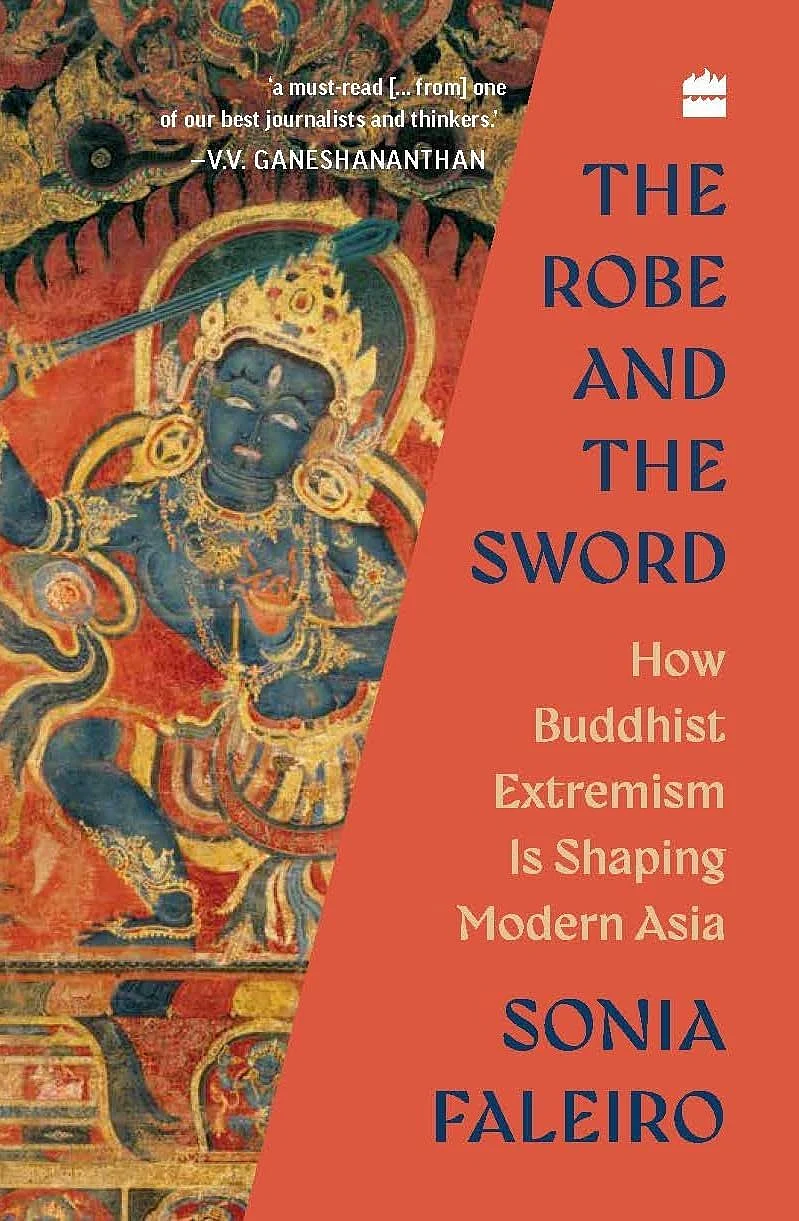
The Robe and the Sword challenges the idealised image of Buddhism by examining how religious authority, when fused with nationalism and political power, can fuel exclusion and violence.
Through case studies in Sri Lanka, Myanmar, and Thailand, Sonia Faleiro documents varied forms of Buddhist extremism, from militant monks to quiet institutional complicity.
The book argues that extremism emerges from political, social, and economic forces rather than theology alone, while highlighting voices within Buddhism that resist hate and defend compassion.
Buddhism has long occupied a special place in the global imagination. It is widely associated with calm, restraint, and compassion, a philosophy more than a religion, stripped of dogma and seemingly immune to the violence that has marked other faith traditions.
Sonia Faleiro’s The Robe and the Sword dismantles this comforting idea with care, precision, and moral seriousness. The book is not an attack on Buddhism itself, but a searching investigation into how religious authority, when fused with nationalism and political power, can become a force of fear and exclusion.
Faleiro, an award-winning journalist, structures the book around three countries, Sri Lanka, Myanmar, and Thailand, each offering a different expression of Buddhist extremism in the modern era. Together, they form a disturbing regional portrait of how monks in robes have stepped beyond spiritual leadership into the realms of mob mobilisation, ethnic hatred, and state violence. The result is a work that feels both deeply reported and urgently relevant.


First Section
The book opens in Sri Lanka, where Buddhism is inseparable from national identity. Here, Faleiro traces how Sinhala Buddhist nationalism evolved from a sense of historical grievance into a powerful political movement that marginalised minorities, particularly Tamil Hindus and Muslims. She carefully shows that this transformation did not happen overnight. Colonial policies, economic inequality, and the politics of majority rule created fertile ground for religious hardliners who claimed Buddhism itself was under threat.
At the centre of this section is the rise of militant monks linked to organisations such as the Bodu Bala Sena. Faleiro portrays these figures not as aberrations, but as products of a system that rewards outrage and grants clergy immense moral authority. What emerges is a chilling picture of how rumours, conspiracy theories, and coded language can turn everyday anxieties into collective violence. Importantly, Faleiro also documents moments of resistance, activists, minorities, and dissenting monks who challenge the idea that Buddhism must be defended through aggression.
Second Section
The second section, set in Myanmar, is the emotional core of the book. Here, the consequences of extremist ideology are laid bare in the persecution of the Rohingya Muslims. Faleiro explores how Buddhist nationalism merged seamlessly with military power, creating a narrative in which an entire community was portrayed as a demographic and cultural threat. Through interviews and firsthand observation, she shows how hate speech was normalised, often delivered from the pulpit by monks whose words carried immense influence.
One of the book’s most powerful insights lies in its examination of language. Faleiro reveals how slurs and simplified slogans were used to create an “us versus them” worldview, offering belonging to those who felt ignored or humiliated. Extremist leaders positioned themselves as protectors, father figures who promised dignity and purpose in exchange for loyalty. The outcome was catastrophic: mass displacement, brutality, and a moral collapse that many followers struggled to confront even after the violence unfolded.
Final Section
In Thailand, the final section takes a different tone. The violence here is less overt, but no less troubling. Faleiro examines how Buddhist institutions became deeply enmeshed with the military state, benefiting from privileges while remaining officially “above politics.” This contradiction, she argues, allowed corruption, excess, and quiet complicity to flourish. Monks appear not as fiery ideologues, but as figures shaped by money, celebrity, and proximity to power. The effect is unsettling precisely because it feels familiar: religion functioning as a shield for authority rather than a challenge to it.
Across all three countries, Faleiro resists easy explanations. She does not reduce extremism to theology alone, nor does she excuse violence as a misunderstanding of doctrine. Instead, she locates it at the intersection of economic insecurity, historical trauma, political opportunism, and human vulnerability. Ordinary people, she shows, are drawn to extremist movements not because they are inherently cruel, but because such movements offer clarity, pride, and a sense of order in uncertain times.
Stylistically, The Robe and the Sword is restrained and disciplined. Faleiro avoids dramatic flourishes, allowing facts, conversations, and quiet observations to carry the weight of the narrative. Her prose is accessible without being simplistic, making complex histories understandable to general readers while remaining rigorous enough for academic interest. The book’s structure, three distinct national case studies, works well, giving readers space to absorb each context while recognising the broader pattern that connects them.
One of the book’s greatest strengths is its refusal to generalise. Faleiro repeatedly reminds the reader that Buddhism, like any religion, contains multitudes. Alongside extremists, she introduces monks who reject nationalism, believers who risk their safety to protect minorities, and survivors who refuse to surrender their humanity despite immense loss. These voices prevent the book from becoming a catalogue of despair and instead frame it as a struggle over the soul of faith itself.
In the end, the Robe and the Sword is not only about Buddhism or Asia. It is about how sacred ideas are reshaped by modern politics, how fear travels faster than compassion, and how institutions meant to guide moral life can be bent toward exclusion. Faleiro’s work feels especially timely in a world where religion and nationalism are once again entwined across continents.
This is an unsettling book, but a necessary one. It asks readers to abandon comforting myths and to confront a harder truth: no tradition, however peaceful its ideals, is immune to misuse. For anyone interested in contemporary history, political religion, or the fragile line between faith and power, The Robe and the Sword is a vital and sobering read.