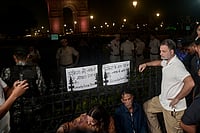
In many cases, backlash erupted before audiences saw the film over titles, casting, history, or perceived offence, forcing directors and actors to respond publicly.
Sanjay Leela Bhansali was assaulted, Deepika Padukone received death threats, and Karan Johar issued a pressured apology.
Beyond individual films, these incidents reveal how political, religious, and cultural pressures can shape what reaches theatres and what never gets made at all.
Even before its release, Ghooskhor Pandat, directed by Neeraj Pandey and starring Manoj Bajpayee, has found itself at the centre of a political and legal storm. Petitions have been filed, an FIR has been registered in Lucknow, and political leaders across parties have called the title “derogatory” and “casteist”, arguing that it maligns the Brahmin community. As demands for a ban grow louder, the makers have defended the film as a fictional cop drama and temporarily pulled down promotional material. The film hasn’t released yet — but the controversy already has.
What follows isn't just a list of controversies. It's a record of who was affected, directors assaulted, actors threatened, films stalled and apologies extracted. In each case, the pressure came before the public had even bought a ticket.
1. Padmaavat (2018)


Assault on set, death threats, and a forced title change.
When Sanjay Leela Bhansali began shooting Padmavati in 2017, members of the Karni Sena stormed the Jaipur set and physically assaulted him, accusing the film of distorting Rajput history.
The protests escalated quickly. Fringe leaders publicly threatened to behead Deepika Padukone, who played Rani Padmavati. The allegation that the film showed a romantic dream sequence between the queen and Alauddin Khilji persisted despite repeated denials from the makers.
The Central Board of Film Certification cleared the film only after modifications, including changing the title to Padmaavat and adding disclaimers. The title change was not the only alteration. In the song Ghoomar, Deepika Padukone’s midriff was digitally covered with computer-generated fabric in the revised version released ahead of certification, reportedly to comply with the board’s guidelines. The updated cut replaced the earlier version online without a formal announcement.
The film was released in January 2018 under heavy police security across multiple states. Bhansali did not remove the film. But he had to rename it and make visible alterations to get it into theatres.
2. Ae Dil Hai Mushkil (2016)

A public apology under political pressure.
In the aftermath of the Uri terror attack, political groups in Maharashtra opposed the release of films featuring Pakistani actors. Ae Dil Hai Mushkil starred Fawad Khan. Maharashtra Navnirman Sena threatened to block the film's release. Cinema owners hesitated. The stakes were high, the film carried major investment and a Diwali release window.
Karan Johar released a video statement saying he would no longer work with Pakistani artists. Later, in an interview with CNN-News18, Johar admitted how that moment played out for him: "It felt like there was an invisible gun on my head."
The film was released after assurances and reported financial arrangements for security. The apology, however, stayed in public memory.
3. Jodhaa Akbar (2008)

Historical debate turns into bans.
Ashutosh Gowariker's epic romance between Mughal emperor Akbar and Rajput princess Jodhaa Bai faced immediate opposition from Rajput groups, who claimed the depiction was historically inaccurate.
Protests erupted in Rajasthan and parts of Uttar Pradesh. Screenings were stalled. Some states imposed temporary bans before courts intervened.
Aishwarya Rai Bachchan and Hrithik Roshan found themselves at the centre of a political debate about lineage and community pride. Gowariker defended the film as research-based, but legal battles preceded its wide release.
4. Raees (2017)

Banned in Pakistan and a debut caught in crossfire.
Rahul Dholakia’s Raees, starring Shah Rukh Khan and Pakistani actor Mahira Khan, was banned in Pakistan in 2017. The Central Film Censor Board there refused certification, stating that the film portrayed Muslims in a negative light and carried what it called an “anti-Islam” theme.
For Mahira, this was not just another controversy. It was her first Bollywood film.
The timing made everything worse. Relations between India and Pakistan were already tense following the Uri attacks in 2016, and there had been growing pressure against Pakistani artists working in India. By the time Raees was released, she could not travel to India to promote it. Nor could the film be released in her own country.
In later interviews, Mahira admitted the backlash took a personal toll. She spoke about anxiety, panic attacks, and feeling publicly attacked from all sides. At one point, she said, the pressure became so overwhelming that she fainted during a panic episode. She eventually sought therapy.
What should have been a milestone moment in her career turned into something far heavier. Raees went on to perform well at the Indian box office. But for Mahira Khan, the debut came wrapped in silence, restrictions, and a backlash she had little control over.
5. Goliyon Ki Rasleela Ram-Leela (2013)

A title that sparked FIRs.
Before release, Sanjay Leela Bhansali's film was simply titled Ram-Leela. Religious groups objected, arguing that the title hurt Hindu sentiments by invoking a sacred name in a violent romantic drama.
An FIR was filed against Bhansali, Deepika Padukone, and Ranveer Singh. Court proceedings followed.
The compromise was strategic: the title was expanded to Goliyon Ki Rasleela Ram-Leela. The film itself remained unchanged.
6. Bajirao Mastani (2015)

Descendants object, and protests threaten screenings.
Another Bhansali film, another historical dispute. Descendants of Peshwa Bajirao opposed the film's portrayal of their ancestor and Mastani, alleging misrepresentation. Protests took place in Pune and parts of Maharashtra. There were attempts to disrupt screenings.
Bhansali maintained that the film was based on documented accounts and creative interpretation. Despite the noise, the film was released, but not without weeks of public tension.
7. Pathaan (2023)

A song triggered protests and a colour became the controversy.
Siddharth Anand’s Pathaan, starring Shah Rukh Khan and Deepika Padukone, ran into political backlash weeks before its release. The objection centred on the song Besharam Rang, in which Deepika appeared in a saffron-coloured outfit.
In Madhya Pradesh, State Home Minister Narottam Mishra called the visuals “objectionable” and said the costumes and scenes should be corrected, warning that the state government would otherwise consider blocking the film’s screening. He accused the makers of hurting sentiments and described the song as having been shot with a “dirty mindset”.
The criticism was not limited to the ruling party. Leader of Opposition Govind Singh also objected to the costumes, calling them unacceptable within Indian culture. Right-wing groups, including the Sanskriti Bachao Manch, staged protests and demanded that the song be removed. Some protesters framed the use of saffron — a colour associated with Hindu identity — as an insult.
The film was not banned in the end. But the controversy dominated headlines before release, turning a dance number into a national debate.
After the Noise
Strip away the box office numbers and the Twitter trends, and something sharper remains. In every case, the film became secondary. The fight was about control — who gets to narrate history, who gets to represent faith, who gets to decide what is offensive and what is art.
What's unsettling is how often the loudest voices belonged to people who hadn't seen a single frame. Scripts were condemned without being read. Scenes were debated without being screened. Titles were tried and sentenced in public courtrooms before censor boards, or judges weighed in.
And the cost wasn't abstract. Sanjay Leela Bhansali was slapped on his own set. Deepika Padukone faced open death threats. Karan Johar recorded an apology he later admitted he didn't believe in. Anurag Kashyap spent years waiting for a release window. Alankrita Shrivastava had to defend the legitimacy of stories about female desire.
Some filmmakers fought back and won in court. Some compromised quietly. Some absorbed the humiliation and moved on because hundreds of livelihoods depended on a release date. That's the part we don't talk about enough: behind every "controversial film" are crew members, technicians, and junior artists whose paycheques depend on whether the theatre doors open.
None of this means filmmakers are above criticism. Cinema should be debated. It should be argued over. But there's a difference between critique and coercion. Between protest and intimidation.
The pattern is clear now: outrage builds, political groups amplify it, pressure mounts, and the makers are pushed into a corner. Sometimes they hold their ground. Sometimes they blink. Either way, the message travels, loud and clear, to the next director drafting a risky script.

And maybe that's the quiet consequence of all this. Not just the films that were delayed or renamed. But the ones that were never written at all.