Nemcha Kipgen was appointed Manipur Deputy CM, becoming the first woman and first Kuki-Zo leader to hold the post.
Her appointment sparked protests by Kuki-Zo groups, who accused her of betraying the demand for separate administration.
The move has deepened political divides amid Manipur’s ongoing ethnic conflict.
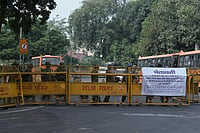
As new government was sworn in at Imphal on Wednesday, protests erupted hundreds of kilometres away in New Delhi. Outside Manipur Bhawan, Kuki-Zo students' organisation raised slogans—“Nemcha In, Justice Out” and “We want Nemcha out”—angrily rejecting the elevation of Nemcha Kipgen as one of the state’s Deputy Chief Ministers.
The protests happened with the formation of what the BJP has called a “popular government” in violence-scarred Manipur, led by Yumnam Khemchand Singh as Chief Minister. Alongside him, three Deputy Chief Ministers were appointed: Kipgen, Losii Dikho—a senior Naga People’s Front (NPF) leader and MLA from Mao—and two legislators from the Meitei community.
For many in the Kuki-Zo community, however, Kipgen’s appointment is not historic—it is a betrayal.
‘A First, But at What Cost?’
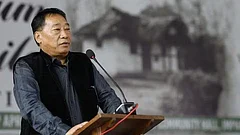
Nemcha Kipgen, 60, is the first woman Deputy Chief Minister of Manipur and the first leader from the Kuki-Zo tribal community to hold the post. She virtually took oath from Manipur Bhawan in New Delhi, administered by Governor Ajay Kumar Bhalla, soon after Khemchand Singh was sworn in at Lok Bhavan, Imphal.
Her elevation comes nearly 21 months after ethnic violence erupted in Manipur on May 3, 2023, leaving over 260 people dead, more than 1,500 injured, and over 60,000 displaced.
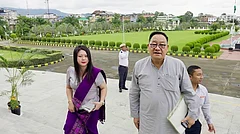
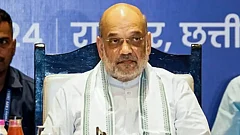
Kipgen herself was among the 10 Kuki-Zo MLAs, including seven from the BJP, who had publicly demanded a separate administration with legislature following the outbreak of violence. Her official residence in Imphal West was also burnt by miscreants in June 2023, making her one of the politicians directly affected by the conflict.
Yet on Tuesday, Kipgen was one of five BJP Kuki-Zo MLAs who attended the BJP legislature party meeting in New Delhi, where Khemchand Singh was elected leader, effectively ending months of political boycott by Kuki-Zo legislators.
Outlook reached out to Kipgen but did not receive a response at the publication of this report.
A Long Political Journey
Kipgen’s political career began with the Sadar Hills District Demand movement, led largely by women activists. She was first elected to the Manipur Assembly in 2012 from Kangpokpi on a Manipur State Congress Party (MSCP) ticket. The MSCP later merged with the Congress in 2014, before Kipgen resigned from the party in 2017 and joined the BJP.
She served as Minister for Social Welfare and Cooperation (2017–2020) in the first N. Biren Singh government and later as Cabinet Minister for Textile, Commerce and Industry in the second Biren Singh ministry.
Her husband, S.T. Thangboi Kipgen, is the chairman of the Kuki National Front (President), a militant group under a Suspension of Operations agreement with the Government of India since 2008.
The BJP has projected Kipgen’s elevation as a step toward inclusive governance in a deeply fractured state. For many in the Kuki-Zo community, however, her appointment has only widened the sense of abandonment.
As Manipur attempts to move forward politically, Kipgen’s rise now stands as both a milestone and a deep fault line, in a state still struggling to heal.
“She Chose Power Over People”
Outside Manipur Bhawan, protestors including the survivors of the violence, said Kipgen no longer represents them.
“All our people are aiming for one thing—separate administration with legislature,” said Chachan, a 23-year-old student who was pursuing her master’s degree at Manipur University when the violence broke out. Her family is now in a relief camp in Churachandpur, while she is in Delhi searching for work.
“She went out of her way for her own profit. She wasn’t elected, she was appointed. That’s why we call her a traitor,” Chachan said, adding that the protestors wanted Kipgen to explain “how she has the guts to betray her own people.”
Another protester, Joyce, said the decision of Kuki-Zo MLAs to join the same government they accuse of enabling violence was deeply personal.
She has been the victim of violence as well. Her village, Aigizang in Khamenlok, one of the flashpoints of the violence, was attacked while her family members were scattered in different locations.
“We lost our homes. My mother and sisters were alone. My family stayed in camps for days. Now they are living in government housing meant for relief,” she said. “Justice will never come from this government. We want a separate administration—this is the only way.”
“This is the very government that hunted us down, that used every machinery to kill us,” she said. “Our MLAs who consented to this do not represent us anymore. We want them to step down.”
Echoing that sentiment, Tingbem, president of the Kuki Students’ Organisation (KSO) Delhi, said Kipgen had “chosen enemies over her own people.”
“She has made peace with those who tortured us, who paraded our sisters naked, who beheaded our brothers,” Tingbem said. “She has never even taken the time to speak about our grievances.”
“She is no longer one of us," she added.
Silence, Condemnation, and Contradictions
Kipgen has not openly condemned the violence in Manipur, except in the case of the viral incident involving two Kuki-Zo women who were paraded naked and gang-raped. At the same time, she has continued to sign memorandums demanding a separate administration, along with other Kuki-Zo MLAs, adding to the contradictions surrounding her political stance.
The Kuki Inpi Manipur, the apex body of the Kuki tribes, has formally opposed any Kuki-Zo MLA joining the new government.
“The Kuki Inpi Manipur is vehemently opposed to any Kuki-Zo MLA joining such a government,” the organisation said in a statement, referring to the Guwahati Conclave resolution adopted earlier. “Any MLA who chooses to do so must come clean before the public.”