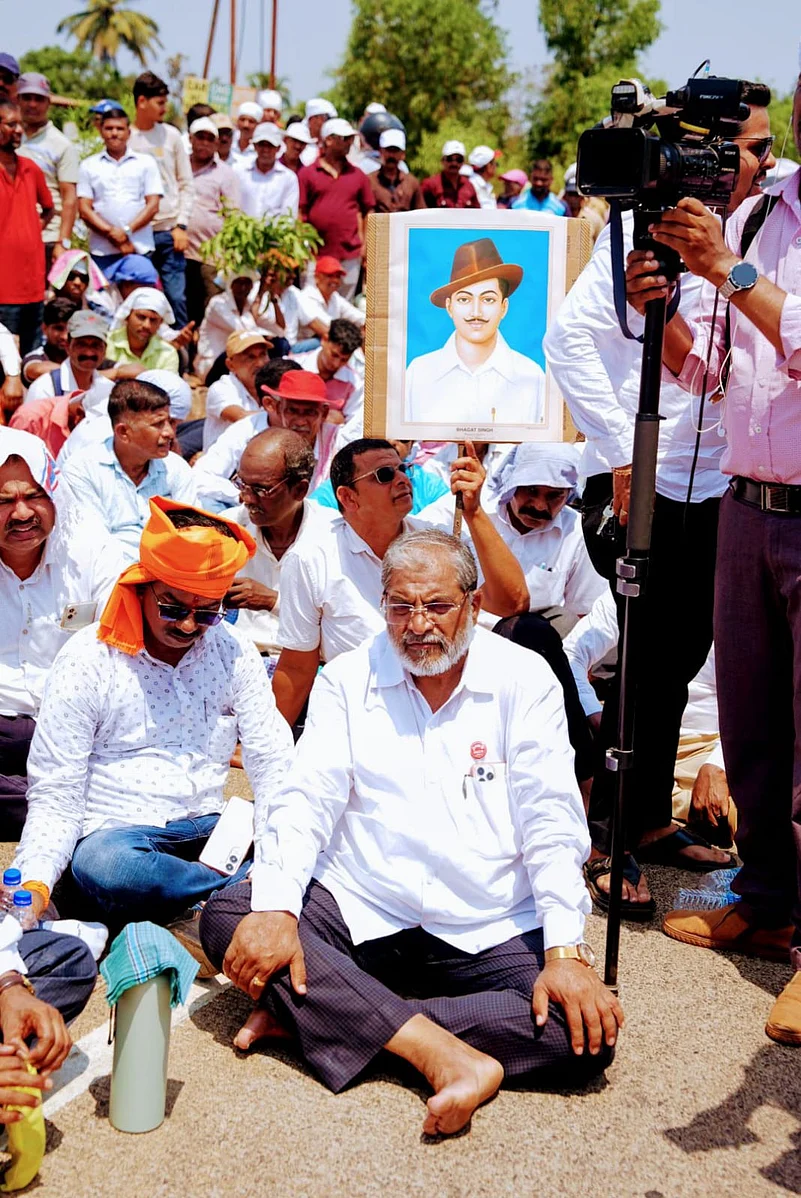
Thousands of farmers, blocked the Mumbai-Goa highway on March 23, demanding compensation for their mango and cashew crop loss.
On most days, the highway carries the region's harvests to markets, now it carried the farmers' collective grief and demands.
After assurance from the district collector, the protest had paused, but the fight, they knew, was far from over.
In the scorching heat, when flowers turn too shy to bloom and leaves wither to merge with the parched earth, the farmers of Maharashtra's Nandgaon chose not to rest. Instead, they gathered, thousands of voices rising in unison, roaring the immortal words of Lal Bahadur Shastri: Jai Jawan, Jai Kisan. The slogan, born decades ago to honour the soldier and the farmer, rang out once again along the sun-baked Mumbai-Goa highway, a defiant echo against a season that had offered nothing but despair.
Sindudurg, situated roughly 450 kilometers south of Mumbai, lies at the very heart of India's famed Alphonso mango belt. This is a land of deep, well-drained sandy loam and red laterite soil, conditions that have long been kind to the cultivation of mangoes and cashews, the twin lifelines of the local economy. But this year, the farmers say, the earth has turned cruel. The produce, they insist, is the worst they have ever witnessed.
Among the many voices raised in protest was that of Yash Surendra Parab. A farmer from Devgad, a town that is synonymous with premium Alphonso mangoes, Parab stood at the forefront of the agitation. His face, weathered by years of labour under an unforgiving sun, spoke of losses that ran into lakhs. "This year's produce is worse than last year," he said, his voice barely rising above the constant chants surrounding him. "The flowers are not blooming. The fruit quality is degrading." When asked what lay behind this agricultural collapse, Parab did not hesitate. "It is the changing climate," he said simply. "The heat has been unbearably intense, and yet the winter stretched on for far too long. Even when we decided to increase the use of pesticides, the produce did not come out good." Then came the admission that cut deepest: "I have around ten to twelve people working in my farm. I have not been able to pay their salaries on time."



Parab was not alone. Thousands of farmers, their stories differing in detail but united in anguish, had gathered to block the Mumbai-Goa highway, a major artery that usually carries the region's famed harvests to markets across the country. Now, it carried only their collective grief and their demands.
At the front of the crowd, surrounded by a restless sea of farmers on one side and camera-wielding police on the other, sat farmer leader Raju Shetti. A former member of parliament from Hatkanangle, Shetti has long been a formidable voice for agrarian rights in Maharashtra. As the slogans swelled around him, he laid out the demands with the precision of a man who knows that this time, words must translate into action. "Pay the mango farmers Rs 5 lakh compensation," he declared. "And pay the cashew farmers Rs 3 lakh compensation."
Behind him, the highway stretched into the distance, a road that once promised prosperity, now blocked by the very hands that once tilled the soil. The farmers of Nandgaon, like Parab, had come not just to protest, but to remind the world that when climate change steals the harvest, it also steals livelihoods, dignity, and the simple hope that the next season will be kinder.

Double Trouble
For the coastal belt of Maharashtra, a region synonymous with the golden blush of the world famous Alphonso mango and the crunch of the cashew, summers of 2025 and 2026 will be remembered not for harvest festivals, but for empty orchards and mounting debts. In a cruel twist of fate, two consecutive years delivered a one-two punch of climatic extremes that pushed the region’s horticulture to the brink. The 2025 season was scorched by a relentless heatwave, while 2026 brought an abnormally prolonged winter. Together, these weather anomalies did not merely reduce yields; they devastated them, destroying the delicate biology of the mango trees and the flowering patterns of cashews, leaving farmers with losses that, in some districts, touched a staggering 90 percent.
Temperatures in February and March 2026 soared past 42 degrees Celsius, a threshold the delicate fruit was never meant to endure. Under the relentless sun, the fruit began to cook on the branches. Farmers watched in despair as the young mangoes developed spongy tissue, a physiological disorder where the pulp turns into a white, fibrous, tasteless mass, rendering the fruit unsellable. For the cashew crop, the heat accelerated flowering, leading to poor fruit set and malformed nuts. By the end of the 2025 season, the initial cracks in the agricultural backbone of the region were showing, but nature was not finished.
If 2025 was a story of scorched earth, 2026 was one of frozen hope, farmers say. Defying the patterns of global warming, Maharashtra experienced an unusually extended winter that lingered well into the months when mango trees typically bloom. While a slight chill is beneficial for flowering, the prolonged cold spell wreaked havoc on the trees’ reproductive cycle. Due to this, the trees produced an overwhelming majority of male flowers, which wither and fall away, rather than the hermaphroditic female blossoms required to set fruit. The result was a flowering season with no fruit to follow. Concurrently, the cashew crop suffered from delayed blossoming, pushing the harvest cycle out of sync and exposing the kernels to unseasonal rains and pest infestations that further slashed yields.
The numbers that emerged from government surveys painted a picture of agricultural ruin. In the 2026 season, the mango heartlands of Sindhudurg and Ratnagiri recorded estimated losses between 80 and 90 per cent, with neighbouring Raigad district faring only marginally better. It was not just a bad year; it was effectively a total wipeout. The cashew industry, a vital source of income for coastal farmers, mirrored this decline with estimated losses of 60 to 70 percent in Sindhudurg. Farmers here say that they invested heavily in fertilization, irrigation, and labour throughout the year but all of this translated into a complete loss of livelihood. “Climate change has been the biggest reason for the despair of the farmers,” Shetti says.
The financial strain was exacerbated by market volatility, as local growers found themselves unable to compete with cheaper, inferior mango dupes from Karnataka and Kerala and processed cashews imported from Africa.
A few days back, on March 12, farmers had a similar sit-in in Sindudurg, raising these demands. Responding to this, Maharashtra Chief Minister Devendra Fadnavis said that the government will look into the problems of the farmers. Speaking at a high-level meeting in Vidhan Bhavan on March 17, Fadnavis said the government is committed to supporting orchard farmers who suffered heavy losses due to unseasonal weather, which led to large-scale flowering damage in mango and cashew crops.
“Mango and Cashew crops, which are extremely important for Konkan, have suffered losses due to the shedding of blossoms. A firm commitment stands to support the affected mango and cashew growers during this challenging time. Relief measures for the impacted farmers will be announced on the floor of the House before the conclusion of the ongoing session, ensuring timely assistance and reaffirming support for the farming community of Konkan,” Fadnavis said on a Facebook post.
Farmers Hell-Bent On Their Demands
A sit-in protest later turned to a march when the farmers decided to take their demands in a firm way straight to the District Collector’s office. This demanded a 6 kilometre walk. And before setting off, the farmers echoed the name of and remembered Bhagat Singh, the revolutionary who was killed on this very day in 1931. “Today is the death anniversary of a revolutionary leader of our nation, Shahid Bhagat Singh,” Shetti said.
While the long march continued, Shetti added that the central government must look into this matter and declare the climate crisis here as an urgency. “The government in the state and the central government shall look into this matter and declare this a climate emergency. Fund from the National Disaster Relief Fund can be used to make sure that the farmers here do not suffer,” Shetti said.

As the march reached the halfway point, Sindhudurg district collector, Trupti Dhodmise, arrived in a car, steering straight toward the gathered farmers and Shetti. Stepping out into the heat, she faced the restless crowd with a measured calm. "I came to hear the demands of the farmers," she says. "They are our farmers, and we are here to help them. I will take up their issues to the state government."
Her words offered a sliver of reassurance. For a moment, the tension eased, and the farmers allowed themselves a collective exhale, a brief pause in a struggle that had left them breathless for months. They gathered around Shetti, their trust in him forged through years of shared hardship.
Standing at the centre of the crowd, Shetti addressed them with the resolve of a man who had fought these battles before. "We are giving the government only two more days," he declared. "We are ending our protest for now. We do not want to cause any trouble, nor do we expect any trouble from the police toward our farmers. But after two days, we will decide to head toward Mantralaya, and even to Varsha Bungalow if we must. We will bring our cars, and if not cars, we will go by train. Trains are our, we do not need to book tickets. But we will not end this fight before receiving our due compensation."
His voice carried not just anger, but the weary determination of a community that had been pushed to the edge. The farmers nodded in silence; their eyes fixed on their leader. The protest had paused, but the fight, they knew, was far from over.