Rahul Gandhi called the project a “crime against nature and tribal heritage.”
The plan includes a port, airport, township and power project on the island’s southern tip.
Activists warn of large-scale forest loss and risks to the Shompen tribe and fragile ecosystems.
A vast infrastructure project is underway on Great Nicobar Island, an island known for its rainforest and indigenous communities..
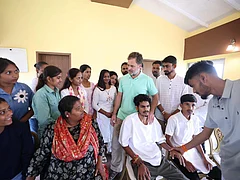
When Rahul Gandhi arrived on Great Nicobar Island on Wednesday, walking through forests marked for clearance, he called what he saw “one of the biggest scams and gravest crimes against the natural and tribal heritage of the country.” His visit has pulled some attention to a project that has long moved forward.
Great Nicobar Island has one of the last intact tropical rainforests in India, a tribe of roughly 300 people who have never needed a government ID, and a ₹92,000 crore project set to transform both.
The Great Nicobar Development Project, a transshipment port, international airport, township and power plant on India’s southernmost tip, has been in the works for years. It has received environmental clearances, survived legal challenges at the National Green Tribunal (NGT), and been championed by the government as a geostrategic necessity, positioned to compete with Singapore and counter China’s growing influence in the Indian Ocean.
The Shompen tribe, a Particularly Vulnerable Tribal Group (PVTG), have lived in these forests since before recorded history. They communicate in a language that has not yet been fully deciphered.


Social ecology researcher Manish Chandi, who has worked among the Andaman and Nicobar’s indigenous communities says, “We have met some families of Shompen living in Great Nicobar and none of them are interested in outsiders coming there and setting up shop or home or factories. The southernmost family of the Shompen live close to Indira Point, and their territory extends to the mouth of the Galathea Bay, which is exactly where the port is slated to be constructed. So you can imagine a complete transformation of their lives.”
When the government claimed that legal safeguards and constitutional provisions for tribal communities had been followed, Chandi asks: “Has the environment minister conducted an assessment? Has he ever talked to the Shompen or the Nicobarese about the problems they are facing and the other ground realities?”
Does Gandhi’s visit matter, or can it slow down a ₹92,000 crore project?

Activist says that the project will fell an estimated one million trees across 130 sq km of primary rainforest, some of the last of its kind in India. It will subsume Galathea Bay, the country’s most significant nesting ground for the giant leatherback turtle. It will bring a projected population increase from 8,000 to 350,000 people onto an island that sits on the Ring of Fire, in one of the most seismically active regions on the planet. The same coastline saw a permanent subsidence of over four metres during the 2004 Indian Ocean earthquake and tsunami.
Environmental researcher and IIT Bombay professor Pankaj Sekhsaria, who has spent three decades documenting these islands, has warned that the approval process itself has been compromised. “Institutions like WII, NGT and others have actually facilitated the clearances the project needed. The autonomy and scientific rigour of institutions like WII and NGT are clearly compromised.”
Historian Ramachandra Guha has described the project as “imposed by New Delhi with no transparency, no accountability, and no consultation with the Indians most affected by it,” warning that “in social and ecological terms, this project will bring devastation in its wake.” He has also noted that the project has been placed under the Home Ministry, not Shipping or Commerce, making it increasingly difficult for journalists to visit the island and creating “an atmosphere of secrecy and repression.”
In an open letter to the Environment Minister, over 70 signatories, including Guha, Romulus Whitaker, and Ravi Chellam, argued that it was “disingenuous to label what is essentially a commercial project as a strategic one and invoke national security whenever questions on the project are raised,” noting that the airport, the only component with genuine defence utility, occupies just 5 per cent of the total project area.
The NGT’s clearance in February 2026 did not settle the debate. Environmentalist Debi Goenka of the Conservation Action Trust told Outlook: “The NGT and even the Supreme Court are not willing to stay a project which impacts the environment if the government has a significant interest in it. The project will destroy 130 sq km of pristine forest” whose full biodiversity value remains unknown. Former environment minister Jairam Ramesh called the ruling “deeply disappointing,” saying there is “clear evidence that the project will have disastrous ecological impacts” and that clearance conditions “will do little to deal with these long-term consequences.”
Survival International, in a report submitted to the United Nations, described the project as a “death sentence for the Shompen, tantamount to the international crime of genocide,” noting that the community was never asked for their Free, Prior and Informed Consent.
A Shompen woman, quoted in the same report, said: “Don’t come into our forests and cut them down. This is where we collect food for our children and ourselves. We don’t want outsiders in our forests.”