






Incumbent CMs in multiple states are seeking a verdict on governance
Debates around delimitation have emerged as a defining undercurrent in these elections
The verdict, on May 4th, will be an important barometer of the popular mood
It’s a big referendum on incumbent chief ministers: Assembly elections 2026 kick-off in a few days. At the centre of this election moment stand Mamata Banerjee, Himanta Biswa Sarma, M. K. Stalin and Pinarayi Vijayan, each representing a distinct grammar of power, governance and political response. In West Bengal, Banerjee continues to anchor her politics in mobilisation and resistance, sustaining an image that blurs the line between incumbent and insurgent.
In Assam, Sarma embodies a sharply centralised and assertive model of leadership, closely aligned with national power. In Tamil Nadu, Stalin operates within the legacy of Dravidian politics while increasingly positioning himself at the forefront of federal resistance.
In Kerala, Vijayan represents a model of governance that blends ideological continuity with administrative centralisation, redefining the contours of Left leadership. “BJP will draw a blank this time too,” Vijayan said.
It is through these leaders that the current electoral moment can be best understood. As these four states, along with the Union Territory of Puducherry, head into assembly elections, the contests are not merely about electoral turnover. They unfold against the backdrop of a larger structural tension that has brought questions of representation, autonomy and federal balance into sharper focus.
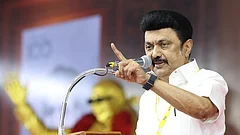


Debates around delimitation have emerged as a defining undercurrent in these elections. With the prospect of parliamentary seats being redistributed on the basis of updated population data, concerns have intensified, particularly in southern states, over a potential erosion of political representation despite decades of demographic stabilisation.
Leaders such as Stalin have framed this not merely as a technical exercise, but as a question of federal equity, arguing that states which have successfully controlled population growth risk being disadvantaged in the national power structure. "This is not just about the number of MPs... this is about all state’s rights… if delimitation exercise is carried out based on 2026 population levels, our representation in Parliament will suffer. This is why we have raised our voice first. This is not just about the number of MPs... this is about all state's rights," Stalin said.
In this context, delimitation becomes more than an administrative recalibration. It is a political flashpoint, shaping how states negotiate their place within the Union. Each state carries its own specific context while feeding into this broader churn. West Bengal remains deeply polarised, shaped by a prolonged confrontation between regional assertion and national expansion. Mamata said that by attempting to "destroy Bengal, BJP will lose power in the country. West Bengal has a long tradition of communal harmony. Any attempt to divide people in the name of religion will be resisted."
Assam continues to grapple with questions of identity, citizenship and governance, even as political authority remains tightly consolidated. “Development has been the key. But what is it that people can really expect? We have two agendas — development and identity. Assam people have been going through an identity crisis for the last three or four decades,” Sarma said.
Tamil Nadu stands at an inflection point, where the Dravidian order faces both internal transition and external pressure. Kerala presents a more nuanced contest, where governance models, welfare delivery and ideological positioning intersect, even as leadership becomes increasingly centralised. Puducherry, meanwhile, underscores the fragility of coalition politics within a smaller electoral framework, where regional aspirations remain closely intertwined with national influence.
Elections in Assam, Kerala, and Puducherry are scheduled for 9 April 2026, while Tamil Nadu and West Bengal will go to the polls on 23 April 2026, with West Bengal voting in a second phase on 29 April 2026. Counting of votes for all five regions will take place on May 4th, offering a definitive snapshot of voter sentiment across these politically significant regions.
Outlook’s cover story The Flagship Project approaches these elections through the prism of leadership. Moving beyond electoral arithmetic, it examines how individual political figures shape, and are shaped by, the larger structural tensions between Centre and state, continuity and change, mandate and narrative.
In West Bengal, Snigdhendu Bhattacharya’s “Didi in Her Favourite Shoes” presents Banerjee as a leader rooted in confrontation and endurance, positioned against Narendra Modi and an expanding opposition apparatus. In Assam, Ashlin Mathew’s “Himanta Hustle: Man Of Many Words” captures Sarma as emblematic of assertive governance and political consolidation.

Tamil Nadu’s moment is explored through N.K. Bhoopesh’s “Chennai Express” on MK Stalin, where leadership is framed within the tension between legacy and reinvention. Bhoopesh’s “The Right in the Left” turns to Kerala, offering a portrait of Vijayan as a leader who has redefined Left governance through centralised authority.
Finally, R. Vijaya Sankar, former editor of Frontline, in “Centralised Dravidian” reflects on the AIADMK’s uncertain future and the evolving Dravidian binary, asking whether this election could become another watershed moment like 1967, when Tamil Nadu’s political landscape was dramatically transformed.
















