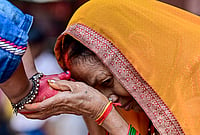
Before a campaign launched by DC Faiz Aq Ahmed Mumtaz, nearly 90% of people in Ramgarh had no idea what CPR was
In cardiac arrest cases, the time between collapse and hospitalisation is critical.
If someone knows CPR and starts chest compressions immediately, the patient’s chances of survival improve significantly
February 13 will always remain the most important day in Teklal Mahto’s life. That morning, he saved a man’s life. 33-year-old Teklal had left his village, Mahlidih, for work when he noticed two men out on a morning walk along the roadside. Within moments, one of them, Arun Kumar, suddenly collapsed unconscious. Seeing this, Teklal stopped his motorcycle in the middle of the road and rushed toward him. What he did next was something even he had never imagined he would one day do.
Recalling the incident, Teklal says, “Two men were walking on the right side of the road. Both seemed perfectly fine. Then, within less than a minute, one of them suddenly fell to the ground. His friend was trying to lift him up, but I immediately sensed it was a heart attack. I ran towards them and told the other man to call an ambulance while I tried something. I had recently learned CPR training, so taking God’s name, I started pressing Arun’s chest. After around thirty compressions, he slightly opened his eyes. Then he lost consciousness again. I immediately started compressions once more, and after another round of around thirty presses, he fully opened his eyes. Watching that happen felt nothing short of a miracle."


Within 10 to 15 minutes, an ambulance arrived and Arun was taken to a nearby health centre in Gola block of Ramgarh district. Teklal accompanied Arun and his friend to the hospital. There, after hearing the full account, doctors told him that timely CPR had likely saved Arun’s life. Teklal says hearing those words felt like achieving something extraordinary.
CPR — Cardiopulmonary Resuscitation — is an emergency life-saving procedure performed when a person’s breathing or heartbeat suddenly stops. It is commonly used during cardiac arrest, heart attacks, drowning, suffocation or electric shock. The aim is to maintain the flow of oxygen-rich blood to the brain and vital organs by repeatedly compressing the chest until medical help arrives.
Before explaining how he learned CPR, Teklal mentions someone else first. He says, “If I had known nothing about CPR, I too would have kept trying to lift him up, just like his friend was doing. I would have run around helplessly trying to save him. If God made me do a good deed that day, then the credit goes to the DC sir of Ramgarh.”
The “DC sir” Teklal refers to is Faiz Aq Ahmed Mumtaz, who is an IAS officer known not only for his administrative work but also for community-driven social initiatives that often make headlines.
A 2014-batch Indian Administrative Service officer, Mumtaz has been widely recognised for initiatives in education and social empowerment across Jharkhand. In Jamtara, a district long associated with cybercrime, he helped establish dozens of community libraries in an effort to shift the district’s image from cyber fraud to education and public learning.
Later, as Deputy Commissioner of Ramgarh, he introduced several initiatives aimed at bringing the transgender community into the social mainstream, including a “Trans Cafe,” dedicated toilets and a special OPD at the district hospital.
Now, however, discussion around him centres on another initiative — one that is quietly saving lives. During his tenure in Ramgarh, Mumtaz launched a district-wide CPR awareness and training campaign. In just ten months, more than 200,000 people were trained in CPR, including villagers like Teklal Mahto. 35-year-old Dhananjay Kumar Putush from Ramgarh town also counts himself among those who not only learned CPR but later used it to save a life.

Dhananjay recalls, “On the night of February 6, around 9 pm, I was having tea near a culvert in Ramgarh town when I heard the sound of a crash. A Swift car had rammed into the divider nearby. The driver was wearing a seatbelt, so he was relatively safe, but the man sitting beside him was unconscious and bleeding heavily. We pulled him out of the car. Before the ambulance arrived, I started giving him CPR. In the middle of it, he suddenly jolted awake. Once he regained consciousness, we shifted him into the ambulance and took him to the hospital, where he received treatment.
”Dhananjay believes CPR training should be made mandatory across India. According to him, before this campaign, nearly 90 per cent of people in Ramgarh district had no idea what CPR was. Today, he says, almost every village household has at least one person who understands the basics of the procedure.

Like Teklal and Dhananjay, Gauri Kumari, for instance, says she managed to save her mother’s life using CPR techniques she learned during the campaign. A few days ago, her mother suddenly collapsed unconscious at home. Seeing her stop breathing, Gauri gave rescue breaths and managed to revive her before the family rushed her to a nearby hospital.
All three – Teklal, Dhananjay and Gauri -- received CPR training only a few months ago. Today, they are themselves spreading awareness in their villages. According to residents and officials, there is now hardly any village or panchayat in Ramgarh in which people have not at least heard of CPR.

Explaining how CPR became a mass movement in Ramgarh, Faiz Aq Ahmed Mumtaz says, “I have been running CPR awareness campaigns for the past two years. In Ramgarh, we expanded it on a much larger scale. Even earlier, while working in the Excise and Agriculture departments, I would organise awareness sessions through doctors. But the idea really began from a normal conversation at home. After Covid, reports of sudden heart attacks were everywhere. Since my wife is a doctor, we often discussed these deaths and the importance of CPR. That’s when I realised that if someone like me, an IAS officer, educated and exposed, does not know how to perform CPR, then what about everyone else”
That realisation pushed him to first learn CPR himself. Afterwards, with the help of doctors, he began training others. By the time he became Deputy Commissioner of Ramgarh, around 50,000 people had already been trained through his efforts. After taking charge in Ramgarh in May last year, Mumtaz scaled up the campaign dramatically. The goal was simple: at least one CPR-trained person in every household of the district. By April 18 this year, more than 200,000 people across Ramgarh had been trained under the initiative.
Doctors, paramedical staff, master trainers, teachers, social workers and local representatives all became part of the campaign. Under the supervision of the district administration, training camps were organised in both urban and rural areas.
The administration first created around 3,500 master trainers with the help of doctors and paramedical teams. These trainers then carried the campaign into villages, schools, panchayats, wards, mines, factories and public institutions. Hundreds of camps, small and large, were organised to teach people how to perform CPR and basic first aid.
Dr. Pallavi Kaushal, who was associated with the campaign, says CPR is a crucial life skill, “Even an ordinary person knowing CPR can make the difference between life and death during the golden hour. In cardiac arrest cases, the time between collapse and hospitalisation is extremely critical. If someone nearby knows CPR and starts chest compressions immediately, the patient’s chances of survival improve significantly. The first ten minutes after cardiac arrest are especially crucial.”
India records a massive number of sudden cardiac deaths every year. Between 600,000 and 700,000 people die due to sudden cardiac arrest every year, many of them at home, on roads or before reaching a hospital.
Medical studies also show that timely CPR is administered in only a small fraction of cases in India, which is roughly around seven percent. Yet those first few minutes after cardiac arrest are often the most decisive. Despite this, more than 90 percent of people still do not know how to perform CPR.
In that context, what happened in Ramgarh is more than just an administrative campaign. It is an example of how public health awareness, when taken beyond hospitals and into communities, can turn ordinary citizens into first responders and sometimes, into lifesavers.