



Himachal Pradesh Chief Minister Sukhwinder Singh Sukhu has initiated a multi-tiered action against the sale and distribution in HP.
The Chief Minister announced a reward scheme of Rs 10,000 to Rs five lakhs for those who aid in the seizure of drugs.
Himachal’s DIG (North) at Dharamshala, Soumya Sambasivan, admits that the drug menace cannot be defeated by the police alone.
Redrawing the battle lines against an alarming rise in drug abuse—partly linked to Punjab’s gravest social threat and its spillover into the hills—Himachal Pradesh Chief Minister Sukhwinder Singh Sukhu this week initiated a multi-tiered action to break the grip of narcotics, especially its current form, chitta, which is fast trapping schoolchildren, youth, and college campuses.
It’s not just the consumption of chitta—a white, powdery substance derived from heroin—that worries the government, but also its illegal trade in rural and semi-urban towns, directly involving young and elderly women, government employees, police personnel and block-level officials.
At Dharamshala, one of the state’s picturesque towns known for the presence of the Tibetan spiritual leader, the Dalai Lama, the Chief Minister announced a novel reward scheme of Rs 10,000 to Rs five lakhs for those whose secret information leads to the seizure of drugs.
As per the decision, for every two grams of seized drugs, the government will pay Rs 10,000, and those whose tip-off results in the seizure of more than one kg will be paid Rs 10 lakhs. There will be a reward of Rs five lakh for one kg of the drug, and the same for the informer helping the police and Anti-Narcotics Task Force (ANTF).



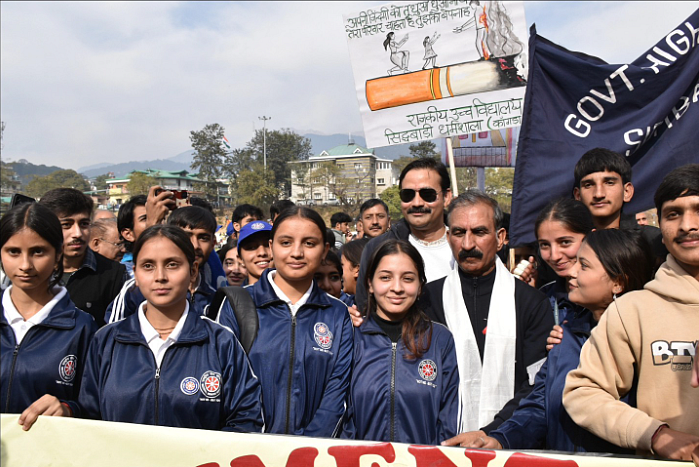
The move came after Sukhu led a massive walkathon—a spirited padyatra in Dharamshala that drew support from social action groups, citizens, students, youths, sports figures, ministers, and MLAs.
Himachal’s DIG (North) at Dharamshala, Soumya Sambasivan, admits that the drug menace cannot be defeated by the police alone. It demands citizens’ support, youth activism, and the cooperation of parents—especially those with children in vulnerable age groups. "Chitta addiction leaves a youngster with just two to three years of life." She warns, "There is hardly any chance of a comeback; it is the darkest phase one can enter."
What has really alarmed the agencies and the state’s leadership is drug abuse among an increasing number of girls, who have also turned to peddling to finance their own doses of Chitta. A young girl in Mandi,a college pass-out, also turned her mother into an addict, while a teenager in the Sama district killed his grandmother to rob her of her jewellery and cash.
In May 2025, police arrested two women—a mother and her daughter-in-law from Chhanni village in the Nurpur police district—for allegedly peddling chitta. Earlier in November 2025, in a raid at Tamota village in Kangra, police arrested a woman along with her son for possession of around 9.42 grams of heroin and also recovered Rs 60,000, suspected to be drug money. Two women, including one from Jubbal-Kotkhai, were arrested for supplying drugs to youths in the Shimla district.
Shimla Police arrested a female advocate and two other women in February 2025 for their involvement with the infamous "Shah gang," a major drug trafficking network operating across North India. Investigations revealed links to 25 more women whose bank accounts were scrutinised for evidence, confirmed a senior police officer.
A woman was arrested while procuring chitta to feed her son’s drug habit at Dehra in Kangra district.

These cases prove that women—sometimes as part of family units—are being used in the narcotics supply chain, not just male traffickers.
According to official statements, over 80 government employees, including police personnel, are currently facing legal proceedings for being involved in drug-related offences.
These developments show the crackdown is not only targeting lower-level peddlers but also government insiders accused of facilitating or enabling drug supply or corruption linked to it.
"The fact that police personnel, forest guards, welfare officers, lab technicians, and HRTC mechanics are among the accused shows that the drug trade’s tentacles reach across several government sectors, signalling a systemic issue rather than a few suspicious individuals," argues Balbir Thakur, a retired IPS officer.
When asked about the scale of involvement of government officials, the chief minister admitted that there were challenges in dealing with the kind of problem the government faced in weeding out the system. “We are not only dealing with gangs and those involved in the supply chain; there are also people in the government actively working as tools,” he claims.
As a measure to crack down on such elements, the government will seek the help of every section of society, including parents, youths, and other responsible citizens, to confront chitta smugglers head-on. They will have no place in the government, and action will be initiated; rather, orders have been issued for their dismissal from their jobs and the confiscation of their property.
Under the newly enacted law of preventive detentions, the state government has already detained 48 habitual drug traffickers and seized properties worth Rs 46 crore from those who were convicted under the NDPCs Act or willfully indulging in drug smuggling in the state.
In a legislative measure—the Himachal Pradesh Drugs and Controlled Substances (Prevention, De‑addiction, and Rehabilitation) Act 2025—the government has decided to target the offenders of the crime, including drug trafficking, as part of a broader crackdown on organised illegal activities. Recently, the cabinet approved the establishment of a dedicated Special Task Force (STF) under senior police leadership, specifically for narcotics and organised crime, to improve coordination and intelligence sharing and crack down on trafficking networks.
According to media reports, more than 35 drug overdose deaths, including youths, have occurred between February 2025 and November 2025.















