
Playing With Fire
- In Kerala, 500 lives have been lost in fireworks explosions since 1950
- In the last three years, 131 people killed during minor festivals
- Rs 2,000 cr spent yearly on fireworks
- 316 fireworks licenses issued
- 626 festivals known for pyrotechnics
- 3 Kerala temple festivals, including Thrissur Pooram, hold the most extravagant fireworks display in Asia
- 200-2,000 kg fireworks used at a time. A kilo lasts about a minute.
- At Puttingal, the show was on for five hours before the huge blast
***
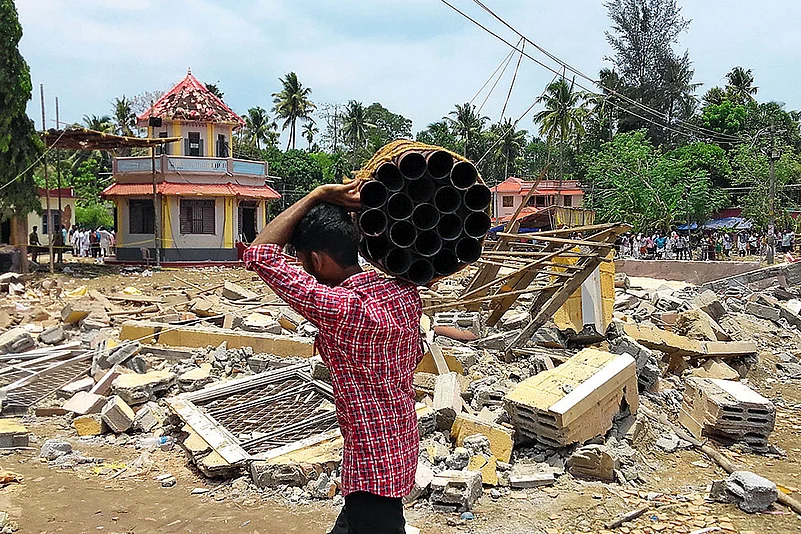
The massive firecracker explosion at the 100-year-old Puttingal temple festival in Paravur in Kollam that snuffed out the lives of 116 people and injured more than 300 grievously on April 10 was like a disaster waiting to happen. Though not the first, the tragedy was by far the deadliest that Kerala has ever witnessed. It has been attributed partly to the negligence of the temple authorities, and partly to political indifference to safety measures.
A. Shainamol, Kollam district collector (and a Muslim, as was pointed out rather rudely on social media), had denied permission for the fireworks display on the ground that competitive displays are dangerous, but the two competing teams and the temple authorities shrugged off the DC’s order and, with the connivance of the local political leadership, went ahead with the pyrotechnics. It began at 10:30 pm and continued till the wee hours of April 10. No safety precautions were in place, proving that, when it comes to handling explosives in large quantities, Kerala is still illiterate—or just ignores the risks. Fireworks manufacturers, pyrotechnicians, festival organisers, local politicians—no one seemed to heed the possibility of a conflagration and the loss of lives. At the disaster site, the display, the viewers and the fireworks storage were within 65 metres of each other though the Explosives Act (2008) stipulates a minimum 100 metres.




Instead of only gunpowder, the crackers, rockets and girandoles also contained the highly unstable compound potassium chlorate, which may burn or explode spontaneously. Arsenic, too, was added for maximising sound and colour effects. These chemicals are being blamed for the large number of casualties and the extensive damage to property near the site. Carelessness was shown even in the setting-off: the iron pipes for launching aerial displays were not being driven into the ground or anchored with wire to prevent them from tipping and sending fireworks rocketing into where they might kill or cause damage—the crowds of devotees, nearby homes, passing traffic, other fire-prone zones.
As it happened, a firework launched about 3:30 am angled sharply into a room where thousands of kilos of crackers meant for the festival were stored. So powerful was the explosion, it destroyed the whole concrete structure in one huge fireball, hurling chunks of rubble as far as one and a half kilometres. In fact, more than a hundred people died from being struck by this shrapnel. The rest died from burns or in the ensuing stampede in the darkness caused by power outage.
There’s no assessment yet of the quantity of fireworks found, but sources say experts from the office of the Controller of Explosives destroyed over 1,000 kg of firecrackers found in three abandoned cars, besides an additional 400 kg of explosive material found near the site. Intelligence agencies suspect the use of potassium chlorate as the sound of the fireworks could be heard several kilometres away. Material found at the site is being subjected to forensic analysis.
Strangely, in Kerala, organisers of such displays do not generally buy fireworks from regulated manufacturers. They hire traditional “experts” who prepare chemical mixtures for the crackers, rockets and ornamental displays and pack them into reusable iron pipes in a way there’s sound, sparkle and colour when the fuse is lit but no dangerous ripping or bursting of the pipes. Such expertise is passed down generations. Activist V.K. Venkitachalam of the Heritage Animal Task Force likens it to a cottage industry where safety regulations are blatantly violated. As temples started spending more on fireworks, riskier additives found their way into the mixtures with the demand for louder and more colourful displays.
Some who believe fireworks are an intrinsic part of temple ritual and must not cease. But priests and experts say it’s not so. N.R. Madhu, editor of RSS mouthpiece Kesari, says, “The use of fireworks began only in the 15th century with the arrival of the Portuguese. The Portuguese fired guns to keep time and soon people were using crackers to wake up the devi in the temples (palli-unarthal). Setting off fireworks became an offering (vedivazhipad) to the gods.” (In fact, a temple in south Kerala is called Vedivechankovil, or ‘temple of fireworks’.) Over the years, fireworks have become a feature of temple festivals and the Malayali obsessed with pyrotechnics. But it’s just pomp, and nothing to do with rituals, says Dr S. Jayasooryan, chairman of the Winworld Foundation, who has done a study of temple festivals. He’s for a complete ban on temple fireworks.
In the wake of the Puttingal tragedy, one would expect political leaders to opt for a pro tem ban, pending final decision, but the government, in the midst of an election, seems in no mood for it. The government favoured fireworks for the Thrissur Pooram, the biggest temple festival of its sort, and sanctioned the use of 4,000 kg of fireworks for Asia’s largest pyrotechnics on the occasion. After Puttingal, Justice V. Chitambaresh wrote to the Kerala High Court seeking a ban on fireworks. The court converted it into a PIL and pulled up the administration and demanded strict regulation of fireworks. The court banned the use of high-decibel fireworks at night. Finally, the pooram organisers have decided to suspend the fireworks display and even give the elephants a rest this year.
Former fire & rescue department chief Jacob Thomas was in the process of creating committees to prevent accidents of various kinds, and rescue people in case they took place, when he was shunted out. The present chief of the department, Loknath Behera, says there has to be a safety audit in place and the regulations will have to be enforced strictly. R. Venugopal, deputy chief controller of explosives, a Malayali credited with bringing down human casualties in Sivakasi firecracker manufacturing units to zero in just four years, feels it is time to educate Keralites on the dangers. For the very literate, know-all Malayali, it is time to get an education before more lives are lost.