Kerala heads into a finely balanced UDF–LDF contest, with a narrow vote-share edge for the opposition and a seat race too close to call.
Late campaign controversies involving both the BJP and the Congress may shape last-minute voter behaviour, with the LDF seeking to convert turbulence into advantage.
Assam is anchored in leadership preference for a stable vote base.
Polling began on Wednesday in two states that often move to very different political rhythms. In Kerala, long defined by its alternating mandates and ideological clarity, the contest has tightened into a familiar but fiercely contested bipolar fight. In Assam, where politics has in recent years tilted towards consolidation, the mood appears more settled, with the BJP-led NDA entering the fray from a position of strength. Voting in both states will conclude on April 9 in a single phase
If Kerala feels like a contest on a knife’s edge, it is because the margins are thin. The latest C-Voter survey places the Congress-led United Democratic Front (UDF) at around 40% vote share, just ahead of the ruling Left Democratic Front (LDF) at 36%. The BJP-led NDA trails at roughly 17%, with others accounting for the remainder. On paper, it is a narrow advantage. In practice, in a state where small shifts can redraw the electoral map, it is anything but decisive.
There is also history at work. Kerala has long followed a simple electoral rhythm: cross the low-40s in vote share, and power usually follows. The UDF appears close to that threshold; the LDF, not far behind. Seat projections mirror this uncertainty. The UDF is expected to win between 69 and 81 seats in the 140-member Assembly, while the LDF could secure between 57 and 69—a potential slide from its commanding 99-seat victory in 2021, but not yet a rout. The NDA, as before, remains on the margins, with a projected one to five seats.

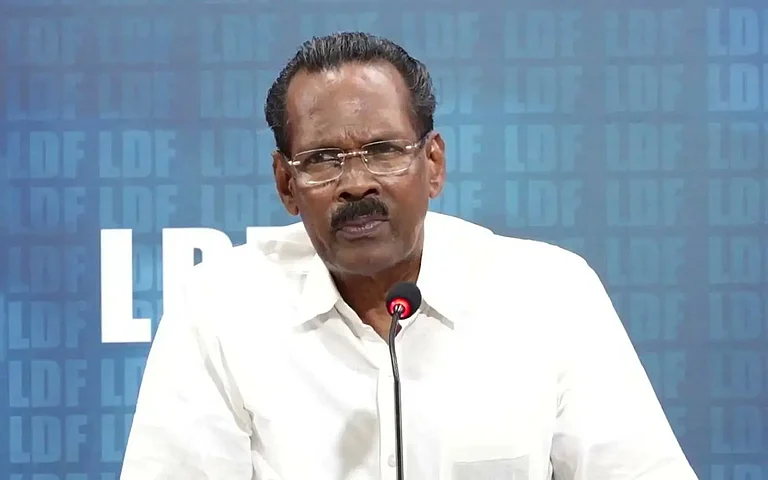
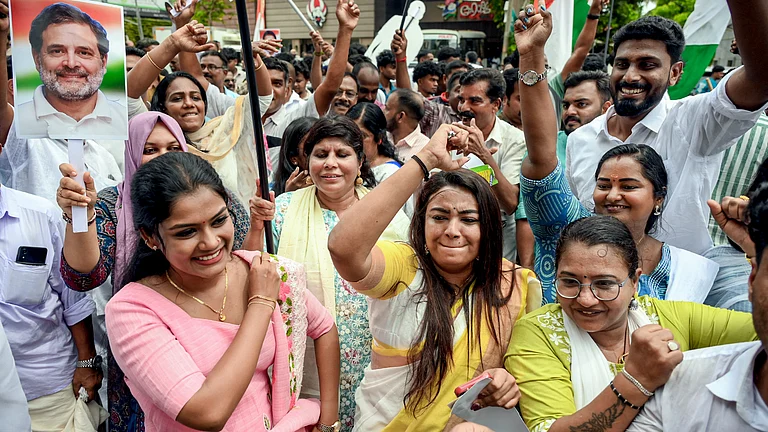

Yet numbers alone do not tell the full story of the final stretch. The closing days of the campaign have been marked by controversy. In Palakkad, BJP workers were allegedly caught distributing cash, with videos circulating widely. The Congress, meanwhile, has faced allegations over the misuse of funds collected for housing landslide victims in Wayanad. In a tightly fought election, such episodes matter less for their verification than for their velocity—the speed at which they travel, settle, and shape perception. The LDF, by most accounts, has sought to leverage both.
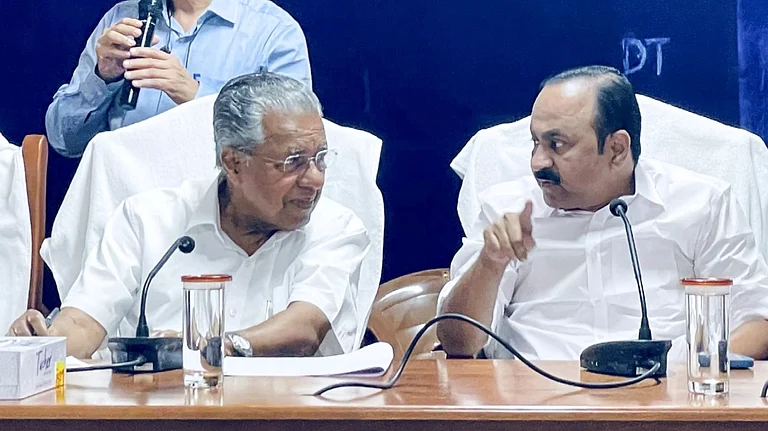
Leadership preference, too, reflects a fragmented field. V. D. Satheesan leads with around 25% support as the preferred chief ministerial face, followed by Pinarayi Vijayan at 21%. Shashi Tharoor, despite his national profile, trails with roughly 17%. The spread underscores the absence of a single dominant figure—unlike in Assam.
In Assam, the contest appears less volatile and more structured. Opinion polls consistently give the BJP-led NDA a vote share of around 43–44%, ahead of the Congress-led alliance at approximately 39–40%, with others making up the rest. The gap is not overwhelming, but it is steady—and in electoral terms, sufficient.
Taken together, the two states offer a study in contrast. Kerala remains what it has long been: competitive, contingent, and resistant to easy prediction. Assam, at least for now, appears more settled—its political direction shaped as much by leadership as by arithmetic.
As the votes are cast, the question is not just who wins, but what kind of mandate emerges: one forged in uncertainty, or one reaffirming continuity. In that difference lies the story of this election.